


Research Article
Computational Analysis of Lipid Modification in Crambe
Neetesh Pandey N1, Kumari R2* and M Grover1*
1Centre for Agricultural Bioinformatics, ICAR- Indian Agricultural Statistics Research Institute, India
2Department of Chemistry, Maitreyi College, India
*Corresponding author: Kumari R, Department of Chemistry, Maitreyi College, ChanakyaPuri, New Delhi -110021, India, Tel: +91 9899171244, FAX: 011 24101053, E-mail: kmramesh17@gmail.com Grover M, Centre for Agricultural Bioinformatics, ICAR- Indian Agricultural Statistics Research Institute, Pusa, New
Delhi-110012, India, Tel: +91 9899965285; E-mail: monendra_grover@yahoo.com
Copyright: © Neetesh Pandey N, et al. 2021. This is an open access article distributed under the Creative Commons Attribution License, which permits unrestricted use, distribution, and reproduction in any medium, provided the original work is properly cited.
Article Information: Submission: 09/09/2020; Accepted: 25/11/2020; Published: 08/01/2021
Abstract
Metabolic engineers are examining the non food oil seed to develop suitable crop with enhanced performance in fatty acid functionalities and properties.
The growth and production of various innovative fatty acids find various application for industrial processes. Crambe species of perennial flowering plants
have miniscule white and yellow flowers. These are primarily used as food plants by larvae of some Lepidoptera class. Crambe is a unique seed crop
exclusive grown for its industrial manufacturing especially enhanced oleic acid content by the Crambe genes of Fatty Acid Desaturase (FAD) and Fatty
Acid Elongase (FAE) via down-regulated process. The FAD 2 enzymes are expressed in different manner in various tissues of the plants and transforms
the functional and vegetative features due over expression. This study involves the computational analysis of the Crambe oleate desaturase and fatty acid
elongase1 genes using various web tools with the ultimate aim of providing recommendations to wet lab researchers. The oleate desaturase and fatty acid
elongase1 (FAE 1) sequences from Crambe were retrieved from NCBI nucleotide database. Lipases can be tailored to mitigate the carbon chain length,
extent of unsaturation, and relevant improvement in the esterification reaction. This is significantly important for molecular pathway in delta-12 desaturases
FAD2. These studies will be highly beneficial in predicting the feasibility of generating amplified wax ester oils in transgenic crops, fatty acid reshaping such
as oleyl-oleate for the availability of enhanced levels of fatty acid formation in vegetative tissues. The study will be useful for the better understanding of the
demonstration, regulation and mechanism that will help in enhancing the oil seed characteristics and confrontation towards various temperature and salt
stresses in plants. These studies will be quite useful for the necessity of timely desirable traits in vegetable oil produce with reference to carbon economy, to
meet the demand of traditional fossil fuel advancement and human health.
Keywords
Crambe; Erucic acid; FAE1 gene; FAD enzyme; Web tools
Introduction
Lipids are the heterogeneous class of organic compounds
composed of long chain fatty acids. They exist as oily, waxy and greasy
in nature and insoluble in aqueous media. Lipids act as a mechanical
barrier in the form of cell membrane. The oils can be saturated with 12-
24 carbon chain and unsaturated fatty acid having one or more carbon
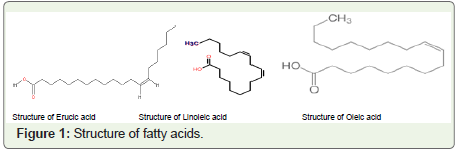
–carbon double bonds (Figure 1). Oleic acid (Cis -9-octadecenoic
acid 18) is an example of mono saturated fatty acids. Most vegetable
oils like sun flower, saff flower, corn oil are rich in linoleic acid. They
are source of energy and help in signalling process. Progressive health
benefits are expected with the metabolism of omega-3 fatty acids. The
utilization of trans fat present in hydrogenated oil may have adverse
effects on human health which are manifested in the form of various
life style disease associated with heart, liver, pancreas and cancer.
Fatty acids as ingredients are utilized in various industries like food,
cosmetic, lubricants, plasticizers, and nano products.
Crambe is a genus of about 20 species of annual and perennial
flowering plants in the cabbage family Brassicaceae, native to a variety of habitats in Europe, Turkey, southwest and central Asia and eastern
Africa. They carry dense racemes of tiny white or yellow flowers on
(mostly leafless) stems above the basal leaves [1]. Crambe species
are used as food plants by the larvae of some Lepidoptera species
including Lime-speck Pug. The advantages of using Crambe as an
alternative source of Erucic acid are that it contains the highest level of
Erucic acid in the seed oil naturally occurring within the Brassicaceae,
10-15% higher than the current HEAR (High Erucic Acid Rapeseed
Oil) oils. Crambe is essentially self-pollinated and does not out-cross
with any other food oilseed crops or closely related wild species [2].
Vegetable oil production with extraordinary elevated monoenoic oileic acid constitution is one of foremost areas of oil up gradation for industrial application. The high oleic oil concentration in industrial feedstock has been of concern due to its great thermal and oxidative stability during high boiling processes employed food industry.
Crambe (Crambe abyssinica) is important oilseed crop, appropriate for industrial oil synthesis by FAD and FAE genes via down-regulated process. The first cloned genes of this process were the Crambe CaFAD2, CaFAD3 and CaFAE1 genes as reported in another study. In that study, numerous copies of these genes were segregated, RNAi constructs were made by exceedingly identical arrangements. These constructs were earlier tried and carried out on Arabidopsis, which controlled the elevated oleic or linoleic levels depending on the genes targeted, indicating that the RNAi constructs were efficient in regulating the expression of the selected genes in a nonidentical but closely related species. Furthermore, down-regulation of CaFAD2 and CaFAE1 in Crambe species with the FAD2-FAE1 RNAi vector resulted in even more substantial intensification in oleic acid concentration in the seed oil with up to 80% compared to 13% for wild type. The high oleic trait has been stable in subsequent five generations and the GM line grew normally in greenhouse. Crambe is indispensable for constructing high oleic oil, thus subsidizing to the category an oil crop platform for industrial oil production [3].
Erucic acid is an important fatty acid in the oleochemical industry.
The current major industrial source of erucic acid is high-erucic acid
rapeseed oil. Erucic acid is one of the chief fatty acids existing in
the oil separated from the segments of the family Brassicaceae [4].
Crambe also has other valuable by-products, such as protein meal and
possible fibrous material. The acceptance of Crambe meal by the feed
industry is based on its attractive price and satisfactory performance
as a feed for ruminant animals. The crucifer Crambe abyssinica has
high erucic acid content (52- 59%) in its seed oil, in addition to wide
climatic and agronomic adaptation hence, this plant is receiving more
focus as an alternative industrial crop [5].
Crambe cordifolia, syn. Crambe glabrata is a species of flowering
plant in the family Brassicaceae, native to the Caucasus. Growing to 2.5 m (8 ft) tall by 1.5 m (5 ft) broad, it is a substantial clump-forming
herbaceous perennial with kidney-shaped dark green leaves, 35 cm
(14 in) or more in length, which die down in mid- to late summer. It
is widely cultivated in gardens for its foliage and spectacular multibranched
inflorescences of many small, white, cruciform (crossshaped)
flowers, reaching up to 2 metres (6 ft 7 in) high and appearing
in early summer [6]. The phylogenetic analysis of Crambe hispanica,
Crambe hispanica subsp abyssinica, Crambe filiformis and Crambe
kralikii arrangements designated that the FAE1 genes of these classes
might have gone through a remote gene replication phenomenon,
during the process of species differentiation. Oleate desaturase FAD2
(1-acyl-2-oleoyl-sn-glycero-3-phosphocholine Delta12-desaturase) is
the key enzyme responsible for the production of linoleic acid in nonphotosynthetic
tissues of plants. Little is known, however, concerning
the post-transcriptional mechanisms that regulate the activity of this
important enzyme.
Materials and Methods
The oleate desaturase and fatty acid elongase1 sequences from
Crambe were retrieved from NCBI nucleotide database (http://www.
ncbi.nlm.nih.gov) (Table 1).
The protparam tool was used for analysis of Physico-chemical
properties (http://web.expasy.org/protparam/)
Results
Analysis of physicochemical properties:
The Physicochemical properties analysis of all protein sequences
of oleate desaturase and fatty acid elongase1 of Crambe was predicted
by computational method. The analysis of biochemical property
has been calculated in respect of positively charged amino acid,
negatively charged amino acid, molecular weight, grand average of
hydropathicity (Gravy), instability index and Theoretical pI value. All
30 proteins are a class of Crambe protein family. These all sequences
are native to a variety of habitats in Europe, Turkey, southwest and
central Asia and eastern Africa. They carry dense racemes of tiny
white or yellow flowers on (mostly leafless) stems above the basal
leaves. These Crambe species are used as food plants by the larvae of
some Lepidoptera species including Lime-speck Pug. The advantages
of using Crambe as an alternative source of erucic acid are that
it contains the highest level of erucic acid in the seed oil naturally
occurring within the Brassicaceae.The analysis of Physico-chemical properties in Oleate desaturase protein sequences from Crambe:
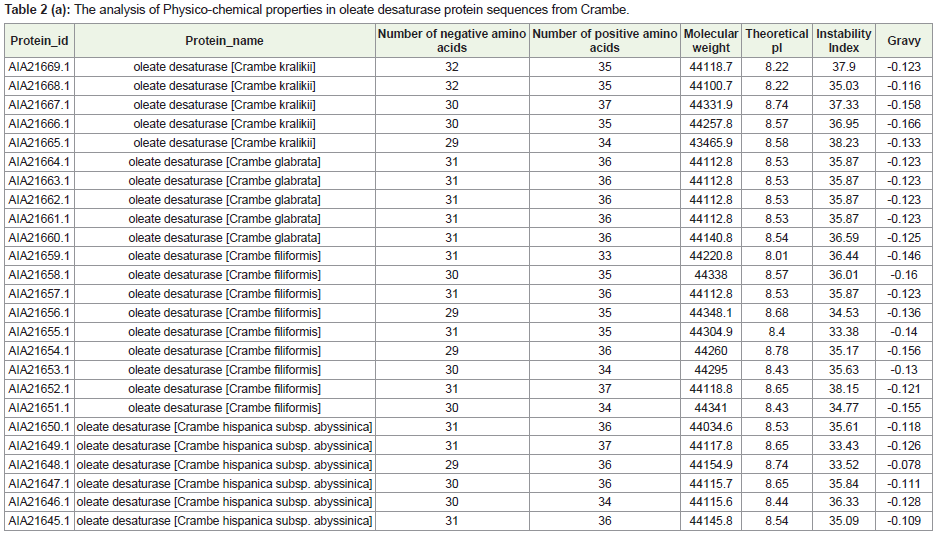
In physico-chemical analysis of oleate desaturase class of protein
shows instability index less than 40, it means they are probably stable
proteins but instability index of protein oleate desaturase class of
Crambe filiformis (AIA21655.1) is very less that is 33.38 and it is a
very unstable protein. The quantitative value for the hydrophobicity
of all proteins were measured by the GRAVY score (Grand average
of hydropathicity value) has been found to be nearby similar in all
oleate desaturase protein sequences of Crambe. The grand average
of hydropathicity of the sequences calculates the sum of hydropathy
values among all protein sequences. Very less score of GRAVY shows
that less hydropathicity in that protein sequence. This principle is based on the basis of increasing negative score of GRAVY
shows that smaller hydropathicity. In this result the protein oleate
desaturase (Crambe hispanica subsp. abyssinica) shows that larger
hydropathicity (AIA21648.1) with GRAVY score -0.078 and the
protein oleate desaturase (Crambe kralikii) (AIA21666.1) showing
smaller hydropathicity with GRAVY score -0.166. The protein
sequence of oleate desaturase (Crambe filiformis-AIA21659.1) has
less positive value of isoelectric point. 8.0, which means that have less
solubility (Table 2(a)).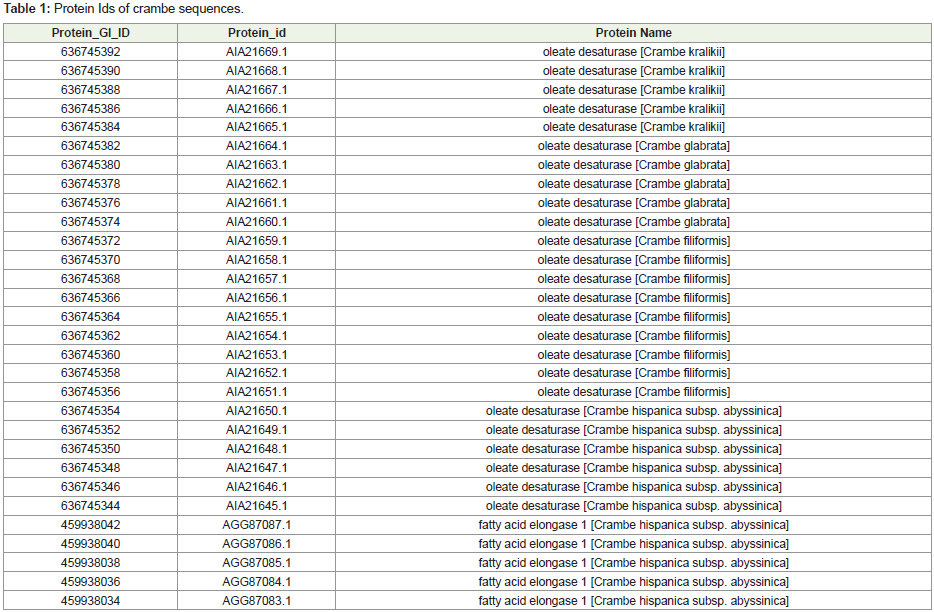
The analysis of Physico-chemical properties in fatty acid elongase1 protein sequences from Crambe:
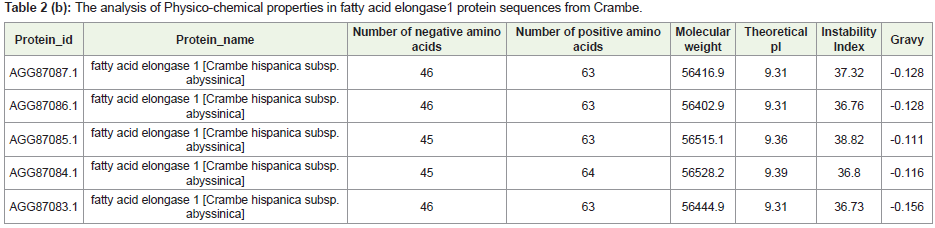
Physico-chemical property analysis of fatty acid elongase 1 of
Crambe family sequences shows instability index less than 40 which
means they are probably stable proteins as well as oleate desaturase
class of protein family. Instability index of protein fatty acid elongase
1 Crambe hispanica subsp. abyssinica (AGG87083.1) is very less that
is 36.73 and this protein is very unstable. The score of GRAVY shows
the hydropathicity character in particular protein. The grand average
of hydropathicity of the sequences calculates the sum of hydropathy
values among all protein sequences. Very less score of GRAVY shows
that less hydropathicity in that protein sequence. This principle is
based on the basis of increasing negative score of GRAVY shows
that smaller hydropathicity. In this result the fatty acid elongase 1
of Crambe protein family sequences shows that the GRAVY score
is nearby in all these sequences and they have similar hydropathicity
character. The protein sequence of these family shows strong positive
value of isoelectric point in range of 9, which means they have strong
solubility (Table 2(b)). The Instability index is smaller than 40 which
show it is stable in test tube.The conventional approach for lipidomic investigation deals in enzymatic assays and use of Gas Chromatography (GC), Mass
Spectrometry (MS) and Nuclear Magnetic Resonance (NMR) for the
evaluation and analysis of lipids. These methods have their pros and
cons and can be overcome by combining with bioinformatics tools.
The results obtained in this study can be utilized for recommendations
for the wet lab experiments. The amino acid conformation can
predicts the basic properties of the enzymes, the isoelectric point can
be utilized for the purification techniques using various buffers. The
instability index value can give indication of stability of protein. This
can help in altering the lipid composition, enzymatic activity and
characterisation. Thus the present investigation can aid in formulating
the various lipids and proteins for various industrial application with
reference to oil enrichment in less time and economical preposition.
References
Citation
Neetesh Pandey N, Kumari R, Grover M. Computational Analysis of Lipid Modification in Crambe. J Plant Sci Res. 2021;8(1): 201