


Review Article
Morphological and Phytopharmacological Evaluation of Indian Artabotrys Species: A Review
Aswathi Krishna KU and Pradeesh S*
Department of Botany and Research Centre, Mahathma Gandhi College, Kesavadasapuram, Thiruvananthapuram, Kerala, India.
*Corresponding author:Dr. Pradeesh S, Department of Botany and Research Centre, Mahathma Gandhi College, Kesavadasapuram, Thiruvananthapuram, Kerala, India. E-Mail Id: pradeeshnair10@gmail.com
Copyright: © Aswathi Krishna KU, et al. 2026. This is an open access article distributed under the Creative Commons Attribution License, which permits unrestricted use, distribution, and reproduction in any medium, provided the original work is properly cited.
Article Information:Submission: 15/06/2026; Accepted: 10/07/2026; Published: 13/07/2026
Abstract
Artabotrys R.Br. (Arta- = to suspend; -botrys = a bunch of grapes) is one of the largest genera in the family Annonaceae (the custard-apple family). The palaeotropical genus Artabotrys comprises approximately 110 species of woody climbers characterized by persistent inflorescence hooks and is distributed mainly throughout tropical and subtropical regions, particularly tropical Africa and Southeast Asia. In India, the genus is represented by 10 species: A. burmanicus, A. caudatus, A. hexapetalus, A. manoranjanii, A. nicobarensis, A. sahyadricus, A. sericeus, A. speciosus, A. suaveolens and A. zeylanicus. Species of Artabotrys are rich in diverse phytochemicals, including alkaloids, flavonoids, saponins, phenolic compounds, tannins and glycosides, which contribute to their broad spectrum of biological activities. Traditionally, Artabotrys species have been used in the treatment of cancer, skin diseases, diabetes,
headaches and several other ailments. Pharmacological investigations have demonstrated such as antimicrobial, anthelmintic, anticancer, anti-inflammatory, antioxidant, antileishmanial, mosquito repellent and antifertility activities. In addition, certain species exhibit uterine stimulant, muscle relaxant and cardiac stimulant properties. The present review provides a comprehensive account of the morphology, phytochemistry, traditional uses and pharmacological
properties of the genus Artabotrys, with particular emphasis on the Indian species. The novelty of this review lies in integrating the currently available information on Indian Artabotrys species into a single comprehensive resource, encompassing taxonomy, ethnobotany, phytochemistry, pharmacology and their potential for drug discovery. In conclusion, Artabotrys species and their bioactive metabolites possess considerable medicinal and socio-economic
significance. Further phytochemical, pharmacological, toxicological and clinical investigations are required to validate their therapeutic efficacy, facilitate the discovery of novel drug candidates and promote the sustainable utilization and conservation of these valuable plant resources.
Keywords:Artabotrys; Morphology; Phytochemicals and Pharmacological Analysis
Introduction
India is a major source of medicinal plants, with two of the world’s
18 plant biodiversity hotspots located in India: The Eastern Himalayas
and the Western Ghats. Surprisingly, India ranks seventh among the
16 super diverse countries, with 70% of the world’s species occurring
collectively. India’s natural resources are exorbitant, accounting for a
rich flora of endemic plant species consisting of 5725 angiosperms, 10
gymnosperms, 193 pteridophytes, 678 bryophytes, 260 liverworts, 466
lichen characteristic features are shown in chens, 3500 fungi and
1924 algae [1]. Plants have been always an integral part of the ancient
Indian Culture, China and Egypt as medicine and their importance
even dates back to the Neanderthal period. These medicines initially
took the form of crude drugs such as tinctures, teas, poultices, powder
and other herbal formulations [2]. According to the World Health
Organization (WHO), approximately 80% of the people in developing
countries still rely on traditional medicines for their primary health
care needs [3] and a significant portion of conventional medicine
involves the use of plant extracts or their therapeutic ingredients [4].
Artabotrys is one of the most significant genera of Annonaceae, a
pantropical family of flowering plants consisting of over 2430 species.
Artabotrys, a genus with over 100 species discovered in the tropical
forests of Africa, Madagascar, Asia, New Guinea and Australia, belongs
to the Xylopieae tribe of the Annonoideae subfamily [5]. Artabotrys
is represented by nine species in India [6]. It inhabits tropical rain
forests and seasonally dry forests and is distributed mainly in tropical
Africa and Asia [7]. Artabotrys is characterized by hooked peduncles
and inflorescence axes, as well as constricted inner petals over the
reproductive organ. Kebler (1993) [8], Chen et al., (2018) [9] and
Chen and Eiadthong (2020) [10] describe biovulate carpels with basal
placentation and sessile to stipitate monocarps. Artabotrys species
commonly climb by means of hooked. Peduncles and inflorescence
axes, but can also appear as straggling shrubs [11]. Some Annonaceae
species have thorns, which are typically found on the lower part of
the plant [12].
Methodology
A systematic literature search was carried out using major scientific
databases, including Google Scholar, PubMed, Scopus and Web of
Science. Relevant publications were identified using keywords such
as Artabotrys, traditional uses, phytochemistry and pharmacology.
The reference lists of selected articles were also screened to obtain
additional relevant studies.
Plant Description:
Artabotrys (Arta-: to hang; -botrys: a cluster of grapes) is among
the largest genera within the custard-apple family, Annonaceae
[13]. The genus Artabotrys, which is found in paleotropical regions,
includes approximately 110 species of woody climbing plants
known for their persistent inflorescence hooks [10], primarily
located in tropical and subtropical areas of the world [14], with a
particular abundance in tropical Africa and Eastern Asia [15]. This
genus has various traditional applications, such as the treatment of
cholera, malaria and additional health conditions [16]. The chemical
compounds found in these plants include alkaloids [17], volatile oils
[13], cyclohexenes [18], phenylpropanoids [19] quinones, flavonoids [20] and sesquiterpenes [21]Systematic position (Bentham and Hooker):
Class : DicotsSubclass : Polypetalae
Series : Thalamiflorae
Order : Ranales
Family : Annonaceae
Genus : Artabotrys
Morphological Characters:
The leaves are simple, alternate and possessing petioles [22] or
opposite [23], having a leathery texture [24], smooth or becoming
smooth [25], shiny [26]. Accessory buds located in the leaf axils on
orthotropic shoots can develop into vegetative plagiotropic shoots,
produce thorns particularly in shady environments or form sympodial
inflorescences, with each sympodial unit ending in a hook [27]. The
flowers possess both male and female reproductive structures [25]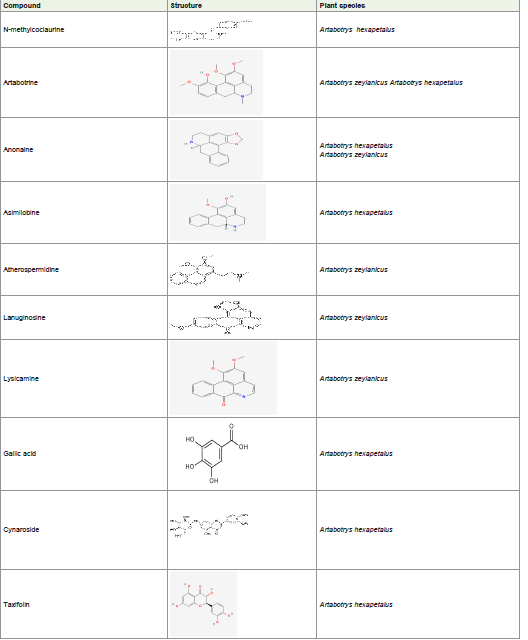
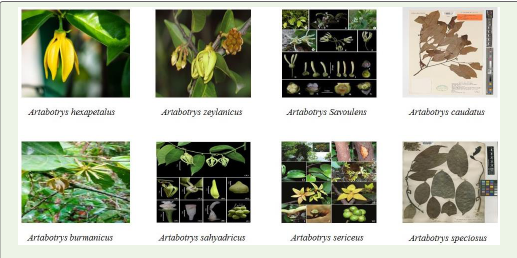
and can be either white or yellow [24], functioning as hermaphrodites
[22] with a strong fragrance [28]. They may appear alone or in small
clusters [29] and are supported by woody, typically thick [26] and
almost always distinctly hooked peduncles, which are frequently
found opposite to the leaves or adjacent to lateral branches [25]. The
three sepals may either be partially fused at the base [30] or completely
separate [23] and arranged valvately [22] the six petals are arranged
in a valvate manner [26], consisting of two whorls, each containing
three petals [31], which are roughly equal in size, distinct from one
another, concave at the base [25] and overlap above the stamens and
carpels [32]. The stamens are numerous [5], tightly grouped [30], have a quadrate oblong or cuneate shape [29] and feature a truncate,
expanded connective apex [23]. The carpels are also numerous [33],
have an oblong or oval shape [26] and contain two basal ovules within
the ovary [10]. The fruits are made up of cylindrical or ellipsoid
monocarps that are indehiscent [22], primarily sessile [23] and have
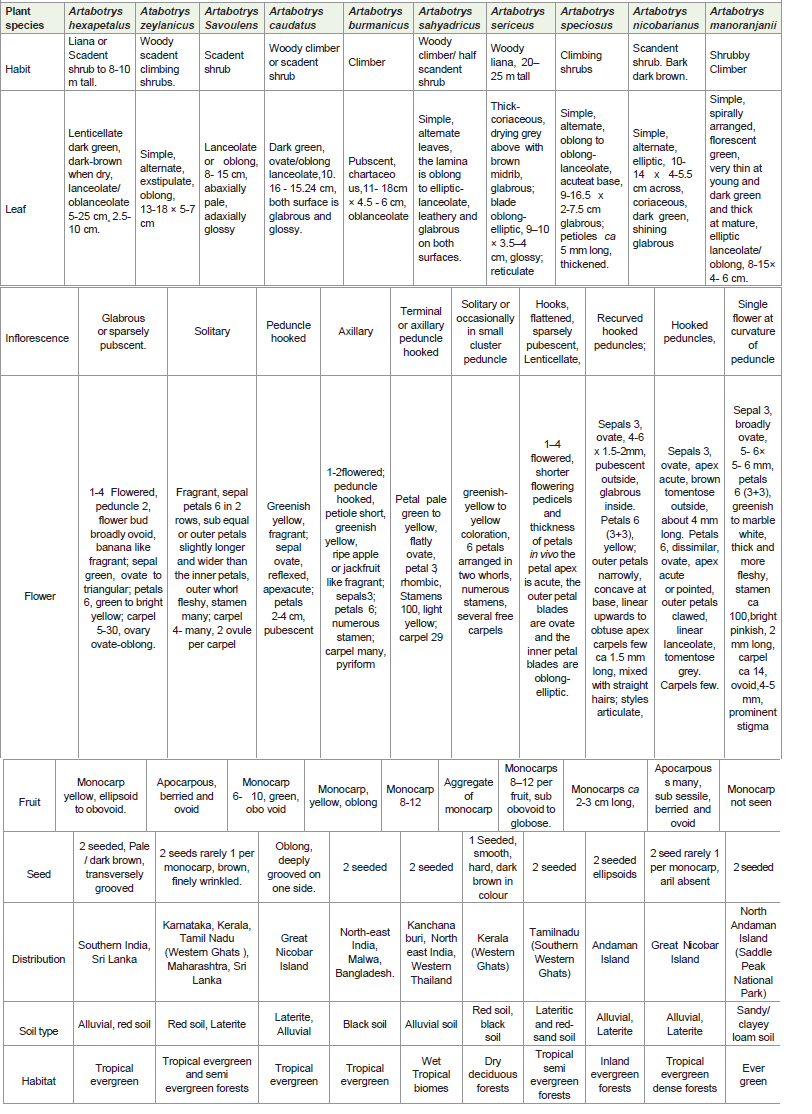
one or two seeds [25]. The seeds are oblong [22], erect [34], collateral [10] and lacking an aril [35]. These characteristic features are shown in [Table 1].
Ethnomedicinal and non-medicinal uses:
Traditional medicine has constantly depended on medicinal
plants as its basis for functioning. India has a bizarre nature of old
medical systems. These conventional drug systems prioritize safety,
efficacy and quality, leading to a desire to preserve their conventional
practices [36]. The fragrant flowers of A. hexapetalus are tonic and
stimulating. The fruits and bark are useful for fever, diarrhoea,
infections of the skin, sores, ulcers, inflammation, cough, asthma and
bronchitis. The leaves extracts exhibit antibacterial, antifertility and
antifungal activities [37]. In Assam, the pulp of ripened fruits is used
to treat fungal illnesses in domestic animals, while Malay tribes make
use of a leaf decoction to treat cholera. Aromatherapy uses the volatile
oil from flowers in the Unani system of healing. Flowers are utilized as
tonics and stimulants in the Ayurveda and Siddha medicinal systems.
Flowers are used as flavouring in tea. South India; Sri Lanka used in
perfumery to produce essential oils. In Salem, Tamil Nadu, Southern
India, it is used to prepare stimulating tea-like beverages [38]. The
pleasant odour of the flower is often employed in the production of
perfumes [39]. In Java, Indonesia, Philippines, Southern China and
India, the entire plant is used as an attractive plant and screen planting
in big gardens. Malaria and scrofula are treated with traditional
Chinese medicine [40]. Artabotrys species have been traditionally used
to treat a range of medical conditions, including scrofula [41], malaria
[42] and cholera [43]. Artabotrys species are used as folk medicines in
many countries to treat a wide range of ailments. The most commonly
used plant parts in local populations include roots, leaves, stems,
flowers and fruits. Prior to delivery, the majority of plant treatments
are made as decoctions and infusions from specific plant parts or
combinations of plant parts or species. The utilization of numerous
plant species in the formulation of remedies may be related to their
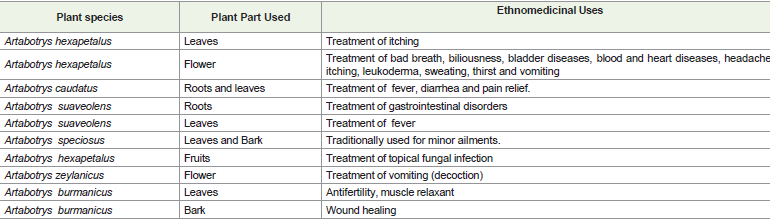
synergistic effects during disease therapy [44]. Ethnomedicinal and
non-medicinal uses are shown in [Table 2].Phytochemical Constituents:
More than 200 chemical constituents have been found and
isolated from the Artabotrys genus, including 67 terpenoids [45],
68 alkaloids [46], 28 phenolic compounds [47] and 40 additional
related chemicals [48]. Aporphinoids make up the majority of
the alkaloids found in Artabotrys species, with anonaine [49],
asimilobine [50], norstephalagine [51] and atherospermidine [41] being the most commonly isolated chemicals. Flavonoids are the
most common type of phenolic chemical found in Artabotrys
species, with catechin being the most abundant [52]. Modern
chromatography and spectroscopy techniques, such as HPLC (High
Performance Liquid Chromatography), UPLC (Ultra Performance
Liquid Chromatography), NMR (Nuclear Magnetic Resonance) and
MS (Mass Spectroscopy), have greatly aided in the isolation and
determination of natural products [53].Alkaloids:
Artabotrys plants are likely to contain a high concentration of
alkaloidal compounds. Artabotrys alkaloids are classified into many
categories, the most common being aporphines, which have over fifty
isolates. Aporphines are identified in seventeen Artabotrys plants.
Artabotrys aporphines are found in both monomeric and dimeric
forms. Anonaine, artabotrine, asimilobine, atherospermidine,
liriodenine, nornuciferine and norstephalagine were commonly
identified. As a representative example, annonine was discovered in
A. hexapetalus stem and A. zeylanicus stem bark. Chromatographic
separation of the acidic methanol extract of A. hexapetalus stem led in
the identification of two new benzylisoquinolines hexapetalines and a
known analogue (+)-reticuline [54].Terpenoids and sterols:
Terpenoid types: sesqueterpenoids were the second most
abundant chemical class in Artabotrys plants [55]. A. hexapetalus
contains a derivative of the sesqueterpenoid. A. hexapetalus was a
source of novel sesqueterpenoids. Artaboterpenoid A and its two
enantiomers (-)- artaboterpenoid B and (+)- artaboterpenoid B were
isolated. The alcoholic extract of A. hexapetalus root along with seven
new pairs of enantiomers (±) - yinzhaosus E-K and two analogs
yinzhaosus L-M, were isolated and identified [56].Sterols were discovered as the second chemical class in the isolation process of Artabotrys extract. Artabotrys plants frequently produce β-sitosterol and stigmasterol, two well-known sterols. A. hexapetalus contains β-sitosteryl-3-O-β-D glucoside, a glycoside derivative [57].
Flavanoids and Polyoxygenated Compound:
Flavanoids are a chemical class of naturally occurring metabolites
with antioxidant characteristics that are thought to have a favourable
effect on the cellular signalling system. Artabotrys plants are also said
to contain some common chemicals. Over twenty flavonoids have
been purified to date. They comprised flavones, flavan, flavanone
and pterocarpan [58]. Artabotrys flavones are given in either free
or glycosylated form. Artabotrys glycones are mostly composed of
glucose, galactopyranose, apiose, arabinose and rhamnose [41]. The
chromatographic isolation of A. hexapetalus leaf extract yielded two
new flavone glycosides, arapetalosides A-B, along with five recognized
analogs [20].Fatty Acids:
Tetrahydrofuran-4-methylidene-3-ol and (+)-tulipalin B were
discovered for the first time in the genus Artabotrys, and they came
from A. uncinatus stems and A. hexapetalus aerial parts, respectively.
Acetogenins are a well-known class of bioactive polyketides from
the Annonaceae family. Currently, Artabotrys plants have given
four novel acetogenins [59]. Three novel compounds, artapetalins
A-C, were successfully precipitated from the methylene chloride
(CH2Cl2) extract of A. hexapetalus aerial portion using a gradient
chromatography column [19].Pharmacological Values:
The current pharmacological study on Artabotrys plants has
resulted in a variety of biological studies. Various biomedical
categories have been investigated to date, however cytotoxic and
antibacterial actions were shown to be the most abundant in assays
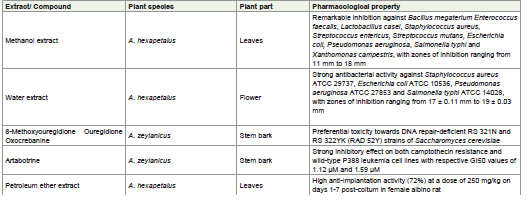
using Artabotrys plant materials. The key pharmacological values
such as cytotoxic activity, antimicrobial activity, antioxidative
activity, antidiabetic activity, antiviral activity, antiplasmodial activity,
hepatoprotective activity and more were shown in [Table 4].Research gap and future perspectives::
• Several Indian Artabotrys species remain unexplored
phytochemically.• Nutritional studies are extremely limited.
• Pharmacological validation is lacking for many species.
• Toxicity and safety studies are scarce.
• Tissue culture and conservation studies are insufficient.
• Genomic and metabolomics investigation are largely absent.
• Clinical validation of traditional uses is lacking.
Summary:
Artabotrys plants are commonly known in traditional medicine
systems to treat various ailments such as cholera, vomiting, malaria,
headache etc. Around 10 species, including Artabotrys hexapetalus,
Artabotrys zeylanicus, Artabotrys burmanicus, Artabotrys caudatus,
Artabotrys nicobarensis, Artabotrys speciosus, Artabotrys manoranjanni,
Artabotrys sahyadricus, Artabotrys sericeus and Artabotrys suaveolens.
So far, over two hundred thirty secondary metabolites have been
extracted and their structures clarified from Artabotrys species.
The metabolites discovered were found to encompass various
chemical classes, with the major categories including alkaloids
(78 compounds), terpenoids (44 compounds), flavonoids (22
compounds), polyoxygenated compounds (19 compounds) and fatty
acids (16 compounds), along with several minor components. These
findings highlight the considerable medicinal and socio-economic
importance of the genus. The compiled evidence demonstrates
that the certain species, particularly Artabotrys hexapetalus, have
been investigated extensively, most Indian species remain poorly
explored. Information on their phytochemical constitutions,
nutritional composition, biological activity, toxicity, tissue culture
potential and conservation status is limited or unavailable for several
taxa. Addressing these knowledge gaps through phytochemical
investigations, pharmacological validation, toxicological evaluation,
metabolomic studies, molecular approaches, tissue culture techniques
and conservation programs is essential to fully realize the medicinal
and economic potential of these species.The novelty of this review lies in its integration of the most upto-
date information on all Indian Artabotrys species into a single
comprehensive resource. By combining taxonomic revisions with
ethnobotanical, phytochemical, pharmacological, tissue culture and
conservation data, this review provides a holistic understanding of
the genus in the Indian context. Furthermore, by identifying existing
research gaps and outlining priority areas for future investigation,
it offers a valuable reference for botanists, phytochemists,
pharmacologists, natural products researchers and conservation
biologists. This review is expected to serve as a scientific foundation
for future research, sustainable utilization, conservation planning and
the discovery of novel bioactive compounds from Indian Artabotrys
species.
Acknowledgements
The authors are grateful to Dr. Manoj G. S., Assistant professor,
Department of Botany, Mahatma Gandhi College, Kesavadasapuram,
Thiruvananthapuram for valuable suggestions and encouragement
and Dr. Rakesh G. Vadhyar, Botanical Assistant, Botanical Survey of
India (BSI), Southern Regional Centre (SRC), Coimbatore-3, for all
supports, plant collection and authentication.
References
29. Llamas KA (2003) Tropical flowering plants: a guide to identification and cultivation. Timber Press.
Citation
Aswathi Krishna KU, Pradeesh S. Morphological and Phytopharmacological Evaluation of Indian Artabotrys Species: A Review. J Plant Sci Res. 2026;13(2): 296.