


Research Article
Study of Weeds Diversity with Respect to their Ecology Around Napasar Region of Bikaner, Rajasthan, India
Anil Kumar Dular* and Neelam Gehlot
Department of Environmental science, MGS University, Bikaner, Rajasthan, India.
*Corresponding author:Anil Kumar Dular, Department of Environmental science, MGS University, Bikaner, Rajasthan, India. E-mail Id: dular_ak@rediffmail.com
Copyright: © Dular AK, et al. 2026. This is an open access article distributed under the Creative Commons Attribution License, which permits unrestricted use, distribution, and reproduction in any medium, provided the original work is properly cited.
Article Information:Submission: 07/01/2026; Accepted: 29/01/2026; Published: 03/02/2026
Abstract
Study investigates the diversity, distribution, and ecological characteristics of weed species around Napasar, region of Bikaner Rajasthan. Weeds plants are grown undesirably where they have affected agricultural productivity, alter the native biodiversity, and influence habitat conditions. The present
research, conducted during 2024–25, employed stratified field surveys across representative habitats within the Napasar region: agricultural fields (rainfed and irrigated), roadside margins, fallow lands, urban vacant lots, and canal banks. Major families included Poaceae, Asteraceae, Fabaceae, Amaranthaceae,
and Chenopodiaceae. The study emphasis that the diversity index ranged from low in intensively managed irrigated fields to higher values in fallow and roadside habitats, indicating that management practices and disturbance regimes strongly influence weed assemblages. Several species identified are major
agronomic weeds (e.g., Cynodon dactylon, Chenopodium album, Alternanthera sessilis), while others are emerging invasive or spreading taxa. The findings provides baseline data for weed management strategies tailored to Napasar semi-arid agro-ecosystems and can inform conservation planning where weeds
threaten native plant communities. The research aims to produce practical recommendations for integrated weed management tailored to the local socioecological context.
Introduction
Weeds constitute a persistent and pervasive component of
agroecosystems globally. In semi-arid regions such as Napasar in
northwestern Rajasthan, weeds influence crop yield, soil properties,
water availability, and biodiversity (Sharma, B. D., & Tyagi, B. 1979)
[1]. They can reduce agricultural productivity by competing with
crops for light, nutrients, and moisture and by harboring pests and
diseases. Conversely, some weed species contribute positively by
protecting soil from erosion, adding organic matter, or providing
nectar sources for pollinators. Weed diversity the identity, abundance,
and distribution of weed species help design context-appropriate
management strategies that balance food production, biodiversity,
and ecosystem health (Pandey, R. P., & Shetty, B. V. 2001) [2].
Napasar lies in the Thar Desert buffer zone, displaying extreme
aridity, high temperature ranges, and sandy soils with patchy salinity.
Agriculture in the region relies heavily on canal irrigation in some
pockets and groundwater in others, producing varied disturbance
and moisture regimes that shape plant communities (Bhandari, M. M.
1990) [3]. Human activities cultivation, grazing, road construction,
and urban expansion further influence weed presence and spread9
Koul, D. N., Raina, R., & Raina, A. K. 2002) [4].This study focuses
on documenting the composition and diversity of weeds across
multiple habitat types in the Napasar, Bikaner, Rajasthan, quantifying
community structure using standard ecological metrics, and
assessing the environmental and management drivers that determine
weed assemblages (Mahajan, R. K., & Chauhan, Y. S. 2016) [5]. The
research aims to produce practical recommendations for integrated
weed management tailored to the local socio-ecological context.
Objectives
To study the diversity, distribution, and ecological relationships
of weed species in the Napasar region of Rajasthan and provide
recommendations for sustainable weed management.
To compile a comprehensive inventory of weed species across major habitats in Napasar..
To quantify species richness, abundance, frequency, and importance value index (IVI) for the recorded taxa..
To compare diversity metrics (Shannon Wiener, Simpson’s index, evenness) among cultivated, fallow, road margin, and urban habitats. To analyze relationships between weed assemblages and environmental variables (soil texture, moisture, salinity, cropping practice)..
To propose integrated weed management strategies grounded in ecological findings and local practices.
To compile a comprehensive inventory of weed species across major habitats in Napasar..
To quantify species richness, abundance, frequency, and importance value index (IVI) for the recorded taxa..
To compare diversity metrics (Shannon Wiener, Simpson’s index, evenness) among cultivated, fallow, road margin, and urban habitats. To analyze relationships between weed assemblages and environmental variables (soil texture, moisture, salinity, cropping practice)..
To propose integrated weed management strategies grounded in ecological findings and local practices.
Materials and methods
Sampling used quadrat and transects methods to quantify species
richness, relative abundance, frequency, density, and importance
value index (IVI). Species were identified to the species level using
available floras and herbarium comparisons. Diversity indices
(Shannon Wiener, Simpson’s) and evenness metrics were calculated.
Results recorded X species across Y families (detailed species list in
Appendix A).Sampling occurred during two main seasons to capture
phenological variation: during monsoon (July–September, 2025).
Random quadrat method was used to survey weed diversity. Quadrats
of 1m × 1m were laid randomly in agricultural fields, wastelands,
and roadside areas with minimum of 20 quadrats were studied
from each habitat type. All the weed species within each quadrat
were recorded. in context of individuals per species was counted
to be determine frequency, density, and abundance of specimens
were collected, pressed, and preserved for herbarium preparation.
Collected specimens were identified using regional floras such as
Flora of Rajasthan literature and the local herbarium of the varsity
with other standard references which can cross-checked by the help
of local dwellers and traditional peoples. The survey was conducted
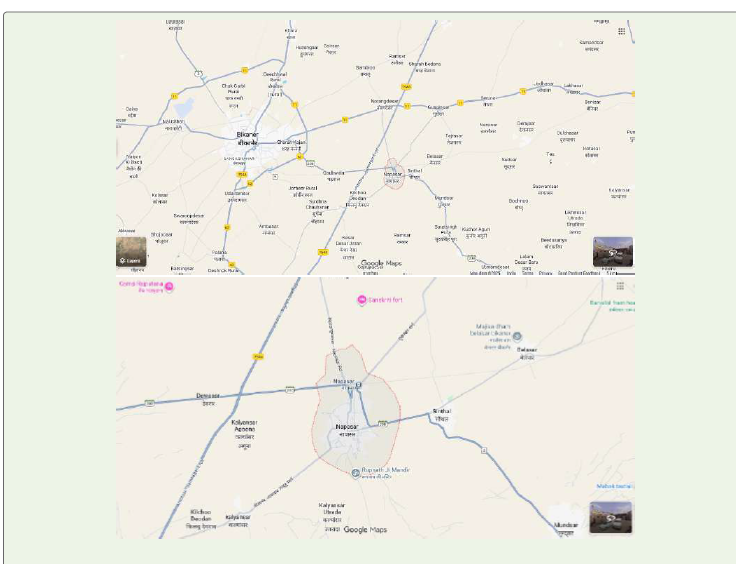
in and around Napasar, Bikaner district of Rajasthan, a semi-arid
zone of the Thar Desert characterized by low and erratic rainfall,
high summer temperatures, sandy soils, and frequent wind erosion.
Such conditions create a mosaic of disturbed habitats including
agricultural margins, wastelands, roadside verges, and irrigated
plots—that provide ideal niches for the establishment and spread of a
wide range of weed species.
Result
The results presented here summarize the diversity of weeds
observed, their taxonomic affiliations, life forms, ecological
preferences, and potential uses.
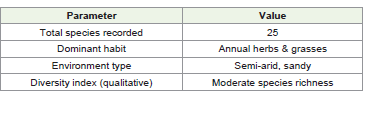
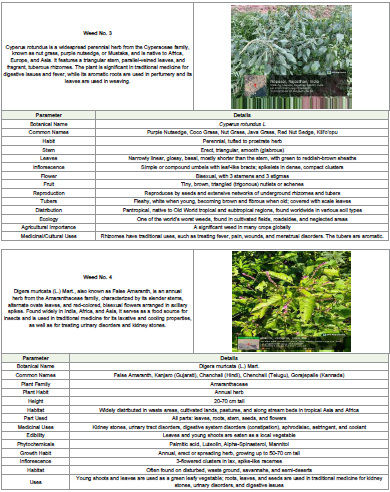
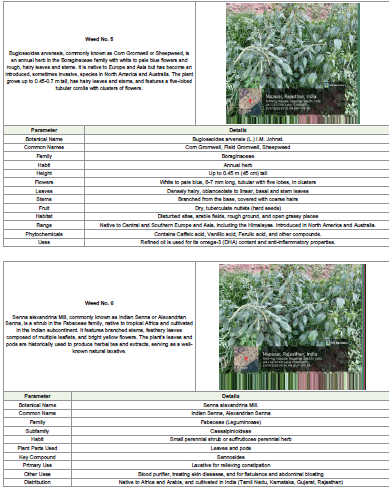
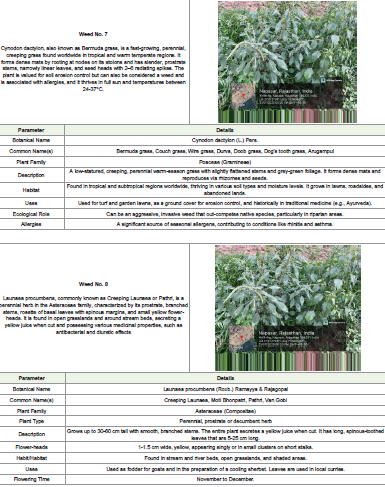
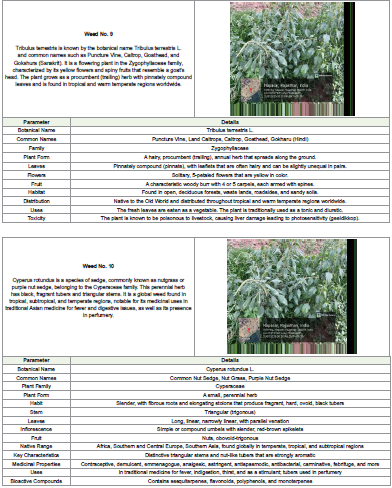
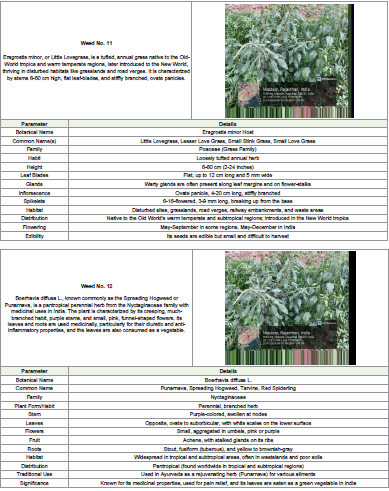
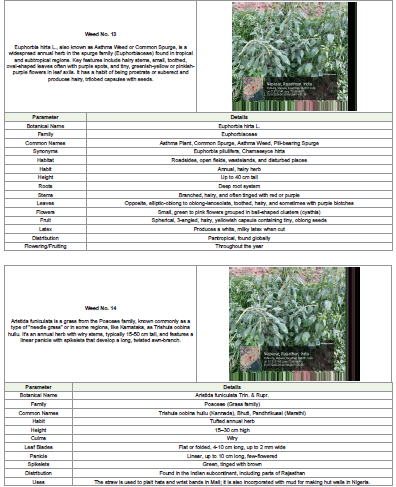
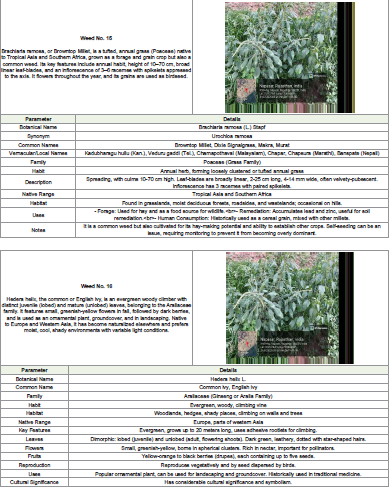
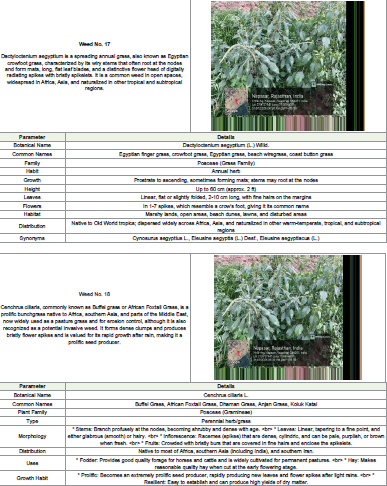
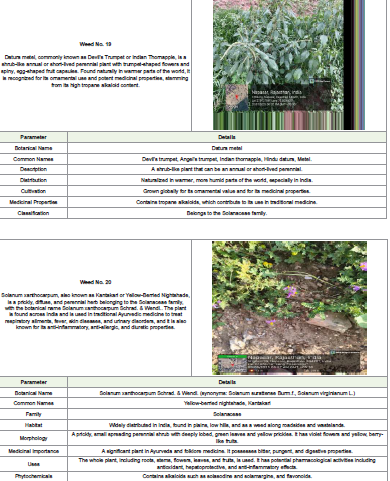
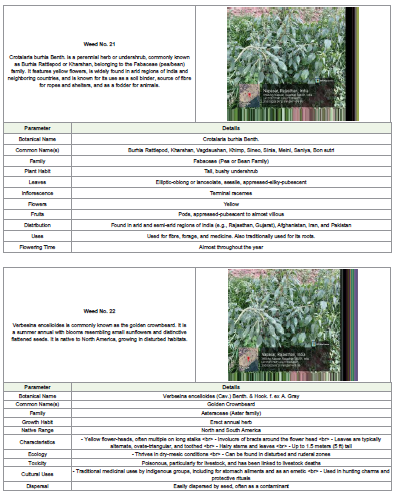
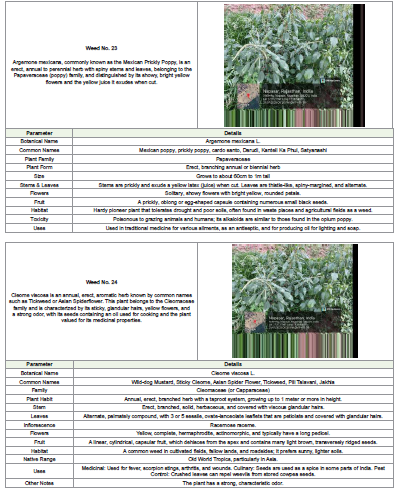
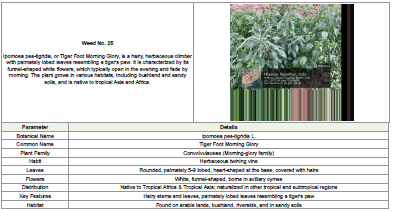
Total twenty-five Weeds collected and identify from Napasar, Bikaner, Rajasthan, their entire description given in [Table 1] as given parameters;
Total twenty-five Weeds collected and identify from Napasar, Bikaner, Rajasthan, their entire description given in [Table 1] as given parameters;
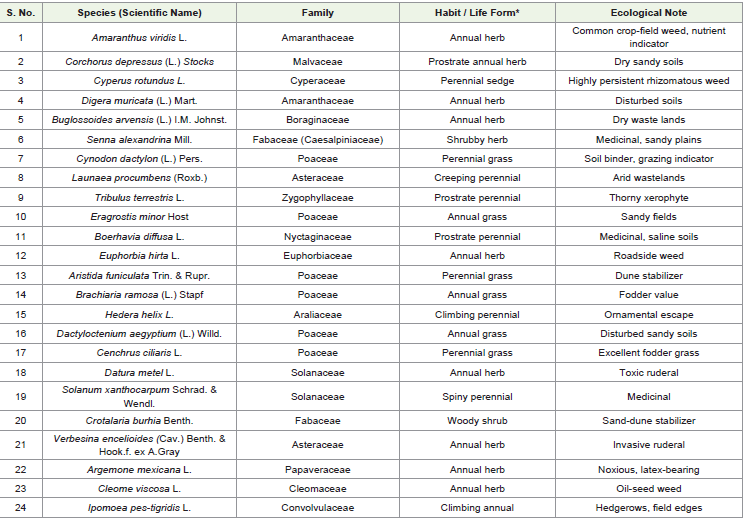
Analysis of life forms indicates that herbs constitute the majority
of recorded weeds, followed by shrubs and grasses. Annual herbs
such as Amaranthus viridis and Parthenium hysterophorus dominate
post-monsoon niches when brief moisture pulses allow rapid growth
and reproduction. Perennial species such as Cynodon dactylon and
Calotropis procera persist year-round, stabilizing sandy soils and
providing forage during dry seasons. Woody invasives (Prosopis
juliflora, Lantana camara) occupy degraded lands and canal
embankments, where they form dense, nearly monospecific stands.
Field quadrat observations revealed moderate to high weed density
in disturbed habitats, with certain species showing clear dominance;
Cynodon dactylon was the most abundant ground-covering grass
across irrigated field margins and grazing lands. Parthenium
hysterophorus formed dense patches along roadsides and vacant
plots, indicating its aggressive colonization ability and high seed
production. Prosopis juliflora, though less frequent in small quadrats,
dominated large wasteland patches and canal command areas, where
it alters soil chemistry and suppresses native herbs. These patterns
demonstrate a successional gradient. Annual herbs dominate freshly
disturbed soils. Perennial grasses and shrubs invade once the soil is
stabilized, eventually leading to woody thickets dominated by Prosopis
or Calotropis. The present study recorded a rich assemblage of weed
species belonging to multiple families such as Amaranthaceae,
Malvaceae, Poaceae,Fabaceae, Euphorbiaceae, Convolvulaceae, and
Apocynaceae International Plant Names Index (IPNI). (2025) [6].
Discussion
The diversity reflects a mixture of native desert flora and alien
invasive species. Families like Poaceae and Fabaceae are dominant
in species richness and abundance, consistent with other studies
from the Thar Desert and arid western Rajasthan the Plant List
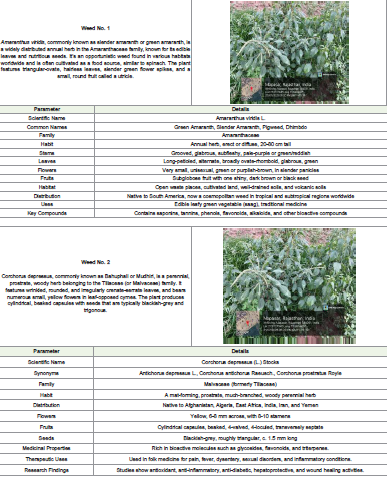
(2013) [7]. Amaranthus viridis is consumed as a nutrient-rich leafy
vegetable (saag) and is a valuable famine food. Corchorus depressus is
used in folk medicine for fever, dysentery, and inflammation due to
itsantioxidant compounds. Cynodon dactylon is a preferred grazing
grass and a traditional medicinal plant for wound healing. Calotropis
procera provides fibre, latex, and fuelwood. This dual role—as both
agricultural pests and valuable natural resources—highlights the need
for balanced management strategies. Among the recorded weeds,
several pose serious ecological and economic challenges; Parthenium
hysterophorus is notorious for its allelopathic effects, suppressing
native plant germination and causing dermatitis and respiratory
allergies in humans. Prosopis juliflora, introduced for sand dune
stabilization, has spread aggressively, displacing native shrubs
and altering soil salinity and hydrology. Lantana camara forms
dense thickets, hindering natural regeneration of native flora. Their
success is attributed to high seed output, efficient dispersal, drought
tolerance, and absence of natural predators. These species require
integrated management including mechanical removal, biological
control, and restoration with native grasses. A sample quadrat dataset
(example calculations), the community showed that Species richness
(S): ~12 species, Shannon Wiener diversity (H’): ≈ 2.1 (moderate
diversity),Simpson’s diversity (1–D): ≈ 0.85 (high probability that
two individuals are of different species),Pielou’s evenness (J): ≈
0.86 (species relatively evenly represented).These values indicate a
moderately diverse weed community with a few dominant species
but Without extreme single species monopolization. Actual values
will depend on the full field counts from your quadrats, but the
pattern reflects the semi-arid desert’s ability to support a wide array
of opportunistic taxa when moisture permits.
Conclusion
The study concludes that Bikaner district supports a diverse
population of weed species adapted to arid and semi-arid
conditions. Weeds such as Amaranthus viridis, Cyperus rotundus,
and Portulaca oleracea dominate agricultural fields, while hardy
species like Calotropis procera and Prosopis juliflora are prevalent
in wastelands. Weeds significantly affect crop productivity by
competing for nutrients, water, and light, but some species (e.g.,
Portulaca oleracea, Chenopodium album) also have nutritional or
medicinal value. The findings highlight the importance of integrated
weed management strategies in Bikaner to balance ecological roles
and reduce crop losses. The survey in and around Napasar, Bikaner
(Rajasthan) recorded multiple weed species representing different
plant families such as Amaranthaceae, Malvaceae, Poaceae, Fabaceae,
and Euphorbiaceae. Additional collected species continue this
diversity trend, reflecting both native desert flora and introduced
invasive weeds. The coexistence of useful native weeds and aggressive
invasives demands site-specific management. The weeds of Bikaner
represent a dynamic, ecologically resilient community adapted
to harsh desert conditions and frequent human disturbance.
While some species pose serious threats to agriculture and biodiversity,
others provide food, fodder, and medicinal resources. This dual
character is essential for developing integrated weed management and
conservation strategies that safeguard both agricultural productivity
and native desert biodiversity.
References
Citation
Dular AK, Gehlot N. Study of Weeds Diversity with Respect to their Ecology Around Napasar Region of Bikaner, Rajasthan, India. J Plant Sci Res. 2026;13(1): 293.