


Review Article
Integrating Tradition and Ecology: The Role of Indian Knowledge Systems in Biodiversity Conservation
Kakati D1* and Barwant MM2
1Department of Botany, Mangaldai College (Autonomous), Mangaldai. Darrang. Assam, India.
2Sanjivani Rural Education Society’s, Sanjivani Arts Commerce and Science College Kopargaon, Ahilynagar Maharashtra, India
2Sanjivani Rural Education Society’s, Sanjivani Arts Commerce and Science College Kopargaon, Ahilynagar Maharashtra, India
*Corresponding author:Dr. Debashree Kakati, Department of Botany, Mangaldai College (Autonomous), Mangaldai, Darrang, Assam, India
Copyright: © Kakati D, et al. 2025. This is an open access article distributed under the Creative Commons Attribution License, which permits unrestricted use, distribution, and reproduction in any medium, provided the original work is properly cited.
Article Information: Submission: 05/10/2025; Accepted: 17/11/2025; Published: 21/11/2025
Introduction
One of the most ecologically and culturally diverse nations in the
world, India is home to a broad range of ecosystems and traditional
communities that have coexisted with nature for thousands of years.
Indian Knowledge Systems (IKS) refers to the indigenous, local,
cultural, and customary ethnic knowledge that people have created
and maintained via intimate connection with their environment for
coexistence. This knowledge system enrooted to cultural customs,
spiritual beliefs and empirical observationstransmitted from one
generation to the next through oral traditions, rituals and group
learning that help in maintaining biodiversity by protecting habitats
and promoting the growth of diverse plant and animal species [1].
In its widest definition, biodiversity encompasses the diversity
and adaptability of all living things, including microorganisms,
plants, animals, and the ecosystems they create [2]. The resilience of
ecosystems and human well-being are supported by biodiversity. But
the swift deterioration of ecosystems caused by several anthropogenic
factors highlighted the necessity of complementary and alternative
conservation strategies.
A subset of IKS is represented by indigenous knowledge in biodiversity conservation, which is defined by environmentally sound techniques tailored to regional conditions [1]. It involves a deep comprehension of biodiversity, soil, climate, and ecological
A subset of IKS is represented by indigenous knowledge in biodiversity conservation, which is defined by environmentally sound techniques tailored to regional conditions [1]. It involves a deep comprehension of biodiversity, soil, climate, and ecological
relationships. Techniques used by indigenous communities that
directly support habitat preservation and increase in species variety
include several traditional methods such as traditional agricultural
practices, agroforestry, ceremonies, taboos, sacred grooves, etc.
Additionally, traditional ecological methods and the usage of
medicinal herbs show a holistic perspective of nature, where livelihood
and conservation are intertwined [3].Blending such traditional and
modern approaches to biodiversity conservation is vital for achieving
sustainable outcomes. While modern science provides advanced
tools, indigenous knowledge offers ecologically sound and culturally
rooted practices, prompting growing support for their integration.
The purpose of this review is to examine how Indian Knowledge
Systems contribute to biodiversity conservation, with an emphasis
on indigenous agroecological models, sacred landscapes, community
stewardship, and traditional ecological practices. Case studies from
certain parts of India were highlighted. The contribution of these
knowledge systems to the preservation of biological diversity will be
discussed, and the possibility of integrating IKS with contemporary
conservation frameworks will be evaluated.
Biodiversity conservation and forest in ancient Indian texts:
Historical manuscripts and ancient literature from ancient India
exhibit rich legacy of biodiversity protection, deep appreciation
for ecological balance and a respect for the natural world.
Kautilya’sArthasastra describes soil types, irrigation techniques,
farming techniques, microecological contexts, management of forest,
garden, orchard and cattle, penalties and punishment were specified
for causing injury to any living being and the king was supposed to
protect the forest and forest resources [4]. Similarly Manusmrti written
in post‑vedicperiod is the first ethical compendium on human law,
contains ecological ethics and recognizes biodiversity as “Chara” or
the animal and “Achara” or plants. It consists of biodiversity rules like
prohibitions on killing certain animals (buffalo, snakes, elephants),
environmental pollution and its effect etc. In Rig Veda, (1700-1100
BCE) there are hymns for mentions tree worship and sacred groves
[5]. Atharva Veda (c. 800 BCE) consist of hymns invoke protection
for forests, rivers, mountains, manifesting early conservation
consciousness. Another important treatise CarakaSamihita and
SusrutaSamhita includes the management of wild medicinal plants
and their cultivation. Post vedic literature, Surapala’sVrikshayurveda
describes the forest ecosystem and its management practices.
Besides, ancient Indian epics like the Mahabharata, Ramayana, and
Bhagavad Gita depict divine and sacred forests inhabited by sages,
and diverse flora and fauna. These texts highlight sacred groves
(Tapovanas) as centers of ecological harmony and spiritual practice.
Abhijnanasakuntalam by Kalidasa beautifully portrays the vibrant
biodiversity of hermitage forests. Such treatises emphasize the
sanctity of nature and advocate for its reverent protection [4].Traditional Practices in Biodiversity Conservation:
Traditional practices in biodiversity conservation
emphasises the time-tested ecological knowledge of indigenous
andethniccommunities in India. These practices have a strong hold on
spirituality, cultural traditions, and sustainable use natural resources.
Their insights into maintaining ecosystem health and species diversity
are invaluable. There are several indigenous technologies used in the
conservation of nature such as, rituals and ceremonies, tabbos, sacred
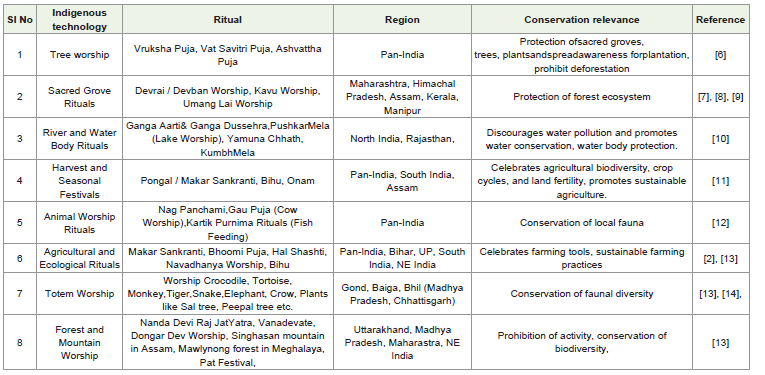
groves, prohibitions etc.1. Rituals and ceremonies:The connection between religious rituals and biodiversity protection is an intriguing story that combines cultural beliefs and environmental responsibility. Ethnic communities worship tree, animals, forest and mountain deities from time immortal. Certain important ethnic ritualsrelated to biodiversity conservation are (Table 1)
2. Traditional agricultural practices:Indigenous Technical Knowledge (ITK) plays a vital role in sustainable agriculture, especially among the 80% of Indian farmers practicing low-input farming [2]. Rooted in local ecosystems, ITK enables effective adaptation to soil, climate, and water conditions. It promotes sustainable resource use through agroforestry, crop rotation, and traditional irrigation. ITK also conserves genetic diversity via traditional seed and breeding practices. It enhances resilience to climate change through drought resistant crops and soil conservation. Culturally embedded, ITK strengthens community identity and intergenerational knowledge transfer. By fostering food sovereignty and reducing external dependence, ITK supports resilient, ecologically sound, and selfreliant agricultural systems.
3. Traditional farming systems:: Indigenous farming technologies in India includes, Jhum culitivation Double cropping
of rice, Multiple Cropping, Bun system of cultivation (Meghalaya),
Rice-fish system of Apatani plateau, Bamboo drip irrigation system
(Meghalaya), Alder based agriculture in Nagaland, ZABO system
(Nagaland), Diversified Hill Horticulture (East Himalaya) etc. [15].
Besides, there is particular seed selection, collection and preservation
methods are there in different states of India. Indigenous organic
manure such as Kunapajala, Adiuram, Makkavaithal, Chapathikalli,
NelmakkuuramandSongukalhave been used by several communities
from ancient time which maintains the health of soil microflora [16].
Several ecocultural festivals and rituals are associated with harvesting
in different communities. Thus, traditional indigenous knowledge
in India is deeply rooted with the protection, preservation and
conservation of farming indigenous practices, native gene pool of the
cultivar verities as well as the tools and techniques of farming.
4. Sacred Groves and Landscape Ethos:: Sacred groves are small forest patches preserved by local ethnic communities due to
their religious beliefs, cultural sentiments, and traditional taboos [17].
These groves not only serve as important reservoirs of biodiversity
but also regarded as living repositories of biological heritage, housing
numerous threatened species. The concept of sacred groves is found
worldwide including in India, as well as in regions across Asia, Africa,
Europe, Australia, and America [18]. India alone may have over 1.5
lakh sacred groves [19]. Sacred groves may be of different types such
as temple groves, traditional sacred groves related to folk deities,
religious groves associated with religious beliefs and customs, island
groves consist of certain ecological importance such as mangroves,
coastal or reverie areas, burial, cremational or memorial groves are
the places where deceased are kept and are believed to be inhabited
by the spirits of ancestors.
Sacred groves serve an important role in biodiversity conservation,
ecosystem protection, and the preservation of traditional ecological
knowledge [5]. Managed by local ethnic communities, these forest
patches serve as sanctuaries for a variety of plant and animal species.
They also hold great cultural and spiritual value, and are frequently
regarded as hallowed sites for rites and ceremonies. The protection of
these groves empowers communities, strengthens their involvement
in natural resource management, and promotes environmental
balance by preventing soil erosion and cleaning the air. Furthermore,
holy groves represent community-led conservation, which promotes
sustainable livelihoods, food security, and the preservation of
indigenous history.
5. Ethnobotany in biodiversity conservation: Ethnobotany is the scientific study of the relationship between people and plants,
holds significant relevance in addressing several global challenges
such as food security, climate change, biodiversity conservation,
and public health. Interaction of local communities with their
environmental resources contributes to sustainable practices rooted
in traditional knowledge [20]. Moreover, it serves as a bridge
between indigenous wisdom and contemporary science fostering
integrated approaches toward achieving biocultural conservation.
Home gardens, herbal markets, traditional food and fodder, folk
livelihood, traditional healing practices continuously foster the
local communities to conserve the locally available medicinal herbs
and other plant species. Thus, ethnomedicinal practices directly
contributes to the conservation of ethnomedicinal biodiversity.
6. Community-based Forest and Wildlife ManagementL:
Community-based Forest and Wildlife Management in India is
a participatory approach that empowers local communities to
sustainably manage forest and wildlife resources [21]. Rooted in
traditional knowledge and practices, this model emphasizes the
role of forest dwellers and indigenous communities in conservation
efforts. One of the most prominent initiatives in India is Joint
Forest Management (JFM), introduced in the 1990s, where village
communities collaborate with the Forest Department to protect
and regenerate degraded forest lands. Other methods include the
establishment of Community Forest Rights under the Forest Rights
Act (2006), allowing tribal and forest-dependent communities legal
access and management rights over forest resources. Community
Reserves and Conservation Reserves, recognized under the
Wildlife Protection Act (1972), further involve local populations in
protecting biodiversity-rich areas outside formal protected zones.
These community-led initiatives often include activities such as
patrolling, afforestation, fire prevention, wildlife monitoring, and
sustainable harvesting of non-timber forest products. By blending
traditional ecological knowledge with modern conservation tools,
these approaches not only contribute to biodiversity conservation
but also ensure livelihood security and cultural preservation. Despite
challenges like inadequate support and legal ambiguities, community based
management remains a vital strategy in India’s efforts to achieve
inclusive, effective, and sustainable forest and wildlife conservation.Case studies
i. Mawphlang Sacred Grove, Meghalaya::
The Khasi tribe has preserved this ancient forest for centuries through strict
taboos which harbours rare orchids, endemic medicinal plants, and unique fungi species [22]ii. Bishnoi Community Saving Wildlife, Rajasthan:: Bishnoi community of Rajasthan is known for their 500 year old
wildlife protection tradition [23].They worship wildlife
and trees and in 1730 Khejarli Massacre, 363 Bishnois died
iii. Apatani Valley Conservation, Arunachal Pradesh::
The Apatani tribe practices traditional wet rice-fish cultivation,
maintaining soil, water, and aquatic biodiversity. In 2014,
their landscape was nominated for the UNESCO World
Heritage list for its unique indigenous resource management
system [24].iv. Niyamgiri Hills Conservation by DongriaKondh, Odisha:: In 2013, the Supreme Court of India upheld the rights of
the DongriaKondh tribe to protect the Niyamgiri Hills from
bauxite mining. Their spiritual and ecological reverence
for the hills helped preserve a biodiversity hotspot rich in
medicinal plants and endemic species [25].
v. Use of Traditional Seed Banks ‘Navdanya Movement’, Uttarakhand:: Founded by Dr. Vandana Shiva, this movement revived traditional seed-saving practices. Farmers
use indigenous knowledge to preserve crop biodiversity,
particularly drought and pest resistant varieties, playing a
crucial role in food security and agrobiodiversity [26].
Challenges and Limitations:
The incorporation of traditional knowledge into biodiversity
conservation faces numerous challenges. Modernization and
urbanization have eroded traditional knowledge systems, with
younger generations becoming increasingly disconnected from
ancestral practices. This is exacerbated by the loss of intergenerational
transmission, in which knowledge is not passed down due to
changing lifestyles, migration, and decreased interest in indigenous
practices. Conflicts frequently arise between state led conservation
efforts and customary practices, particularly when legal frameworks
limit community access to traditionally managed lands, undermining
local stewardship. Furthermore, intellectual property rights and
biopiracy are serious concerns, as corporations and researchers
occasionally exploit traditional knowledge without fair compensation
or acknowledgement, resulting in mistrust and loss of control over
indigenous resources.Future Prospects:
To strengthen the role of indigenous Indian Knowledge Systems
(IKS) in biodiversity conservation, several visionary strategies could
be implemented. Integrating IKS into national biodiversity action
plans formalizes and supports community-based conservation
practices. Revitalizing traditional institutions like village councils and
customary guardians contributes to the restoration of local governance
and environmental stewardship. Participatory documentation and
capacity building enable communities to record and preserve their
knowledge while also improving conservation skills. Eco-cultural
tourism provides a long-term source of income by highlighting
indigenous practices and raising environmental awareness. Finally,
promoting cross-disciplinary and multi disciplinary research and
education could connect traditional wisdom to scientific knowledge,
benefiting both conservation efforts and academic understanding.Conclusion
Traditional ecological wisdom is extremely valuable in
biodiversity conservation and ecosystem sustainability, as it provides
time-tested practices based on a deep understanding of nature. Rather
than being viewed in isolation, this knowledge should be seen as a
supplement to modern scientific approaches, enriching conservation
strategies with cultural, ecological, and ethical dimensions. A truly
sustainable future requires the respectful integration of traditional
knowledge systems into mainstream environmental policies and
practices, ensuring community participation, cultural preservation,
and ecological resilience.
References
Citation
Kakati D, Barwant MM. Integrating Tradition and Ecology: The Role of Indian Knowledge Systems in Biodiversity Conservation. J Plant Sci Res. 2025;12(2): 290.