


Research Article
Pharmacognostic and Phytochemical Investigation of the Leaves of Malvastrum coromandelianum (L.) Garcke
Shinde YP1*, Pachkore GL2, Patale SS1 and Barwant MM3
1Department of Botany, Shri Amolak Jain Vidya Prasarak Mandal’s Smt. S. K. Gandhi Arts, Amolak Science and P.H Gandhi Commerce College, Kada, Dist – Beed, Maharashtra, India.
2Department of Botany, Padmashree Vasantdada Patil College, Patoda Beed, Maharashtra, India.
3Sanjivani Rural Education Society’s, Sanjivani Arts Commerce and Science College Kopargaon, Ahilynagar Maharashtra, India.
2Department of Botany, Padmashree Vasantdada Patil College, Patoda Beed, Maharashtra, India.
3Sanjivani Rural Education Society’s, Sanjivani Arts Commerce and Science College Kopargaon, Ahilynagar Maharashtra, India.
*Corresponding author:Yogesh Pandharinath Shinde, Department of Botany, Shri Amolak Jain Vidya Prasarak Mandal’s Smt. S. K. Gandhi Arts, Amolak Science and P.H Gandhi Commerce College, Kada, Dist – Beed, Maharashtra, India. E-mail Id:ypshinde129@gmail.com
Copyright: © Shinde YP, et al. 2025. This is an open access article distributed under the Creative Commons Attribution License, which permits unrestricted use, distribution, and reproduction in any medium, provided the original work is properly cited.
Article Information: Submission: 02/08/2025; Accepted: 24/08/2025; Published: 26/08/2025
Abstract
Malvastrum coromandelianum (L.) Garcke, commonly known as false mallow, belongs to the family Malvaceae and has been recognized for its ethnomedicinal significance. Ethnobotanical surveys have highlighted its use in treating various ailments, while pharmacological investigations have demonstrated its antinociceptive, anti-inflammatory, analgesic, and antibacterial properties. Despite its therapeutic potential, the lack of established standardization parameters for the herbal raw material of M. coromandelianum poses a significant challenge to ensuring its purity, quality, and consistency. Addressing this gap is critical for its effective use in traditional and modern medicine. The present study focuses on developing comprehensive standardization parameters for M. coromandelianum, including macroscopic, microscopic, phytochemical, and physicochemical evaluations. Establishing these standards will contribute to the scientific validation of this plant and facilitate its inclusion in pharmacopoeia monographs, thereby enhancing its applicability in the pharmaceutical and healthcare sectors.
Keywords:Malvastrum Coromandelianum; Phytochemical Standardization; Total Flavonoid Content; Total Phenolic Content; Pharmacological Evaluation
Introduction
Malvastrum coromandelianum (L.) Garcke, a member of the
family Malvaceae, is a perennial or annual herb widely distributed in
tropical and subtropical regions of the world. It is commonly referred
to as false mallow, broom weed, or clock plant due to its morphological
resemblance to other members of the Malvaceae family (Saxena &
Rao, 2018) [1]. Ethnobotanical surveys have documented the use of
M. coromandelianum in diverse traditional healthcare systems across
Asia, Africa, and the Americas, emphasizing its global therapeutic
relevance (Yadav & Mohite, 2020) [2].
In India, particularly in the Kalsubai region of the Western
Ghats, tribal communities utilize the leaves and stems of M.
coromandelianum to treat skin disorders, wounds, and inflammatory
conditions (Irudayaraj & Fabiola, 2022) [3]. The plant is also applied
as a poultice to alleviate pain, as an anti-inflammatory agent, and
for treating dysentery and gastrointestinal disturbances (Khonsung
et al., 2006; Saxena & Rao, 2018) [4,1]. Within the framework of
the Indian traditional medicine system, it is recognized for its antiinflammatory,
analgesic, antidysenteric, and antimicrobial properties
(Reddy et al., 2001; Sittiwet et al., 2008) [5,6].
Pharmacological studies have validated many of these traditional
claims, reporting significant antinociceptive (Reddy et al., 2001) [5],
anti-inflammatory (Khonsung et al., 2006) [4], antimicrobial (Sittiwet
et al., 2008) [6], and antioxidant activities (Yadav & Mohite, 2020;
Divya & Kumar, 2018) [2,7]. In addition, recent investigations have
identified bioactive phytoconstituents, including flavonoids such as
tiliroside and quercetin, which contribute to its antioxidant potential
(Divya & Kumar, 2018) [7]. Larvicidal properties against Aedes aegypti
and other vector species have also been documented, highlighting
the plant’s diverse pharmacological spectrum (Irudayaraj & Fabiola,
2022) [3].
Despite these findings, there is a notable lack of comprehensive
pharmacognostical and phytochemical standardization of M.
coromandelianum. The absence of standardized quality control
parameters for crude herbal drugs poses a risk to ensuring purity,
consistency, and therapeutic efficacy (Mukherjee, 2002; Harborne,
1984) [8,9]. Such deficiencies often result in variations in chemical
composition, which can compromise the reliability of herbal
preparations and limit their acceptance in modern pharmacopoeias
(Chase & Pratt, 1949; Farnsworth, 1966) [10,11].
The present study addresses these limitations by focusing
on the pharmacognostic and physicochemical evaluation of M.
coromandelianum. Microscopic examination, powder analysis,
fluorescence studies, and phytochemical profiling were conducted
to provide diagnostic features for its proper identification and
authentication. Additionally, physicochemical parameters, including
moisture content, ash values, and extractive values, were determined
to ensure the quality and safety of the raw material. Quantitative
estimation of total phenolic and flavonoid contents was also
performed to highlight its antioxidant potential, further supporting
its therapeutic value (Adesegun et al., 2009; Chang et al., 2002; Hatano
et al., 1989) [12-14], [15-28].
This systematic evaluation aims to establish a scientific foundation
for the traditional uses of M. coromandelianum and facilitate
its integration into formal medicinal applications. The findings
contribute to the development of standardized quality control
parameters, which are crucial for the acceptance of herbal drugs in
the pharmaceutical industry and for ensuring safety and efficacy in
patient care.
Material and Methods
Plant Collection and Authentication:
The plant Malvastrum coromandelianum (L.) Garcke was collected
from the Kalsubai region of the Western Ghats, Maharashtra, India.
The plant was authenticated by experts in the Department of Botany,
Dr. Babasaheb Ambedkar Marathwada University, Maharashtra.
A voucher specimen (00832) was prepared and deposited in the
herbarium of the Department of Botany for future reference.Preparation of Plant Material:
The collected plant material was thoroughly washed under
running tap water to remove dirt and any adhering matter. Fresh
plant material was used for the microscopical study to examine
structural characteristics. A portion of the leaves was air-dried in the
shade, powdered using a mechanical grinder, and sieved through a
60# mesh. The powdered material was used for the determination
of physicochemical parameters, including ash values and extractive
values.Phytochemical and Standardization Studies:
Dried powdered leaf material was subjected to standardization
procedures to determine ash values (total ash, acid-insoluble ash, and
water-soluble ash) and extractive values (water-soluble and alcohol soluble
extractives).Microscopical Analysis:
Fresh plant material was used for microscopic examination to
study the internal structure and anatomical features of the plant. The
observations were documented using standard staining techniques
and microscopy.Phytochemical Screening:
Preliminary phytochemical screening was conducted on
the powdered plant material to detect the presence of bioactive
compounds, including alkaloids, flavonoids, phenolics, tannins, and
terpenoids. Advanced analysis using high-performance thin-layer
chromatography (HPTLC) was performed to detect and quantify key
phytochemicals, such as β-sitosterol.Result and Discussion
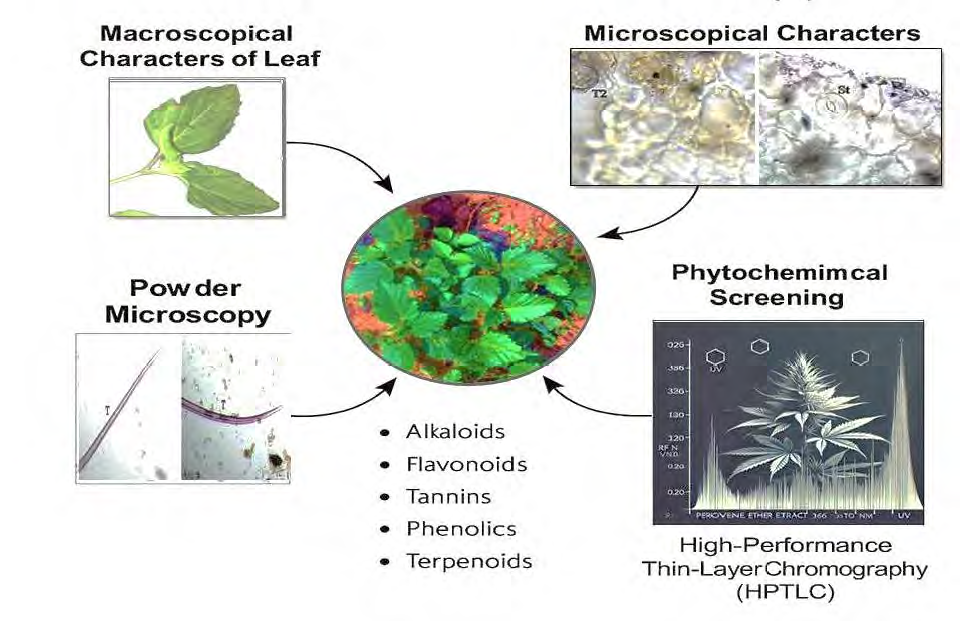
Macroscopic Characters of Leaf:
Malvastrum coromandelianum is a strong-stemmed, woodyrooted
herbaceous plant that grows up to 1 m in height. The leaves are
ovate to ovate-elliptic in shape, measuring approximately 4.5 cm in
length and 3.5 cm in width. The apex of the leaves varies from sharp to
blunt, with a prominent midrib and serrated margins. The leaves are
three-nerved from the base, and the petiole (leaf stalk) ranges from
1.5 to 4 cm in length. These characteristic features are depicted in
[Figure 1a] (entire plant) and [Figure 1b] (detailed view of the leaf).Microscopical Characters:
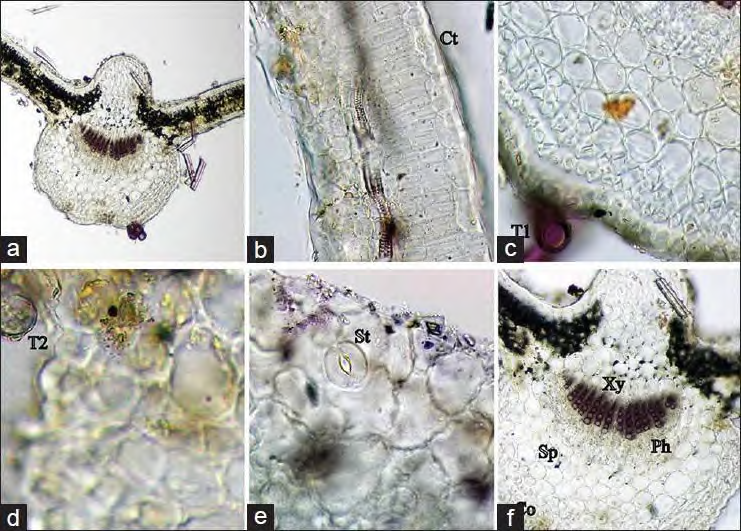
The histological study of the leaf was conducted on both the
lamina and midrib regions [Figure 2a]. The transverse section of
the leaf lamina is dorsiventral, with a single-layered upper and lower
epidermis, which is compactly arranged and cutinized [Figure 2b].
The epidermis displays two types of modifications: trichomes and
stomata.Two types of trichomes were observed::
1. Unicellular, uniseriate, lignified covering trichomes, which
are more abundant on the lower epidermis than the upper
epidermis [Figure 2C].2. Bi-cellular head, sessile, non-lignified glandular trichomes, present on both the upper and lower epidermis [Figure 2a-2d].
The leaf also contains three-celled, unequal anisocytic type stomata, which are well-distributed across the lamina region [Figure 2e]. The mesophyll consists of spongy parenchyma, which does not contain any ergastic cell content.
Microscopical Characters Midrib Region of leaf:
The midrib region of the leaf exhibits a similar type of epidermis
as the lamina, but it is devoid of stomata. The dorsal surface of the
midrib has a concave shape. Beneath both the upper and lower
epidermis, there are two to three layers of collenchyma with thick
cellulosic cell walls, arranged compactly. These layers provide
mechanical support and contribute to the expansion of the leaf
lamina. The central region of the midrib contains a vascular bundle,
responsible for the conduction of food and nutrients, surrounded
by spongy parenchyma. The vascular bundle is arc-shaped and bicollateral
in arrangement, with the phloem surrounding the xylem.
The phloem consists of sieve tubes and companion cells, but phloem
fibers are absent. The xylem is characterized by well-developed spiral
vessels, which facilitate the conduction of water [Figure 2f].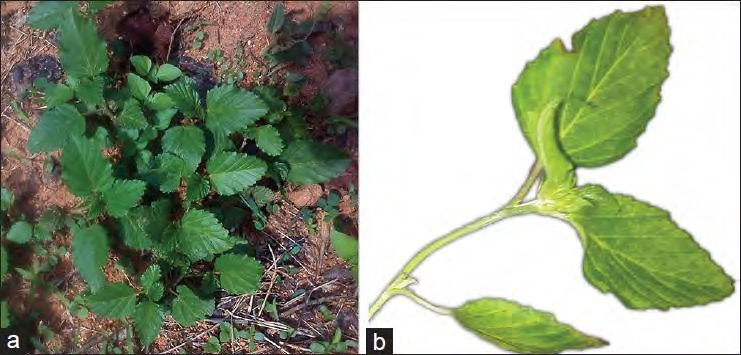
Powder Microscopy:
Powder microscopy of the leaf revealed the presence of
unicellular, lignified covering trichomes with a smooth cuticle
[Figure 3a,3b], spiral xylem vessels, which are slightly lignified
[Figure 3c], and anisocytic stomata [Figure 3d].Physical Constants:
Ash value determination is a critical parameter for assessing the
quality of herbal raw material, as a higher ash value may indicate
adulteration or improper processing. The percentage variation in
the weight of ash across different samples of the same drug is usually
minimal, and any significant deviation suggests a change in quality.
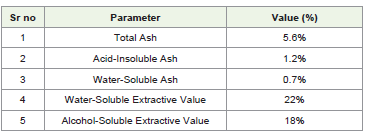
The percentages of total ash, acid-insoluble ash, and water-soluble
ash are presented in Table 1.Similarly, extractive value determination
is essential for evaluating the quality of the raw material. A lower
extractive value may indicate that the raw material has been exhausted
or poorly processed. The results of water-soluble and alcohol-soluble
extractive values are also provided in [Table 1] .Phytochemical screening:
The dried leaf powder of M. coromandelianum was successively
extracted using a Soxhlet apparatus with solvents of increasing
polarity, including petroleum ether, chloroform, acetone, and
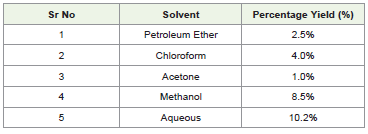
methanol, followed by maceration with water. The percentage yield of
the extract was highest in the aqueous and methanolic extracts, while
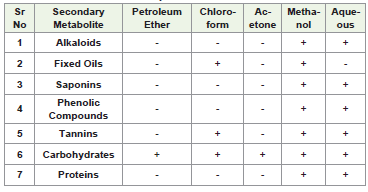
the lowest yield was observed in the acetone extract (Table 2). The
results of chemical tests revealed the presence of various secondary
metabolites, such as alkaloids, fixed oils, saponins, phenolic
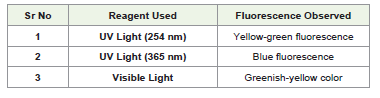
compounds, tannins, carbohydrates, and proteins. These findings are
summarized in [Table 3], while the fluorescence analysis results are
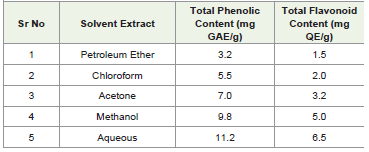
provided in [Table 4].Total Phenolic and Flavonoid Content Estimation:
Plant phenolics are well-known for their antioxidant properties
and play a significant role in protecting plants from oxidative
stress. In the present study, the methanolic extract of Malvastrum
coromandelianum exhibited the highest content of phenolic
compounds, as shown in [Table 5] . These findings underscore the
potential of phenolics as important bioactive components with
therapeutic applications.Flavonoids, renowned for their wide range of biological activities, are essential markers for quality control in herbal raw materials. In this study, the chloroform extract showed the highest flavonoid content, followed by the methanolic extract, as presented in [Table 5] . This indicates that the chloroform extract may possess a higher concentration of flavonoids, which could contribute to its bioactivity.
High-Performance Thin-Layer Chromatography (HPTLC):
High-Performance Thin-Layer Chromatography (HPTLC) is a
versatile and effective tool for the identification and quantification
of secondary plant metabolites. When properly applied, HPTLC
provides a clear visual representation of the compounds present in the
test samples. In this study, β-sitosterol was identified and quantified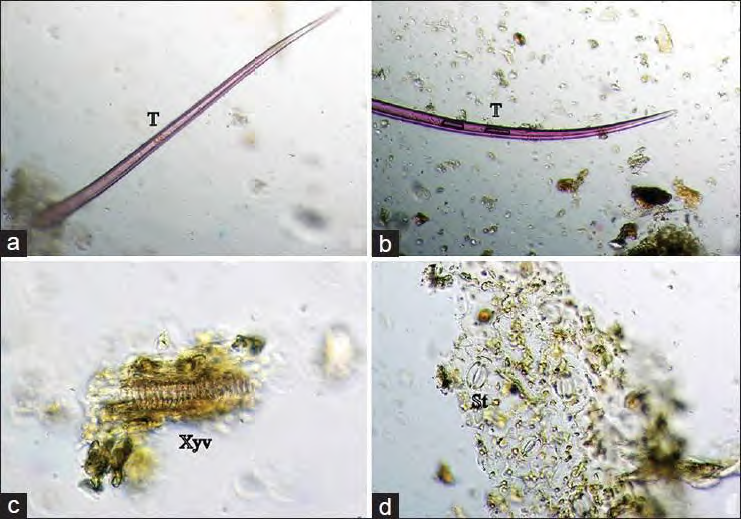
in the petroleum ether extract of Malvastrum coromandelianum
through HPTLC analysis.
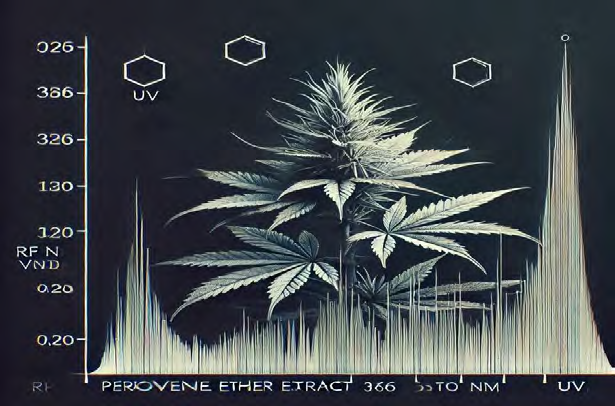
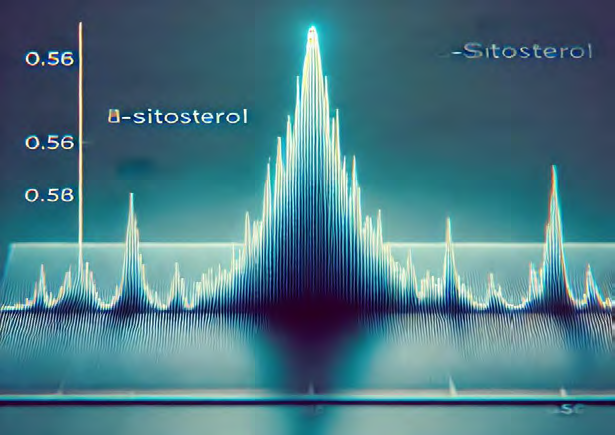
The developed chromatogram at 366 nm confirmed the presence of β-sitosterol, with an Rf value of 0.26 and an area under the curve (AUC) of 459.8 in the sample [Figure 4]. This was compared with the standard β-sitosterol, which exhibited an identical Rf value of 0.26 and a higher AUC of 1068.1 [Figure 5]. Further confirmation was obtained through overlay spectral analysis, as shown in [Figure 4]. The developed plate, after derivatization with 10% sulfuric acid in methanol under 366 nm, is presented in [Figure 6]. The percentage yield of β-sitosterol in the petroleum ether extract was found to be 1.7% w/w.β-Sitosterol, a prominent phytosterol, is known for its
The developed chromatogram at 366 nm confirmed the presence of β-sitosterol, with an Rf value of 0.26 and an area under the curve (AUC) of 459.8 in the sample [Figure 4]. This was compared with the standard β-sitosterol, which exhibited an identical Rf value of 0.26 and a higher AUC of 1068.1 [Figure 5]. Further confirmation was obtained through overlay spectral analysis, as shown in [Figure 4]. The developed plate, after derivatization with 10% sulfuric acid in methanol under 366 nm, is presented in [Figure 6]. The percentage yield of β-sitosterol in the petroleum ether extract was found to be 1.7% w/w.β-Sitosterol, a prominent phytosterol, is known for its
various biological activities, including analgesic, anthelminthic,
antimutagenic, anti-inflammatory, and antihepatotoxic properties
[19-21]. [Figure 4] presents the HPTLC chromatogram of the
petroleum ether extract of Malvastrum coromandelianum leaf. The
presence of β-sitosterol is confirmed by the peak corresponding to
an Rf value of 0.26, with an area under the curve (AUC) of 459.8.
The chromatogram was developed under 366 nm UV light for visual
identification of the compounds.
Conclusion
The evaluation of crude drugs plays a crucial role in determining
their identity, purity, and quality. Purity refers to the absence of
extraneous materials, while quality pertains to the amount of active
constituents present in the drug. Macroscopic and microscopic
evaluations are vital parameters for assessing the identity of herbal
raw materials, while the qualitative and quantitative screening of
secondary metabolites focuses on ensuring the quality of these
materials. Additionally, the therapeutic potential of a plant is directly
related to the nature and concentration of its phytoconstituents.
Therefore, evaluating the chemical composition of herbal raw
materials is essential for confirming their quality. In conclusion,
the various macroscopic, microscopic, physical, and phytochemical
parameters discussed in this study for M. coromandelianum can
serve as reliable tools for its identification, authentication, and
standardization.
Acknowledgement
The authors express their sincere gratitude to the Department of
Botany, Shri Amolak Jain Vidya Prasarak Mandal’s Smt. S. K. Gandhi
Arts, Amolak Science and P.H. College, for providing the necessary
laboratory facilities and support to carry out this research work
successfully. Their encouragement and technical assistance were
invaluable throughout the course of this study.
References
Citation
Shinde YP, Pachkore GL, Patale SS, Barwant MM. Pharmacognostic and Phytochemical Investigation of the Leaves of Malvastrum coromandelianum (L.) Garcke. J Plant Sci Res. 2025;12(2): 288.