


Research Article
Floristic Assessment and Ecological Distribution of Climbing Angiosperms in Bor Tiger Reserve, Maharashtra State, Central India
Narendra G. Chandewar1, Archana Noukarkar2 and Sreelakshmi A3
1Divisional Forest Offcer, METDB, Nagpur, Forest Department, Government of Maharashtra-440001
2Range Forest Offcer (Wildlife), Bor Sanctuary, Bordharan,Bor Tiger Reserve, Wardha, Maharashtra – 442104
3Conservator of Forest and Field Director, Pench Tiger Reserve, Vanbhavan, Nagpur-440001
2Range Forest Offcer (Wildlife), Bor Sanctuary, Bordharan,Bor Tiger Reserve, Wardha, Maharashtra – 442104
3Conservator of Forest and Field Director, Pench Tiger Reserve, Vanbhavan, Nagpur-440001
*Corresponding author:Narendra G. Chandewar, Divisional Forest Officer, METDB, Nagpur, Forest Department, Government of Maharashtra-440001, Email: ngc609@gmail.com
Copyright: © Chandewar NG, et al. 2025. This is an open access article distributed under the Creative Commons Attribution License, which permits unrestricted use, distribution, and reproduction in any medium, provided the original work is properly cited.
Article Information: Submission: 26/07/2025; Accepted: 12/08/2025; Published: 15/08/2025
Abstract
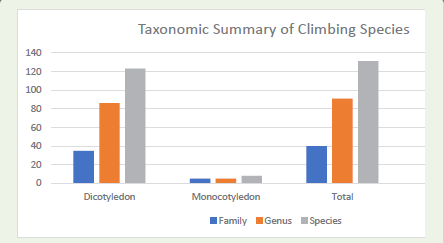
The present study conducted in the Bor Tiger Reserve (BTR), Wardha, documented a total of 131 climber plant species, providing insights into their taxonomic diversity, habitat preferences, and climbing mechanisms. The taxonomic analysis revealed that climbing angiosperms in BTR belong to 40 families
and 91 genera, with dicotyledons dominating the flora (123 species, 93.89%) compared to monocotyledons (8 species, 6.11%). Among these, 35 families and 86 genera were dicots, while only 5 families and 5 genera were monocots, highlighting the predominance of dicot climbers in the region. Habitat classification
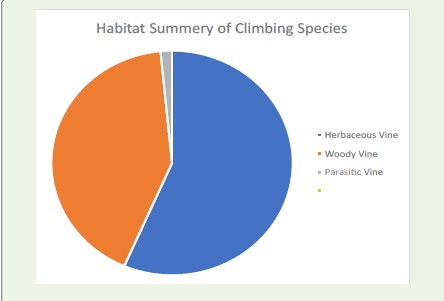
showed that herbaceous vines were the most abundant (74 species, 56.49%), followed by woody vines (55 species, 41.98%), while parasitic vines were rare (2 species, 1.53%). This distribution suggests that herbaceous climbers thrive better in the ecological conditions of BTR, possibly due to their adaptability to
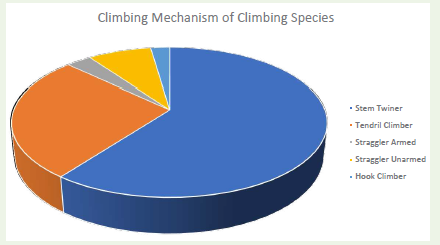
varying environmental factors. The study also categorized climbing mechanisms into four primary types. Stem twiners were the most prevalent (79 species, 60.30%), utilizing stem twining as their primary mode of ascent. Tendril climbers constituted the second-largest group (35 species, 26.72%), employing
leaf or stem tendrils for support. Stragglers, both armed (4 species, 3.05%) and unarmed (10 species, 7.64%), relied on scrambling growth, whereas hook climbers (3 species, 2.29%) were the least common, using thorns or hooks for anchorage. The 昀椀ndings underscore the ecological adaptability and structural
diversity of climbers in BTR, with stem twiners and herbaceous vines being the dominant forms. This study contributes to the understanding of climbing plant ecology in tropical dry deciduous forests and highlights the need for further research on their role in forest dynamics and conservation. The data can serve
as a baseline for future biodiversity assessments, climbers’ conservation and habitat management strategies in protected areas like Bor Tiger Reserve.
Keywords:Angiosperm Climbers; Bor Tiger Reserve; Floristic Diversity; Ecological Distribution; Maharashtra
Introduction
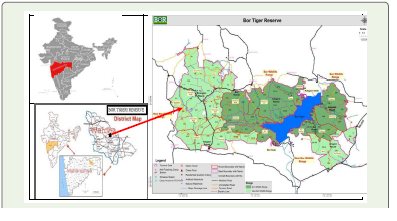
Bor Tiger Reserve is one of the smallest tiger reserves by area in
the country. It became the 47th tiger reserve in India and the sixth
tiger reserve in Maharashtra State. Bor sanctuary established by
vide noti
cation No. WLP.1670/431126(a)-Y Dated 27/11/1970 and
Bor Tiger Reserve was noti
ed on 16 August 2014, with an area of
138.12 km2 as the core comprising Bor Sanctuary (61.10 km2), New
Bor Sanctuary (60.70 km2) and the extended New Bor Sanctuary
(16.32 km2). A total adjoining area of 678.15 km2 (355.83 km2 of
forest area and 322.32 km2 of non-forest area) was declared the buffer
area of Bor Tiger Reserve on 4 December 2015. Bor Tiger Reserve
is situated along the southern boundary of Nagpur district and
northern boundary of Wardha District of Maharashtra, and extends
over on area 61.10 sq.kms including the reservoir. It represents the
oral and faunal wealth of Satpuda-Maikal the landscape. Satpuda
runs along the northern boundary of Maharashtra from West to East
and meets the Maikal hill range which comes from kanha. It was a
game reserve in past which was subsequently declared as wildlife
sanctuary in 1970 to conserve its rich biodiversity. The tiger reserve
represents a typical assemblage of the Central Indian
ora and fauna.
It comprises of good teak bearing forests with natural associates and
extremely valuable mixed deciduous forests from the point of view
of wildlife. The main herbs found in the sanctuary are Cassia tora,
Cassia auriculata, Tribulus terrestris, Urena labata, Dichrostachys
cinerea, Capparis horrida, Ziziphus mauritiana, Madhuca longifolia.
The Bor Wildlife Sanctuary is home to many species including the
endemic and endangered species such as Tiger, Panther, Small Indian
Civet Cat, Wild Boar, Sloth Bear, Blue Bull, Wild Dog, Pangolin, etc.
The avi-faunal diversity of the sanctuary is its most attractive and
remarkable feature. The sanctuary is an abode of reptiles’ species of
endangered status namely, Indian Cobra, Indian Rock Python, Rat
Snake, Russell’s Viper, Checkered Keelback and Common Monitor
Lizard.
Climbing plants (lianas and vines) play a crucial role in tropical
and subtropical forest ecosystems by contributing to structural
complexity, nutrient cycling, and providing resources for fauna
(Schnitzer & Bongers, 2002). [1] Despite their ecological importance,
climbing plants are oen understudied compared to trees and shrubs,
particularly in Central Indian forests. BTR harbors diverse vegetation
types, including dry deciduous forests, moist patches, and grasslandscrub
ecosystems, providing an ideal habitat for climbing plants.
However, comprehensive studies on climbing angiosperms in this
region are lacking. Some work appears to have been done on climbers
angiosperms in Protected Areas. A total of 175 climbing plant
species that belong to 100 genera and 40 families found in tropical
forests of southern Eastern Ghats, Tamil Nadu, India (Chellam M.
et al, 2009).[2] 746 species of climbers reported in Upper Guinean
forests (Jongkind and Hawthorne, 2005) [3] and the total number of
climbing plants species that are found in Puerto Rico and the Virgin
Islands amounts to 386 (Acevedo-Rodriguez 2005) [4].
This study aims to:
1. Document the
oristic diversity of climbing angiosperms in
BTR.2. Analyze their taxonomic distribution (families, genera).
3. Assess their ecological distribution across different habitats.
4. Identify dominant climbing mechanisms (twiners, tendril climbers, etc.).
The findings will contribute to the conservation and management of climbers in Central Indian forests.
Materials and Methods
Study Area:
Location: The Geographic Coordinates of Bor Tiger Reserve are
asLatitude: N 200 55’ 40” to N 210 3’ 15”
Longitude: E 780 34’ 40” to E 780 47’ 30”
Bio-geographical Zone: The Bor Tiger Reserve falls under ‘6BCentral
Highlands’, as per the Bio-geographical classification done
by the Wildlife Institute of India (WII), Dehradun. The details are
as below:
i. Bio-geographic Kingdom - Paleotropical
ii. Sub kingdom – Indo-Malaysian
iii.Bio-geographic zone - 6 - Deccan peninsula
iv.Biotic Province – 6B- Central Highlands
v. Sub Division Region – Satpuda-Maikal Division
ii. Sub kingdom – Indo-Malaysian
iii.Bio-geographic zone - 6 - Deccan peninsula
iv.Biotic Province – 6B- Central Highlands
v. Sub Division Region – Satpuda-Maikal Division
Forest Types: The major forest types of the reserve are as below
(Champion and Seth classification)-
a) 5A/C- i-a: Dry Teak Bearing Forests.
b) 5A/C- 3: Southern Tropical Dry Deciduous Mixed Forests. Vegetation: Dominated by dry deciduous forests (Tectona grandis, Dendrocalamus strictus), with patches of riparian and scrub vegetation.
Climate: Tropical monsoon, with 750–1000 mm annual rainfalland temperatures ranging from 10°C (winter) to 45°C (summer).
a) 5A/C- i-a: Dry Teak Bearing Forests.
b) 5A/C- 3: Southern Tropical Dry Deciduous Mixed Forests. Vegetation: Dominated by dry deciduous forests (Tectona grandis, Dendrocalamus strictus), with patches of riparian and scrub vegetation.
Climate: Tropical monsoon, with 750–1000 mm annual rainfalland temperatures ranging from 10°C (winter) to 45°C (summer).
Soil and Minerals: The soil type is black, often mixed with red
murrum and boulders, with variation in depth and other physical
properties. The alluvial soil along the water courses of main tributaries
of Bor River is eminently suited to tree growth. The basaltic rocks
can be distinguished into two types, namely, those that are extremely
compact, hard and homogeneous and the other type is the soer
basalt exfoliating in soer
akes. The former types of rocks wither
very slowly and the small quantity of soil that is formed in such areas
supports low quality tree growth. In the areas having soer basalt
rapid decomposition takes place and a fine yellowish brown loam is
obtained. It supports valuable tree growth.
Water Bodies and River Pools: Due to undulating, hilly
topographic features the area has a good drainage. There is a reservoir
at Bordharan, spread over an area of about 1500 hectares, apart from
several natural water-points. The reservoir is a perennial source of
water to wild animals, in addition to several perennial nalas, such as
Dhanoli, Sima, Khadaknala, Bhulaidoh and Khori khapa.
Data Collection:
The scheduled study visits to different locations for the collecting
of climbers in the study area are part of the exploration of the area
under investigation. It took place from July 2024 to June 2025. A
number of field trips were conducted on a daily and seasonal basis
to cover the entire Bor Tiger Reserve using grid method.Photographs
of close-ups of
flowering and fruiting specimens were gathered,
and field notes on habitat, habit, flower color, local name, etc. were
made. A picture album of the necessary climber specimens was
created following the completion of the gathering of plant specimen
photographs from the study region (Jain & Rao 1978; Diane &
Leonard, 1998) [5,6] Particular care was taken to take pictures of the
plants in various locations, and every location was photographed in
every season.The laboratory work was mainly in the form of comprised
the correct identification of collected photographs (close up) of
specimens. The photographs of specimens were identified with the
help of published flora like Flora of British India, Hooker (1898) [7],
The Flora of the Maharashtra state; Monocotyledons, Sharma et al.
(1996) [8], Flora of Maharashtra Vol–I to IV, Almeida and Almeida
(2001, 2003) [9-11]. Flora of Maharashtra State; Dicotyledons Vol–I,
Singh and Karthikeyan (2001) [12], Flora of Maharashtra state
Dicotyledons Vol-II, Singh et al. (2001) [13,14]. Flora of Nagpur
District (Ugemuge, 1986) [15] etc.
Data Analysis:
The study involved a comprehensive analysis of various
ecological and morphological aspects of climbing plants, focusing on
species richness, family dominance, and genera distribution. These
parameters provided insights into the biodiversity and evolutionary
adaptations of climbers in different habitats. Additionally, the habitat
preferences of these plants were examined based on forest type and
microhabitat conditions, revealing distinct ecological patterns.
One of the key aspects of the study was the classification of
climbing mechanisms, which play a crucial role in how these plants
anchor and ascend their supports. The climbing strategies were
categorized into four main types. The first type, twiners, consists of
plants that climb by twining their stems around a support, allowing
them to grow vertically. The second type, tendril climbers, utilize
specialized structures such as leaf or stem tendrils to grasp onto
nearby surfaces. The third group, hook climbers, rely on thorns or
hooks to anchor themselves as they grow. Lastly, stragglers, which
may be armed or unarmed, lack specialized climbing structures and
instead scramble over other vegetation for support.
Furthermore, the study classifed climbing plants based on their
habitat types. Woody vines, characterized by their hard, lignified
stems, were found predominantly in forested areas where they could
climb tall trees. Herbaceous vines, with soer and more flexible stems,
were commonly observed in open or disturbed habitats. Parasitic
vines, which derive nutrients from host plants, exhibited unique
adaptations to thrive in specific ecological niches.Results
Floristic Diversity:
The present study conducted in Bor Tiger Reserve (BTR), Wardha,
Maharashtra, documented a rich diversity of climbing angiosperms,
comprising 131 species belonging to 91 genera and 40 families. The
taxonomic analysis revealed that dicotyledons dominated the climber
flora, representing 123 species (93.89%) under 86 genera and 35
families, while monocotyledons contributed only 8 species (6.11%)
under 5 genera and 5 families [Table 1]. The predominance of dicots
aligns with global patterns where dicot climbers exhibit higher species
richness due to their adaptive morphological traits.Habitat Distribution of Climbing Angiosperms:
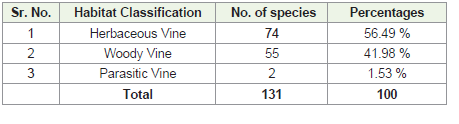
Climbing plants in BTR were classified into three major habitat
categories: herbaceous vines, woody vines, and parasitic vines.
Herbaceous vines were the most abundant, accounting for 74
species (56.49%), followed by woody vines with 55 species (41.98%).
Parasitic vines were the least represented, with only 2 species (1.53%)
[Table 2]. The high prevalence of herbaceous climbers suggests their
adaptability to the reserve’s semi-deciduous forest ecosystem, where
rapid growth and flexibility provide a competitive advantage in lightlimited
understories.Climbing Mechanisms and Adaptations::
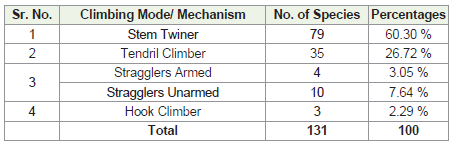
The climbing mechanisms of the recorded species were
categorized into five groups: stem twiners, tendril climbers, stragglers
(armed and unarmed), and hook climbers. Stem twiners were the
most common, comprising 79 species (60.30%), followed by tendril
climbers with 35 species (26.72%). Stragglers (armed and unarmed)
accounted for 14 species (10.69%), while hook climbers were the
least frequent, with only 3 species (2.29%) [Table 3]. The dominance
of stem twiners indicates their evolutionary success in utilizing
surrounding vegetation for support, whereas tendril climbers
demonstrate specialized morphological adaptations for anchorage.Discussion
Taxonomic Richness and Floristic Composition::
The floristic assessment revealed that Bor Tiger Reserve harbors
a significant diversity of climbing angiosperms, with dicotyledons
overwhelmingly dominating the climber community. This trend is
consistent with studies from other tropical and subtropical forests,
where dicots exhibit greater species richness due to their diverse
growth forms and reproductive strategies (Gentry, 1991) [16]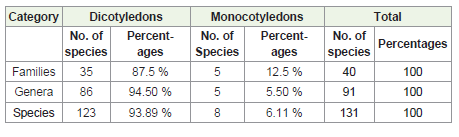
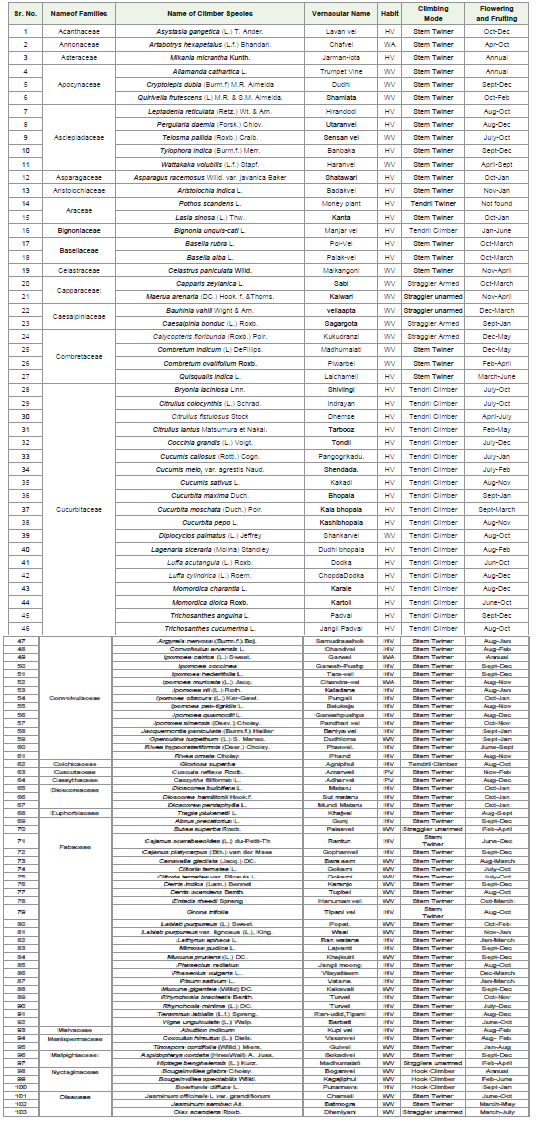
[32]. Families such as Fabaceae (24 spp.), Cucurbitaceae (19 spp.)
and Convolvulaceae (15 spp.) were particularly well-represented,
likely due to their tendril-bearing and twining adaptations. In
contrast, monocot climbers, primarily represented by species from
Asparagaceae, Bigniniaceae, Colchicaceae and Dioscoreaceae, were
scarce, possibly due to their reliance on speci
c host plants and
limited dispersal mechanisms.
Ecological Preferences and Habitat Specialization:
The high abundance of herbaceous vines (56.49%) suggests
their ecological success in disturbed and edge habitats, where rapid
growth and vegetative reproduction facilitate colonization. Woody
vines (41.98%), though less numerous, play a crucial role in forest
dynamics by competing with trees for light and nutrients (Schnitzer
& Bongers, 2002) [1]. The scarcity of parasitic vines (1.53%) indicates
limited host specificity and potential constraints imposed by the
reserve’s vegetation structure.Climbing Mechanisms and Evolutionary Adaptations:
The prevalence of stem twiners (60.30%) underscores their
efficiency in utilizing surrounding vegetation for mechanical support.
Tendril climbers (26.72%) demonstrate specialized adaptations,
with modified leaves or stems enhancing their climbing efficiency.
Stragglers (10.69%), both armed and unarmed, rely on thorns or
sprawling growth to scramble over vegetation, while hook climbers
(2.29%) employ specialized structures for anchorage. These
mechanisms reflect evolutionary trade-offs between energy allocation
and climbing efficiency (Isnard & Silk, 2009).Conservation Implications:
Given the ecological roles of climbers—such as providing food
resources for fauna, facilitating forest regeneration, and contributing
to carbon sequestration—their conservation within BTR is vital.
However, habitat fragmentation and anthropogenic disturbances may
threaten certain climber species, particularly those with specialized
habitat requirements. Long-term monitoring and habitat restoration
initiatives are recommended to sustain climber diversity.Conclusion
The present study provides the first comprehensive assessment of
climbing angiosperms in Bor Tiger Reserve, documenting 131 species
with distinct taxonomic, ecological, and adaptive characteristics. The
dominance of dicotyledons, herbaceous vines, and stem twiners
highlights the evolutionary and ecological success of these groups
in the reserve’s semi-deciduous forests. The findings contribute to
the broader understanding of climber ecology in Central India and
underscore the need for targeted conservation strategies. Future
research should focus on climber-host interactions, phenological
patterns, and the impacts of climate change on climber diversity. By
integrating climber conservation into forest management plans, Bor
Tiger Reserve can enhance biodiversity conservation and ecosystem
resilience.
Acknowledgment
Authors are thankful to Government of Maharashtra, Forest
Department for support and giving opportunity for this research
work. Special thankful to Shri. Srinivasa Rao, IFS, PCCF (Wildlife),
Maharashtra State. Also thankful to Ms. Sonal Mate, DFO o/o
Conservator of Forests and Field Director, Pench Tiger Reserve,
Nagpur, Shri. Mangesh Thengadi, Divisional Forest Officer, Wildlife
Division, BTR, and Staff of Bor Tiger Reserve.
References
12. Singh NP, KarthikeyanS(2001) Flora of Maharashtra State, 1 & 2, Botanical Survey of India;Calcutta.
16. Gentry AH (1992) The distribution and evolution of climbing plants. Biology of Vines 1992: 3-50.
20. Graham RJD (1911) List of wild plants found on the Nagpur and Telankhedi Farms. Govt. Press.Nagpur.
Citation
Chandewar NG, Noukarkar A, Sreelakshmi A. Floristic Assessment and Ecological Distribution of Climbing Angiosperms in Bor Tiger Reserve, Maharashtra State, Central India. J Plant Sci Res. 2025;12(2): 287