


Research Article
Morphological Variations in Marsilea Species across Aquatic and Terrestrial Habitats of Kota District, Rajasthan, India
Noopur Soni* and Pratima Shrivastava
Department of Botany, Government College, Kota, Rajasthan, India.
*Corresponding author:Noopur Soni, Department of Botany, Government College, Kota, Rajasthan, India. Email Id: noopur9943@gmail.com
Copyright: © Soni N, et al. 2025. This is an open access article distributed under the Creative Commons Attribution License, which permits unrestricted use, distribution, and reproduction in any medium, provided the original work is properly cited.
Article Information:Submission: 26/05/2025; Accepted: 24/06/2025; Published: 28/06/2025
Abstract
The genus Marsilea comprises amphibious ferns known for their remarkable adaptability to varied aquatic and semi-aquatic habitats. Numerous species of Marsilea exhibit morphological changes depending on their habitat or geographic location. This study investigates morphological and ecological variation
across eight natural populations of Marsilea from distinct habitat types within Kota District, Rajasthan, India. Extensive field surveys were conducted across diverse habitats, including wetlands, canal systems, agricultural fields, and temporary water bodies, during different seasons. A total of 80 specimens,
comprising aquatic, semi-aquatic, and terrestrial forms, were assessed for key morphological traits, including leaflet length and width, petiole length, sporocarp
characteristics, and growth patterns. Environmental parameters, including soil type, water availability, and anthropogenic pressures, were also recorded to understand habitat influences. The findings reveal significant intra and interspecific variations in response to local ecological conditions, highlighting the
phenotypic plasticity of Marsilea populations. Additionally, the study underscores the role of habitat disturbance and climatic factors in shaping the distribution and vitality of these species. The results contribute valuable insights into the adaptive strategies of Marsilea spp., and they show that Marsilea minuta is more ecologically versatile and stress-tolerant, making it more adaptable to different environmental conditions than Marsilea cf. coromandelina in the semi-arid landscape of Kota district, and provide a baseline for future conservation and ecological studies.
Keywords:Marsilea; Comparative Analysis; Morphological Variation; Habitat Ecology; Kota District; Rajasthan; Phenotypic Plasticity
Introduction
The genus Marsilea, commonly known as water clovers or
pepperworts, comprises small aquatic ferns belonging to the family
Marsileaceae [1]. In India, several species of Marsilea are distributed
across diverse habitats, with notable occurrences in the Kota District
of the Hadoti Plateau, southeastern Rajasthan. Among these,
Marsilea minuta, a cosmopolitan species, is frequently observed
thriving in ditches and ponds throughout the year in the Kota
region, whereas Marsilea cf. coromandelina has been recorded only
during the monsoon season near Borabas village, growing in limited
terrestrial habitats [2]. Notably, the genus is well recognized for its
high degree of phenotypic plasticity, which enables individuals to
modify their morphology in response to varying environmental
conditions [3]. This characteristic is particularly significant in the
Kota region, which experiences pronounced wet-dry seasonal
cycles and supports a mosaic of aquatic, amphibious, and terrestrial
microhabitats. Furthermore, previous studies have indicated that
the genetic diversity of Marsilea plays a crucial role in promoting
these plastic traits, thereby enhancing the species’ ability to adapt
across heterogeneous environments [4]. Therefore, investigating the
morphological variation of Marsilea species across such contrasting
habitats provides valuable insight into their habitat-specific
adaptations. In addition, the seasonal wetlands in this region harbour
ecologically sensitive and endemic flora, which are increasingly
under threat due to anthropogenic land-use changes. Importantly,
compared to aquatic environments, terrestrial habitats generally
expose plants to more fluctuating environmental factors, further
influencing morphological differentiation [5]. In this context, Baruah
and Sarma have emphasized the significance of morpho-ecological
variation and phenotypic plasticity in Marsilea, particularly in regions
experiencing ecological disturbances or anthropogenic pressures
(IUCN, 2022) [6,7]. Consequently, the Hadoti Plateau especially the
Kota District emerges as an ideal landscape to study these dynamics,
given its diverse aquatic and terrestrial systems, including permanent
ponds, riverbanks, seasonal wetlands, and dry agricultural patches.
Nevertheless, despite its ecological richness, this region remains
understudied in terms of pteridophyte diversity and morphological
adaptation. This is especially true for genera like Marsilea, which are
highly responsive to subtle microenvironmental variables such as
soil moisture, water depth, and human disturbance [8]. Hence, the
present study focuses on easily quantifiable morphological traits such
as leaflet length and width, petiole length, and sporocarp size in order
to assess environmental influences on morphological differentiation.
Ultimately, this research contributes not only to a better understanding
of ecological adaptation and phenotypic plasticity in Marsilea but
also to the growing need for region-specific baseline data that can
inform both taxonomic resolution and conservation planning amid
on-going habitat degradation and climate variability.
Materials and Methods
Study Area and Sampling Sites:
The study was conducted in Kota District, Rajasthan (23°45′–
25°53′ N, 75°09′–77°26′ E), located on the Hadoti plateau, Rajasthan
in the Chambal River basin. Based on preliminary surveys, eight
representative populations of Marsilea were selected from distinct
habitat types (Table no.1). The dominant species at each site was
identified: M. minutain the aquatic, Marsilea minuta hybrid in
amphibiotic sites, and M. cf. coromandelina in the purely terrestrial
site. Each site was geo-referenced using GPS, and dominant habitat
features were recorded.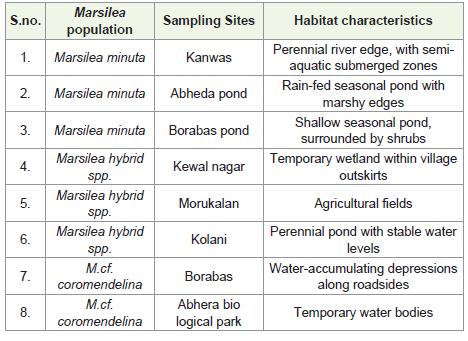
Sampling and Identifications: A total of 10 individuals were
sampled per site (n = 80 in total). Plants were collected during the
active growing season and analysed fresh for morphological traits.
Parameters recorded included leaflet length and width, petiole length,
number of sporocarps per plant, sporocarp shape, and size. Standard
botanical keys, Flora of Rajasthan – Vol 1 and 2 and regional floras
(Khullar, 1994; Chandra, 2000;Fraser-Jenkins, C. R. (2008) were used
for preliminary identification.
Morphological measurements:Morphological analysis was
conducted to evaluate species-specific and habitat-induced variations
among Marsilea populations collected from aquatic, amphibious, and
terrestrial habitats in Kota District, Rajasthan. In the laboratory, each
specimen was carefully washed and assessed for the following key
morphological traits:
• Leaflet length (cm): Measured from the base to the tip of the leaflet using a digital Vernier calliper.
• Petiole length (cm): Distance from the rhizome node to the base of the first leaflet.
• Sporocarp size (length × breadth in cm): Measured using a calliper, focusing on mature sporocarps only.
• Sporocarp shape and surface features: Observed under a stereomicroscope for ribbing, hairiness, and structural characteristics.
• Number and position of sporocarps: The number and Position of sporocarps were visually recorded, with the petiole’s orientation and attachment points noted (horn).
morphological traits:
• Leaflet length (cm): Measured from the base to the tip of the leaflet using a digital Vernier calliper.
• Petiole length (cm): Distance from the rhizome node to the base of the first leaflet.
• Sporocarp size (length × breadth in cm): Measured using a calliper, focusing on mature sporocarps only.
• Sporocarp shape and surface features: Observed under a stereomicroscope for ribbing, hairiness, and structural characteristics.
• Number and position of sporocarps: The number and Position of sporocarps were visually recorded, with the petiole’s orientation and attachment points noted (horn).
The traits were chosen based on their ecological relevance and
established use in previous Marsilea studies (Mangestuti et al., 2017;
Sharma &Bhardwaja, 2019). [2,9]
Identification of Hybrids:The leaf of hybrid Marsilea is a
compound, heteromorphic structure with four leaflets arranged
in a clover-like pattern, exhibiting intermediate size, texture, and
venation between M. minuta and M. cf. coromandelina, and often
marked by variability in petiole length, leaflet symmetry, marginal
curvature and sporocarps arrangements. This key is based solely on
morphological observations, and further anatomical or molecular
analysis is recommended to validate hybrid status.
Statistical analysis: Mean trait values were compared across
habitat groups. One-way ANOVA tests (α = 0.05) assessed whether
leaflet length, petiole length, or sporocarp size differed significantly
among the three habitat categories (aquatic, amphibious, terrestrial).
Descriptive statistics (mean ± standard deviation) were tabulated,
and a bar chart was prepared to illustrate leaflet length differences.[4]
All measurements were conducted using standard protocols for
aquatic Pteridophytes (Khullar, 2000; Pérez-Harguindeguy et al.,
2013) [13,15].
Results
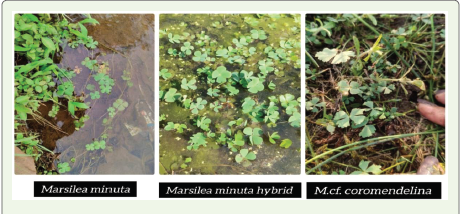
A comparative analysis was conducted on Marsilea taxa,
including Marsilea minuta, M. cf. coromendelina and Marsilea minuta
hybrid, from 8 distinct habitats in the Kota region (Kanwas, Abheda
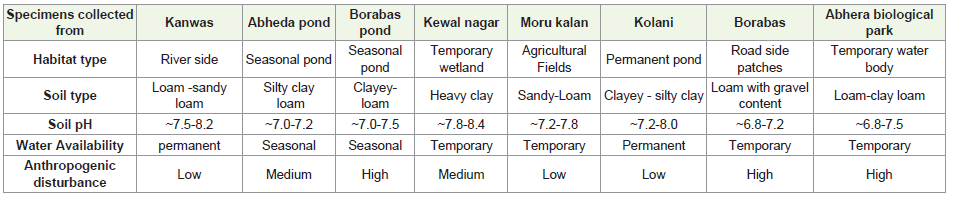
pond, Borabas pond, Kewal Nagar, Moru Kalan, Kolani, Borabas and
Abhera Biological Park).
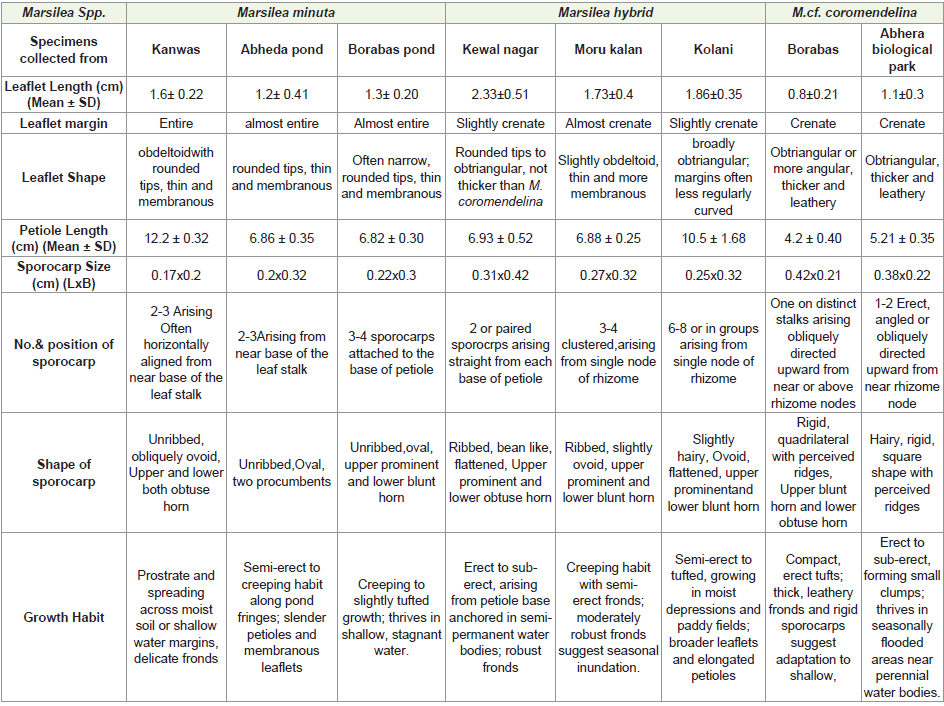
Morphological Assessment: Key morphological characters such as leaflet size, leaflet shape and margin, petiole length, sporocarp size, number and position of sporocarps, and sporocarp shape showed significant interspecific and intraspecific variation:
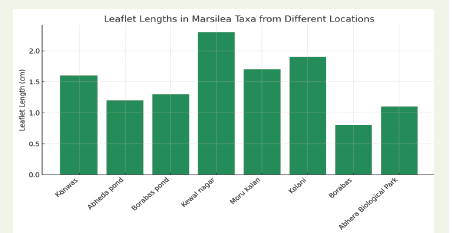
Leaflet length ranged from 0.8 ± 0.21 cm in Marsilea sp. from Borabas to 2.33 ± 0.51 cm from Kewal Nagar. Margins varied from entire (M. minuta) to crenate (Borabas and Abhera samples). Leaflet
Morphological Assessment: Key morphological characters such as leaflet size, leaflet shape and margin, petiole length, sporocarp size, number and position of sporocarps, and sporocarp shape showed significant interspecific and intraspecific variation:
Leaflet length ranged from 0.8 ± 0.21 cm in Marsilea sp. from Borabas to 2.33 ± 0.51 cm from Kewal Nagar. Margins varied from entire (M. minuta) to crenate (Borabas and Abhera samples). Leaflet
shape ranged from obdeltoid and membranous (M. minuta) to rigid,
leathery obtriangular forms (M. cf. coromendelina). It was observed
that leaflet of Marsilea minuta hybrid spp. is larger than M. minuta
and M. cf. coromendelina due to amphibious characteristics, more
water availability and Heavy clay type of soil is favourable for Broad
leaves of Marsilea spp.
Petiole length showed considerable variation, with the longest
observed in M. minuta from kanwas (12.2 ± 0.32 cm) and the shortest
in Marsilea cf. coromendelina from Borabas (4.2 ± 0.40 cm), indicating
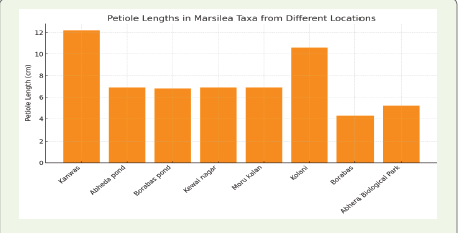
different growth strategies and ecological adaptations. It was observed
that Permanent water availability, low anthropogenic disturbance
and Loam to sandy loam soil also called alluvial soil is favourable for
Marsilea petiole length.
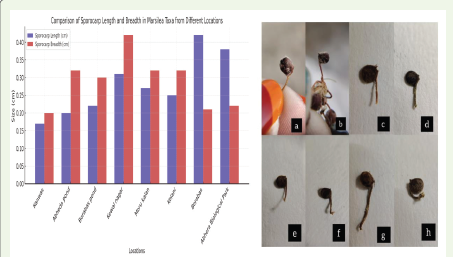
Sporocarp size ranged from 0.17 x 0.2 cm (M. minuta) to 0.42 x
0.21 cm (Marsilea sp. from Borabas). Marsilea hybrid spp. displayed
ribbed, bean-like sporocarps, while the Borabas and Abhera samples
had rigid, quadrilateral or square sporocarps with distinct ridges and
hairs. The number and positioning of sporocarps also varied, with M.
hybrid bearing 3–4 attached at the petiole base and the Kolani form
producing clusters of 6–8 per node.
Discussion
The results clearly demonstrate pronounced morphological
variation in Marsilea across different habitat types, reflecting the
genus’s inherent phenotypic plasticity. Specifically, aquatic and
amphibious individuals exhibited significantly larger leaflets and
longer petioles compared to their terrestrial counterparts. This
enlargement of leaf structures in semi-aquatic conditions may serve
to maximize photosynthetic capacity under higher light availability
and simultaneously reduce the impact of anthropogenic disturbances.
In contrast, the relatively smaller leaf form observed in submerged
conditions might be an adaptive strategy to minimize water drag.
These external morphological traits are consistent with the findings
of Sharma et al. (2019), who reported that Marsilea specimens from
flooded environments developed extensive aerenchyma and thinner
stele, while those growing on land possessed denser internal tissues
[2]. Although internal anatomy was not examined in the present study,
the distinct external features likely result from similar physiological
responses to varying hydric regimes.
Moreover, the relative stability in sporocarp size across habitats
suggests that reproductive organs may exhibit lower plasticity than
vegetative parts. In line with previous observations of M. minuta, all
studied populations consistently produced small, mature sporocarps.
This uniformity implies that reproductive development in Marsilea
may be governed by a conserved genetic program, relatively
unaffected by environmental variability. However, it is important to
note that sporocarp viability and production rates factors that could
also be influenced by habitat quality were not assessed in this study.
Therefore, future research should address these parameters to gain
deeper insight into the reproductive ecology of the genus.
These findings resonate with other studies on Marsilea. For
instance, Mangestuti et al. (2017) [9] demonstrated that M. crenata
individuals cultivated in soil differed markedly in leaflet thickness
and stomatal density from those grown in water, highlighting
habitat-driven morphological differentiation. Similarly, anatomical
investigations conducted in Kota by Sharma et al. (2019) supported
population-level variation correlated with habitat history.
Broadening the scope, similar trends have been documented
across fern taxa. For example, Farrar (1974) [10] observed that ferns
from open, drier habitats produced thicker fronds compared to those
adapted to shaded, humid environments, illustrating phenotypic
modulation of gametophytes in response to ecological pressures. Such
parallels underscore that Marsilea, like other ferns, possesses a high
degree of plasticity, enabling it to adjust morphologically to variations
in light and moisture availability. Additionally, these observations
are congruent with earlier reports by Smith et al. (2006) and Khullar
(1994) [12,13], which emphasize the moisture-responsive plasticity
in Marsilea morphology.
Furthermore, similar patterns of morphological flexibility
have been noted by Khullar (1994) and Chandra (2000) [14], who
documented extensive trait variability among Indian pteridophytes.
The present study builds upon these findings by further confirming
the role of habitat heterogeneity in shaping phenotypic expression.
For example, wetlands such as Kewal Nagar and permanent ponds like
Kolani supported robust individuals with larger leaflets and longer
petioles. These habitats likely provide stable moisture availability,
higher organic content, and microclimatic consistency conducive to
optimal growth. In contrast, Marsilea populations inhabiting more
ephemeral or disturbed environments such as Borabas roadside and
Abhera Biological Park tended to exhibit stunted growth or greater
morphological variability, likely resulting from stress-induced
adaptations or developmental limitations.
Interestingly, transitional zones and anthropogenically impacted
habitats harbored individuals exhibiting intermediate morphological
traits that bridged characteristics of M. minuta and other closely
related species. This phenomenon may suggest ongoing hybridization,
introgression, or ecotypic divergence. Notably, this hypothesis finds
support in the broader literature, including studies by Walker (1961)
and Schneider et al. (2004) [18,19], which discuss the evolutionary
implications of such intermediate forms in fern taxa. These patterns
may reflect ongoing speciation events or rapid evolutionary responses
to complex and fluctuating environmental conditions.
Looking ahead, future investigations should incorporate
quantitative measurements of environmental variables such as
water depth, soil moisture, and organic content to strengthen
the ecological interpretation of the observed trends. Preliminary
observations already indicate that aquatic sites maintained standing
water throughout the year, while terrestrial sites underwent complete
desiccation during summer months. Therefore, it is reasonable
to infer that the observed morphological variations arise not only
from plastic responses but also potentially from local adaptations to
differing moisture regimes.
Conclusion
This study provides comprehensive evidence of significant
morphological variability among Marsilea species across distinct
aquatic, amphibious, and terrestrial habitats in Kota District,
Rajasthan. The observed differences in key vegetative and reproductive
traits, Marsilea minuta was commonly found in permanent aquatic
environments and exhibited delicate, membranous fronds with
longer petioles, reflecting adaptation to submerged conditions.
In contrast, M. cf. coromandelina, primarily found in terrestrial or
seasonally dry habitats, showed thicker, leathery leaflets and compact
growth forms, indicating adaptations to water stress and fluctuating
soil moisture. Notably, hybrid populations displayed intermediate
morphological traits, suggesting possible natural hybridization events
and highlighting the genus’s phenotypic plasticity. Environmental
factors such as soil type, water availability, and anthropogenic
disturbances played a critical role in shaping the observed
morphological differences. The study reveals that permanent water
bodies with loamy soils promote larger vegetative structures, while
temporary and disturbed sites lead to more compact growth forms
and altered sporocarp features.
These findings underscore the adaptive strategies of Marsilea
species in response to ecological gradients and highlight the need for
further integrative taxonomic work, including molecular analyses,
to clarify species boundaries and evolutionary relationships.
Conservation attention is also warranted for morphologically distinct
or potentially endemic populations, particularly those in ecologically
vulnerable areas like Borabas, Kolani, and Abhera Biological Park, where
habitat degradation poses a risk to genetic and ecological diversity.
The study suggests additional molecular and physiological research to
help clarify taxonomic ambiguities, evaluate adaptive responses, and
inform successful biodiversity management strategies for the genus
Marsilea in the Hadoti region and beyond. This will help advance
species delimitation and conservation planning.
Acknowledgments
We thank the Department of Botany at the Government College,
Kota for research support and access to laboratory facilities. We
are grateful to our research supervisor Prof.Pratima Shrivastava,
Principal, Govt. College, Kota for guidance, field assistants and for
help in data collection and would like to Thank Dr. Nilima Bhardwaj
madam for her support and guidance in this work.
References
Citation
Soni N, Shrivastava P. Morphological Variations in Marsilea Species across Aquatic and Terrestrial Habitats of Kota District, Rajasthan, India. J Plant Sci Res. 2025;12(2): 282