


Research Article
Storage Stability and Quality Assessment of Red Banana (Musa acuminata) Complementary Powder Using Microbial, Antioxidant, and Organoleptic Parameters
Pattanashetti S1* and Meti R2
Department of Food Processing and Nutrition, Karnataka State Akkamahadevi Women’s University, Vijayapura, Karnataka, India.
*Corresponding author:Shweta Pattanashetti, Department of Food Processing and Nutrition, Karnataka State Akkamahadevi Women’s University, Vijayapura, Karnataka, India. E- mail Id: svpattanashetti1997@gmail.com
Article Information:Submission: 10/06/2026; Accepted: 14/07/2026; Published: 16/07/2026
Copyright: © 2026 Pattanashetti S, et al. This is an open access article distributed under the Creative Commons Attribution License, which permits unrestricted use, distribution, and reproduction in any medium, provided the original work is properly cited.
Abstract
Complementary feeding plays a crucial role in meeting the nutritional requirements of infants after six months of age. The present study aimed to develop and evaluate a value-added Red Banana (Musa acuminata) complementary powder and assess its storage stability, antioxidant activity, microbiological quality, and organoleptic acceptability. The complementary powder was formulated using finger millet (16%), rice (24%), soybean (8%), pigeon pea (8%), green gram (8%), Bengal gram (8%), cashew nut (4%), almond (4%), and red banana powder (20%). The ingredients were processed, blended, and packaged in foodgrade laminated polyethene pouches under hygienic conditions.
Storage studies were conducted under room temperature for 60 days, and samples were analysed at 0, 30, and 60 days for Total Colony Count (TCC), Fungal/Mould count, DPPH antioxidant activity, and sensory attributes. Organoleptic evaluation was carried out using a 9-point hedonic scale by a panel of 30–40 semi-trained and trained members.
Results indicated that the Total Colony Count increased marginally from 0.06 × 10⁻⁴ CFU/g at day 0 to 0.16 × 10⁻⁴ CFU/g at day 60, while Fungal/mould growth was not detected at 0 and 30 days and remained extremely low (0.02 × 10⁻⁴ CFU/g) at 60 days, demonstrating good microbial stability during storage. Antioxidant activity showed a slight decline from 47.62% to 45.03% DPPH inhibition during the storage period. Statistical analysis revealed that these changes were non-significant (p > 0.05). Organoleptic evaluation demonstrated good consumer acceptability, with overall acceptability scores ranging from 7.52 to 7.87 throughout storage. No significant differences were observed in appearance, colour, flavour, texture, taste, or overall acceptability during the study period.
The findings suggest that Red Dacca Banana Complementary Powder is a nutritionally enriched, microbiologically safe, antioxidant-rich, and consumer acceptable complementary food with satisfactory storage stability for up to 60 days under room temperature.
Storage studies were conducted under room temperature for 60 days, and samples were analysed at 0, 30, and 60 days for Total Colony Count (TCC), Fungal/Mould count, DPPH antioxidant activity, and sensory attributes. Organoleptic evaluation was carried out using a 9-point hedonic scale by a panel of 30–40 semi-trained and trained members.
Results indicated that the Total Colony Count increased marginally from 0.06 × 10⁻⁴ CFU/g at day 0 to 0.16 × 10⁻⁴ CFU/g at day 60, while Fungal/mould growth was not detected at 0 and 30 days and remained extremely low (0.02 × 10⁻⁴ CFU/g) at 60 days, demonstrating good microbial stability during storage. Antioxidant activity showed a slight decline from 47.62% to 45.03% DPPH inhibition during the storage period. Statistical analysis revealed that these changes were non-significant (p > 0.05). Organoleptic evaluation demonstrated good consumer acceptability, with overall acceptability scores ranging from 7.52 to 7.87 throughout storage. No significant differences were observed in appearance, colour, flavour, texture, taste, or overall acceptability during the study period.
The findings suggest that Red Dacca Banana Complementary Powder is a nutritionally enriched, microbiologically safe, antioxidant-rich, and consumer acceptable complementary food with satisfactory storage stability for up to 60 days under room temperature.
Keywords:Red Dacca banana; Musa acuminata; complementary food; storage stability; antioxidant activity; organoleptic evaluation; infant nutrition.
Abbreviations
RBCP – Red Banana Complementary Powder; TCC – Total
Colony Count; CFU/g – Colony Forming Units per Gram; DPPH –
2,2-Diphenyl-1-picrylhydrazyl; PDA – Potato Dextrose Agar; PCA
– Plate Count Agar; SEM – Standard Error of Mean; CD – Critical
Difference; CV – Coefficient of Variation; ANOVA – Analysis of
Variance; NS – Non-Significant; GI – Geographical Indication;
FAO – Food and Agriculture Organisation; WHO – World Health
Organisation; UNICEF – United Nations Children’s Fund; FSSAI –
Food Safety and Standards Authority of India
Novelty of the Study
The novelty of this study lies in the development of a
complementary powder incorporating GI-tagged Kamalapura Red
Dacca Banana (Musa acuminata), which has not previously been
reported in complementary food formulations. Unlike conventional
complementary foods developed primarily from cereals and legumes,
the present formulation utilizes Kamalapura Red Dacca Banana
powder as a functional ingredient, thereby enhancing the nutritional
and antioxidant profile of the product. Previous studies have reported
that Red Dacca banana is rich in bioactive compounds, minerals, and
antioxidant constituents (Amarasinghe et al., 2021; Tuárez-García
et al., 2023; Avci et al., 2026). In the present study, Kamalapura Red
Dacca Banana powder was characterized by high concentrations of
potassium (1119.52 mg/100 g), magnesium (113.25 mg/100 g), zinc
(7.22 mg/100 g), calcium (5.30 mg/100 g), manganese (1.25 mg/100
g), and iron (0.74 mg/100 g), together with significant antioxidant
potential. These nutrients are essential for infant growth, bone
mineralization, cognitive development, immune function, and
overall physiological development. Therefore, the incorporation of
this GI-tagged indigenous banana cultivar not only improves the
nutritional and functional quality of the complementary powder but
also promotes the value addition and utilization of a region-specific
banana variety in infant nutrition.
Introduction
The complementary feeding period, which begins at six months
of age, is a critical stage in infant growth and development. It is
also the period during which malnutrition commonly begins in
many children, contributing significantly to the high prevalence of
undernutrition among children under five years of age worldwide.
Poor infant feeding practices, inadequate nutrient intake, and the lack
of suitable complementary foods are major factors responsible for
childhood malnutrition, particularly in developing countries where
poverty further aggravates the problem [1]. Infants aged 6–24 months
are considered nutritionally vulnerable because of their high energy
and nutrient requirements, which are often not adequately met by
traditional complementary foods. This vulnerable period is further
challenged by repeated infections, poor infant and young child
feeding practices, and the consumption of complementary foods with
low nutrient density [2]
Recognising the importance of appropriate complementary
feeding, the Food and Agriculture Organisation (FAO), World
Health Organisation (WHO), and United Nations Children’s
Fund (UNICEF) have emphasised the development and utilisation
of complementary foods based on locally available ingredients.
Such foods should possess high nutritional value to supplement
breastfeeding, be acceptable to consumers, affordable, and easy to
prepare at the household level [3,4,5]. The involvement of mothers in
the formulation and acceptability evaluation of complementary foods
has also been shown to improve nutrition knowledge and encourage
positive dietary practices for young children [6].
Cereals, pulses, and nuts are commonly incorporated into
complementary food formulations because they provide essential
macronutrients and micronutrients required for infant growth.
Finger millet (Eleusine coracana) is an excellent source of calcium and
dietary fibre, while soybean (Glycine max) contributes high-quality
protein and essential amino acids. Pulses such as pigeon pea, green
gram, and Bengal gram enhance the protein, mineral, and bioactive
compound content of complementary foods. Similarly, nuts such
as cashew and almond improve the energy density and nutritional
quality of infant food formulations [7].
Banana (Musa acuminata) is one of the most widely consumed
fruits in tropical regions and is valued for its nutritional and
functional properties. Among its cultivars, the GI-tagged Kamalapura
Red Banana (Red Dacca) is particularly noteworthy due to its rich
content of potassium, calcium, dietary fibre, carotenoids, vitamins,
phenolic compounds, and natural antioxidants. These nutrients play
an important role in supporting healthy growth, bone development,
immune function, and overall well-being in infants and young
children [8]. In addition, red banana possesses natural sweetness and
desirable sensory characteristics that can enhance the acceptability of
complementary foods. When combined with protein-rich ingredients
such as cereals, pulses, and nuts, red banana can contribute to the
development of a nutritionally balanced complementary food capable
of meeting the dietary needs of growing children.
Processing red banana into powder form facilitates its
incorporation into complementary food formulations, improves
convenience, reduces preparation time for mothers, and enhances
storage stability. However, the quality and safety of such products
during storage must be carefully evaluated. Changes in microbial
load, including total colony count (TCC) and Fungal/Mould growth,
as well as reductions in antioxidant activity, may affect product
quality and consumer acceptance over time. Therefore, assessment of
storage stability under ordinary household conditions is essential to
determine the shelf life and suitability of the product for regular use.
The present study was undertaken to develop a value-added red banana complementary powder using GI-tagged Kamalapura Red Banana along with nutrient-rich cereal, pulse, and nut ingredients. The study focused on evaluating the organoleptic properties of the developed complementary food, including appearance, colour, flavour, texture, taste, and overall acceptability, for children above six months to five years of age. In addition, the storage stability of the red banana complementary powder was assessed at room temperature under household conditions through microbiological analysis, including total colony count and Fungal/Mould count, as well as determination of DPPH antioxidant activity, to identify a storage period that maintains product quality, safety, nutritional value, and consumer acceptability.
The present study was undertaken to develop a value-added red banana complementary powder using GI-tagged Kamalapura Red Banana along with nutrient-rich cereal, pulse, and nut ingredients. The study focused on evaluating the organoleptic properties of the developed complementary food, including appearance, colour, flavour, texture, taste, and overall acceptability, for children above six months to five years of age. In addition, the storage stability of the red banana complementary powder was assessed at room temperature under household conditions through microbiological analysis, including total colony count and Fungal/Mould count, as well as determination of DPPH antioxidant activity, to identify a storage period that maintains product quality, safety, nutritional value, and consumer acceptability.
Materials and Methods
Sample preparation and packaging:
The complementary powder was formulated using finger millet
(16%), rice (24%), soybean (8%), pigeon pea (8%), green gram (8%),
Bengal gram (8%), cashew nut (4%), and almond (4%) [Table 1]. The
ingredients were cleaned thoroughly to remove extraneous matter
and impurities. Finger millet, rice, soybean, pigeon pea, green gram,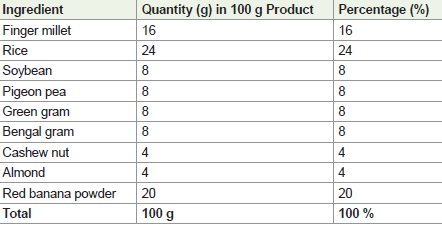
digestibility, and reduce moisture content. Cashew nuts and almonds
were lightly roasted to develop desirable sensory characteristics.
The roasted ingredients were ground individually into fine flour and sieved through a fine mesh sieve to obtain a uniform particle size. The flours were then blended according to the formulation to prepare the complementary powder (80 g). Red banana powder (20 g), prepared from ripe Red Dacca banana (Musa acuminata) fruits by washing, peeling, slicing, dehydration, and pulverisation, was incorporated into the complementary powder to obtain a final product weight of 100 g. The mixture was thoroughly homogenised to ensure uniform distribution of all ingredients.
The roasted ingredients were ground individually into fine flour and sieved through a fine mesh sieve to obtain a uniform particle size. The flours were then blended according to the formulation to prepare the complementary powder (80 g). Red banana powder (20 g), prepared from ripe Red Dacca banana (Musa acuminata) fruits by washing, peeling, slicing, dehydration, and pulverisation, was incorporated into the complementary powder to obtain a final product weight of 100 g. The mixture was thoroughly homogenised to ensure uniform distribution of all ingredients.
Packaging:
The prepared red banana complementary powder was packed in
food-grade laminated polyethene pouches and heat-sealed to prevent
moisture absorption and microbial contamination. The packaged
samples were labelled and stored at room temperature for subsequent
storage studies, microbial analysis, antioxidant evaluation, and
organoleptic assessment. All processing and packaging operations
were carried out under hygienic laboratory conditions to maintain
product quality and safety throughout the study.Storage Study of Red Banana Complementary Powder:
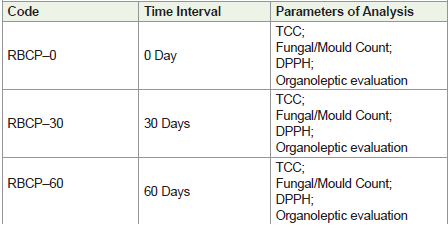
The developed red banana complementary powder was packed in a
polythene cover for storage studies. The packages were coded as RBCP-
0, RBCP-30 and RBCP-60 [Table 2]. The developed complementary
powder was packaged in airtight, food-grade, laminated polyethene
pouches and stored at ambient room temperature (27 ± 2°C).The packaged samples were evaluated at regular intervals of 0, 30, and 60 days to assess their storage stability and quality characteristics. At each storage interval, the samples were analysed for microbiological quality, antioxidant activity, and sensory attributes. Microbiological analyses included Total Colony Count (TCC) and Fungal/Mould Count. Antioxidant activity was determined using the DPPH radical scavenging assay. Sensory quality was assessed through organoleptic evaluation based on appearance, colour, flavour, texture, taste, and overall acceptability [Figure 1].
The analysis of the storage study of Red Banana Complementary Powder was carried out at the Bio Chem Research and Testing Laboratory, Vijaypuri Colony, Tarnaka, Hyderabad – 500017, Telangana. The laboratory operates under the incubation support of KRISHIK-ABI (ICAR RKVY-RAFTAAR), University of Agricultural Sciences, Dharwad.
Total Colony Count (TCC):
Total Colony Count (TCC) was determined using the pour plate
technique as described by FSSAI (2016). Serial dilutions of the sample
were prepared in sterile diluent, and 1 mL aliquots were plated in
duplicate using Plate Count Agar (PCA). The plates were incubated
at 35 ± 2°C for 48 h, after which visible colonies were counted. Results
were expressed as colony-forming units per gram (CFU/g) of sample.
The method was employed to assess the microbiological quality and
safety of the complementary powder during storage [9].Fungal/Mould Count:
Fungal and mould counts were estimated using acidified Potato
Dextrose Agar (PDA) following the procedure outlined by FSSAI
(2016). Appropriate dilutions of the sample were plated in duplicate
and incubated at 25°C for 2–5 days. Developed fungal colonies were
counted and expressed as CFU/g. The analysis was carried out to
evaluate the microbial stability of the product during storage. Results
were recorded at predetermined storage intervals [9].DPPH Radical Scavenging Activity:
The antioxidant activity of the samples was determined using
the DPPH radical scavenging assay [10]. Sample extracts prepared
in methanol were reacted with DPPH solution, and absorbance
was measured at 515 nm. Antioxidant activity was expressed as
the percentage inhibition of DPPH radicals. The assay was used to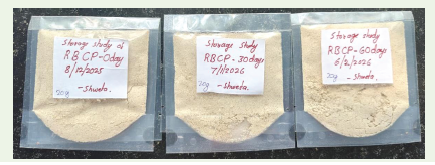

evaluate the free radical scavenging potential of the red banana
complementary powder during storage. Higher percentage inhibition
indicated greater antioxidant activity [10].
Organoleptic Evaluation:
Organoleptic evaluation of the developed complementary
powder was carried out using a 9-point hedonic scale by a panel
of 35 members comprising trained and semi-trained participants,
i.e. healthy adult volunteers including professors, lecturers, Ph.D.
scholars, and postgraduate students from the Department of Food
Processing and Nutrition, Karnataka State Akkamahadevi Women’s
University, Vijayapura. The samples were evaluated for appearance,
colour, flavour, texture, taste, and overall acceptability. Sensory
evaluation was conducted at different storage intervals to assess
consumer acceptability and monitor changes in product quality
throughout the storage period.Statistical analysis:
All experimental data were analysed using IBM SPSS Statistics
for Windows, Version 20.0 [11]. Results are expressed as mean ±
standard deviation (SD). One-way analysis of variance (ANOVA)
was performed to determine significant differences among storage
intervals. Prior to ANOVA, the assumptions of normality and
homogeneity of variances were assessed. Statistical significance was
considered at p < 0.05, and results with p > 0.05 were regarded as
non-significant [12]. Where appropriate, 95% confidence intervals
(CI) were calculated and reported to indicate the precision of the
estimated mean values.Results and Discussion
The storage stability of Red Dacca Banana Complementary
Powder (RBCP) was evaluated over a period of 60 days by assessing
microbiological quality, antioxidant activity, and organoleptic
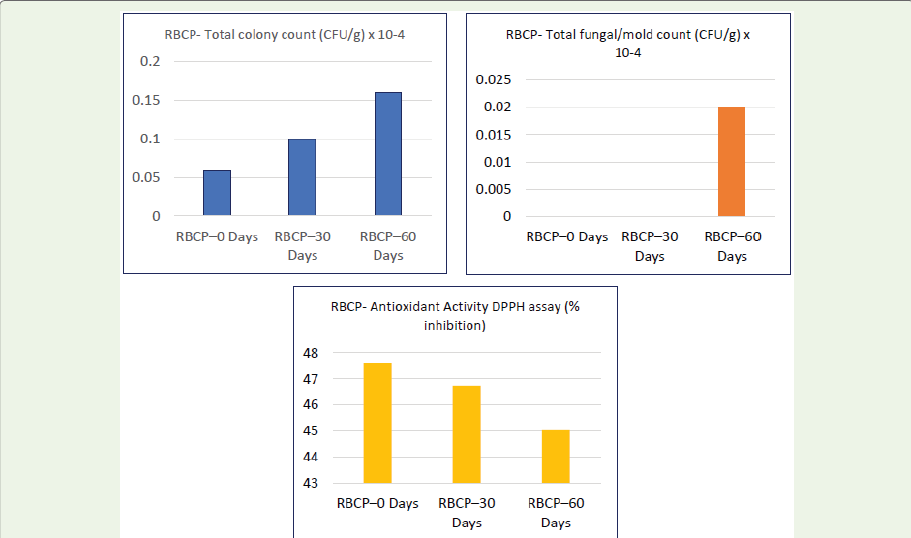
characteristics. As presented in Table 3, the total colony count
increased marginally from 0.06 × 10⁻⁴ CFU/g at day 0 to 0.16 × 10⁻⁴
CFU/g at day 60, while the fungal/mould count remained negligible,
with only 0.02 × 10⁻⁴ CFU/g detected at the end of storage. These
values are substantially lower than the microbiological limits
prescribed by the Food Safety and Standards Authority of India
(FSSAI) and the Codex Alimentarius Commission for cereal-based
complementary foods, which recommend a total plate count not
exceeding 10⁴–10⁵ CFU/g and yeast and mould counts below 10²
CFU/g, depending on the product category [17,18]. Therefore,
the developed complementary powder complied with acceptable
microbiological safety standards throughout the storage period. The
low microbial load may be attributed to the low moisture content
of the formulation, hygienic processing practices, and storage in
airtight food-grade laminated polyethylene pouches. Furthermore,
the formulation was prepared without the incorporation of chemical
preservatives or synthetic additives, demonstrating that appropriate
processing and packaging were sufficient to maintain microbiological
safety and product quality for at least 60 days. Similar findings have
been reported for banana-based and cereal–legume complementary
foods, where proper drying and suitable packaging effectively
minimized microbial growth during storage [13,14].
These findings are consistent with previous studies on banana based
complementary foods, which reported low microbial counts
during storage when products were properly dried and packaged
[14]. Similar observations have also been reported for cereal–legume
complementary foods, where reduced moisture content and suitable
packaging effectively limited microbial proliferation during storage
[13,15]. Although commercially produced complementary foods may
achieve longer shelf life through the use of approved preservatives
or advanced packaging technologies, the present study demonstrates
satisfactory storage stability under natural preservation conditions.
The antioxidant activity determined by the DPPH assay showed
only a slight reduction from 47.62% at day 0 to 45.03% at day 60,
with the differences being statistically non-significant (p > 0.05)
[Figure 2]. The retention of antioxidant activity suggests that the
bioactive compounds present in Red Dacca banana remained
relatively stable during storage. The Red Dacca banana retains
considerable antioxidant activity because of its phenolic compounds
and flavonoids, although a slight decline may occur during storage or
processing [14,16].
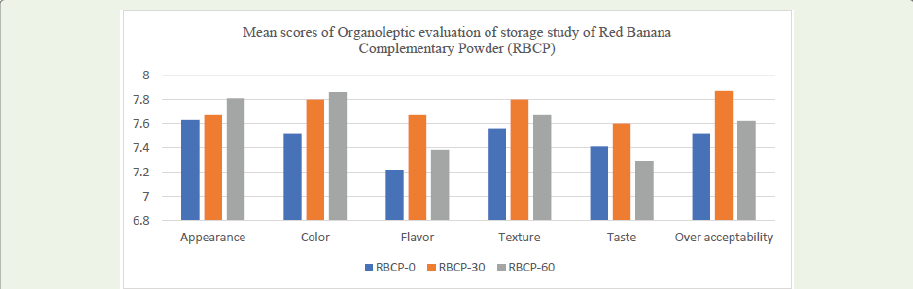
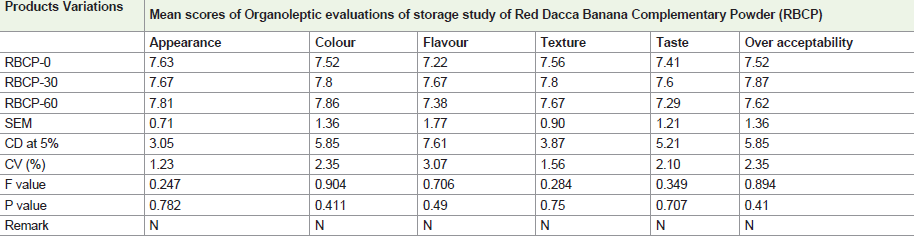
The organoleptic evaluation demonstrated that RBCP maintained good sensory quality throughout the storage period [Table 4], [Figure 3]. A slight increase in overall acceptability was observed at 30 days (7.87) compared with the initial score (7.52), followed by a marginal decrease at 60 days (7.62). However, all sensory attributes, including appearance, colour, flavour, texture, taste, and overall acceptability, showed no significant differences (p > 0.05) during storage. The stable sensory scores indicate that storage under ambient conditions did not adversely affect consumer acceptability. Similar findings have been reported for complementary foods prepared from cereal–legume blends and banana flour, where acceptable sensory quality was maintained during storage due to proper packaging and low moisture content [14,15].
Overall, the results demonstrate that the developed Red Dacca Banana Complementary Powder remained microbiologically safe, retained substantial antioxidant activity, and maintained acceptable sensory quality throughout 60 days of storage without the addition of chemical preservatives. These findings support the potential application of GI-tagged Kamalapura Red Dacca banana as a functional ingredient in naturally preserved complementary foods for infants. Nevertheless, further studies evaluating extended storage periods (90–180 days) under controlled environmental conditions and commercial packaging systems are recommended to establish the product’s long-term shelf life.
The organoleptic evaluation demonstrated that RBCP maintained good sensory quality throughout the storage period [Table 4], [Figure 3]. A slight increase in overall acceptability was observed at 30 days (7.87) compared with the initial score (7.52), followed by a marginal decrease at 60 days (7.62). However, all sensory attributes, including appearance, colour, flavour, texture, taste, and overall acceptability, showed no significant differences (p > 0.05) during storage. The stable sensory scores indicate that storage under ambient conditions did not adversely affect consumer acceptability. Similar findings have been reported for complementary foods prepared from cereal–legume blends and banana flour, where acceptable sensory quality was maintained during storage due to proper packaging and low moisture content [14,15].
Overall, the results demonstrate that the developed Red Dacca Banana Complementary Powder remained microbiologically safe, retained substantial antioxidant activity, and maintained acceptable sensory quality throughout 60 days of storage without the addition of chemical preservatives. These findings support the potential application of GI-tagged Kamalapura Red Dacca banana as a functional ingredient in naturally preserved complementary foods for infants. Nevertheless, further studies evaluating extended storage periods (90–180 days) under controlled environmental conditions and commercial packaging systems are recommended to establish the product’s long-term shelf life.
Conclusion
The present study demonstrated that the developed Red Dacca
Banana Complementary Powder (RBCP) possesses good storage
stability, microbiological safety, antioxidant potential, and sensory
acceptability during 60 days of storage under room temperature.
The Total Colony Count and Fungal/Mould Count remained within
acceptable limits throughout the storage period, indicating the
effectiveness of the packaging and hygienic processing practices.
Antioxidant activity, as determined by the DPPH assay, showed only
a slight decline during storage, suggesting that the product retained a
substantial proportion of its bioactive compounds.
Organoleptic evaluation revealed that the sensory attributes, including appearance, colour, flavour, texture, taste, and overall acceptability, were maintained throughout the storage period with no significant differences (p > 0.05). The product received favourable acceptance scores from the sensory panel, indicating its suitability as a value-added complementary food for infants.
Overall, the findings suggest that Red Dacca Banana Complementary Powder is a nutritionally enriched, microbiologically safe, and consumer-acceptable complementary food product with a storage stability of at least 60 days under room temperature. The incorporation of red banana powder enhanced the functional properties of the product while maintaining desirable sensory quality, making it a promising complementary food formulation for infant nutrition.
Organoleptic evaluation revealed that the sensory attributes, including appearance, colour, flavour, texture, taste, and overall acceptability, were maintained throughout the storage period with no significant differences (p > 0.05). The product received favourable acceptance scores from the sensory panel, indicating its suitability as a value-added complementary food for infants.
Overall, the findings suggest that Red Dacca Banana Complementary Powder is a nutritionally enriched, microbiologically safe, and consumer-acceptable complementary food product with a storage stability of at least 60 days under room temperature. The incorporation of red banana powder enhanced the functional properties of the product while maintaining desirable sensory quality, making it a promising complementary food formulation for infant nutrition.
Acknowledgements
The authors gratefully acknowledge the financial and technical
support provided by the Department of Science and Technology
– Karnataka Science and Technology Promotion Society (DSTKSTePS),
Bengaluru, Karnataka, for supporting the research work.
The authors also express their sincere gratitude to the Department
of Food Processing and Nutrition, Karnataka State Akkamahadevi
Women University, Vijayapura, for providing the necessary laboratory
facilities, infrastructure, academic support, and extending guidance
and encouragement throughout the research work. The authors also
acknowledge the support received from the Biochem Research and
Testing Laboratory, Hyderabad, for conducting microbiological and
antioxidant analyses associated with this study.
The authors appreciate the participation of all panel members who contributed to the organoleptic evaluation and consumer acceptance studies. Their valuable feedback greatly contributed to the successful completion of this research.
The authors appreciate the participation of all panel members who contributed to the organoleptic evaluation and consumer acceptance studies. Their valuable feedback greatly contributed to the successful completion of this research.
References
1. Daelmans B, Saadeh R (2003) Global initiatives to improve complementary feeding. SCN News 27: 10-17.
12. Fisher R A (1925) Statistical methods for research workers. Oliver and Boyd, Edinburgh, Scotland.
Citation
Pattanashetti S, Meti R. Storage Stability and Quality Assessment of Red Banana (Musa acuminata) Complementary Powder Using Microbial, Antioxidant, and Organoleptic Parameters. Indian J Nutri. 2026;13(2): 347.