


Research Article
Development and Nutritional Characterization of Nutrient-Rich Kodo Millet-Based Ready-to-Drink Energy Mix
Soni D1*, Bose S2, Mekala A3, and Singh S4
1Department of Nutrition and Dietetics, Nims College of Allied and Healthcare Sciences, Nims University Rajasthan, Jaipur, India.
2Assistant Professor, Department of Nutrition and Dietetics, Nims College of Allied and Healthcare Sciences, Nims University, Rajasthan, Jaipur, India.
3PhD Scholar, Department of Nutrition and Dietetics, Nims College of Allied and Healthcare Sciences, Nims University Rajasthan, Jaipur, India.
4Research Scholar, Department of Foods and Nutrition, IIS (deemed to be University), Jaipur
2Assistant Professor, Department of Nutrition and Dietetics, Nims College of Allied and Healthcare Sciences, Nims University, Rajasthan, Jaipur, India.
3PhD Scholar, Department of Nutrition and Dietetics, Nims College of Allied and Healthcare Sciences, Nims University Rajasthan, Jaipur, India.
4Research Scholar, Department of Foods and Nutrition, IIS (deemed to be University), Jaipur
*Corresponding author:Damini Soni, Department of Nutrition and Dietetics, Nims College of Allied and Healthcare Sciences, Nims University Rajasthan, Jaipur. E-mail Id: daminisoni1013@gmail.com
Article Information:Submission: 22/05/2026; Accepted: 06/06/2026; Published: 10/06/2026
Copyright: © 2026 Soni D, et al. This is an open access article distributed under the Creative Commons Attribution License, which permits unrestricted use, distribution, and reproduction in any medium, provided the original work is properly cited.
Abstract
In the present era of hectic lifestyles and irregular dietary habits, meeting daily nutritional requirements has become challenging for many individuals. Considering this issue, a cost-effective ready-to-drink energy mix was formulated to provide nearly one-third of the recommended daily nutritional needs of an adult. The developed product was rich in essential macronutrients and served as a good source of energy, dietary fiber, protein, iron, and calcium. Sensory evaluation was carried out using a 9-point hedonic scale by 15 semi-trained panelists, and the product showed good overall acceptability. Cost analysis, including raw material cost, overhead expenses, and profit margin, indicated that the product was economically feasible. Shelf-life stability was evaluated for 30 days through microbial assessment using the standard plate count method and the labeling of the product was designed according to the guidelines prescribed by the Food Safety and Standards Authority of India (FSSAI) 2025.
Keywords:Kodo Millet; Energy Mix; New Food Product; FSSAI, Ready-To-Drink
Introduction
Looking upon the millet production according to estimates
from the Food and Agriculture Organization (FAO, 2025) [1] and
the United States Department of Agriculture (USDA, 2025) [2],
global millet production in 2025–2026 is estimated to be around
30–32 million metric tonnes annually. India is the leading producer,
contributing approximately 12–14 million tonnes, followed by Niger,
China, Nigeria, Mali, and Sudan.
With the rapid growth of the global population, rising economic development, and increasing income levels, the demand for food production and processing has expanded significantly. To meet the evolving preferences and nutritional needs of consumers, the food industry has witnessed substantial growth and diversification in food products. However, this expansion has also led to a considerable increase in food waste and the generation of food processing byproducts, creating major environmental and sustainability concerns (Soni and Saxena, 2021) [3].
With the rapid growth of the global population, rising economic development, and increasing income levels, the demand for food production and processing has expanded significantly. To meet the evolving preferences and nutritional needs of consumers, the food industry has witnessed substantial growth and diversification in food products. However, this expansion has also led to a considerable increase in food waste and the generation of food processing byproducts, creating major environmental and sustainability concerns (Soni and Saxena, 2021) [3].
Millets have been widely consumed and domesticated for at
least 10,000 years in Eastern Asia (Rishitha and Soni 2024) [4] and
have been a staple food for thousands of years because they can be
cultivated in a variety of unfavourable climates, including hot and dry
climates with little rainfall. Millet can be developed into a substitute
nutrient-dense food to meet the dietary requirements of a growing
population (Yousaf et al., 2021) [5].
In North America and Europe, millets are increasingly gaining
attention as valuable ingredients in multigrain, gluten-free, and
functional food products, although they are not yet considered staple
cereals in mainstream diets. In contrast, millets continue to serve
as staple grains across many regions of Asia and Africa, where they
are traditionally consumed in the form of porridges, fermented and
unfermented breads, beverages, and snack products, particularly
among rural and economically vulnerable populations. The rising
global demand for nutritious and climate-resilient foods has further
renewed scientific and commercial interest in millet-based products
worldwide (Muskan et al., 2025) [6].
Kodo millet (Paspalum scrobiculatum L.) is considered one of the important minor millets cultivated mainly in India and parts of Africa due to its high climate resilience and nutritional value. Although exact global production statistics for kodo millet alone are limited because it is often grouped under “small millets” in international databases, recent literature indicates that India is the largest producer and cultivator of kodo millet, particularly in states such as Madhya Pradesh, Chhattisgarh, Tamil Nadu, Karnataka, and Maharashtra. Current studies suggest that kodo millet contributes significantly to the small millet sector due to its adaptability to drought-prone and low-fertility soils, supporting food and nutritional security in semiarid regions (Mishra et al.,2025) [7].
Therefore, the goal of the current study is to create a product that meets the daily needs for macro and micronutrients by combining Kodo millet with other components like red gram dal, almonds, sesame seeds, and jaggery powder.
Kodo millet (Paspalum scrobiculatum L.) is considered one of the important minor millets cultivated mainly in India and parts of Africa due to its high climate resilience and nutritional value. Although exact global production statistics for kodo millet alone are limited because it is often grouped under “small millets” in international databases, recent literature indicates that India is the largest producer and cultivator of kodo millet, particularly in states such as Madhya Pradesh, Chhattisgarh, Tamil Nadu, Karnataka, and Maharashtra. Current studies suggest that kodo millet contributes significantly to the small millet sector due to its adaptability to drought-prone and low-fertility soils, supporting food and nutritional security in semiarid regions (Mishra et al.,2025) [7].
Therefore, the goal of the current study is to create a product that meets the daily needs for macro and micronutrients by combining Kodo millet with other components like red gram dal, almonds, sesame seeds, and jaggery powder.
Significance of the Study:
All essential bodily functions, including those involving protein,
carbohydrate, fats, amino acids, and fibre, depend on energy. Small
millet can be used to make energy drink powder and other instant
mixes. It can also be used in traditional recipes and value-added
goods to increase the nutritional content of the final product.Kodo millet is a type of small millet that is utilized in traditional recipes and value-added goods because of its high fibre content, complex carbohydrate, low fat level, and high-quality amino acid profile. Therefore, the study’s objective was to create a ready-to-drink mix that is affordable and can meet between one-third to one-fourth of an adult’s daily energy needs because it contains millet, pulse, oil seeds, nuts, and jaggery powder, all of which effectively meet the body’s needs for energy, protein, fat, carbohydrates, calcium, and iron. All income levels may afford it because it is convenient and economical.
Objectives of the Study:
• To standardize and develop ready to drink energy powder
incorporating Kodo millet.• To conduct sensory evaluation of the developed energy.
• To determine the proximate nutritional composition of the formulated energy mix.
• To assess the shelf-life and cost of the developed mix.
• To design an appropriate food label for the formulated product.
Material and Methods
• Location of the study
The ready to drink energy mix was developed in the cookery lab, Dept of Nutrition and Dietetics, Nims University Rajasthan, Jaipur.
• Procurement of raw material
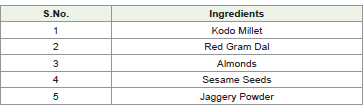
Kodo millet, red gram, sesame seeds, almond, and jaggery powder were some of the raw materials that were purchased from the local market of Jaipur city.
• Processing of raw material
All of the ingredients processed using a variety of techniques (such as washing, shade drying, grinding, and sieving) to get the required outcome. The finished mix was then kept at room temperature in an airtight container for further procedures.
• Standardization and development of the energy mix
The ready to drink energy mix was developed in the cookery lab, Dept of Nutrition and Dietetics, Nims University Rajasthan, Jaipur.
• Procurement of raw material
Kodo millet, red gram, sesame seeds, almond, and jaggery powder were some of the raw materials that were purchased from the local market of Jaipur city.
• Processing of raw material
All of the ingredients processed using a variety of techniques (such as washing, shade drying, grinding, and sieving) to get the required outcome. The finished mix was then kept at room temperature in an airtight container for further procedures.
• Standardization and development of the energy mix
Market survey:
A market survey was carried out in Jaipur’s local markets and
online platforms which revealed that there are a few multi-millets
mixes available to meet the daily nutritional needs of energy,
carbohydrates, protein, and fat in addition to dietary fibres.Pilot study:
A pilot study was conducted in order to prepare the desired
product in which Kodo millet was mixed in different proportions
with red gram dal, almonds, sesame seeds and jaggery powder which
was later tested by the hit and trial method and the most suitable
composition was selected on the basis of their sensory characteristics.Development of the product:
In order to develop a ready-to-drink energy mix, Kodo millet
was combined with red gram powder, sesame seed powder,
almond powder, and jaggery powder to prepare a 100g of the mix.
Four distinct variations and a control were developed where in all
ingredients were combined in varying amounts; KMP1(control)
(40% wheat), KMP2 (30% Kodo), KMP3 (40% Kodo), KMP4 (50%
Kodo), and KMP5 (60% Kodo). The developed energy mix variations
are shown in [Table 1].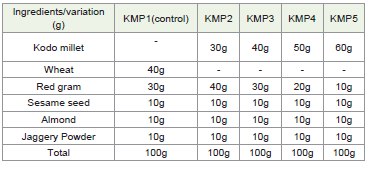
Sensory Evaluation of the ready to drink energy mix:
Sensory evaluation of the developed variations was conducted
where 15 semi-trained panellists were chosen based on the results of a
sensitivity threshold test that was performed on 30 individuals. Using
a nine-point hedonic rating scale, the product’s sensory evaluation
was conducted. The panellists were given the developed product
to taste and rate it based on its colour, taste, aftertaste, appearance,
texture, flavour, and overall acceptability. Statistical analysis of the
developed product was done, in which mean and standard deviations
were calculated.Proximate Analysis of the Product:
For the most acceptable product of after the sensory evaluation,
proximate analysis was done using the standard methods of (AOAC,
2023) [8] to analyze the macronutrients and micronutrients
composition of the developed product.Determination of the Shelf Life of the Product:
The developed product was kept at room temperature (25-
30°C) and relative humidity (40-60%) for a maximum of 30 days.
Polypropylene was the material used for packaging. In order to assess
the storage quality, samples from the best-accepted product were
taken in triplicates at the beginning, zero, fifteen, and thirty-day
points in the storage period. The total viable count (standard plate
method) was used to assess the products’ microbial burden.Analysis of Nutritive Value and Cost of the Developed Product:
The most recent market list is used to determine the produced
product’s cost, which also accounts for expenses.Development of Food Label of the Product:
The food product’s label was created in accordance with the most
recent Food Safety and Standards Authority of India (FSSAI) 2020 [9]
guidelines for food packaging and labelling.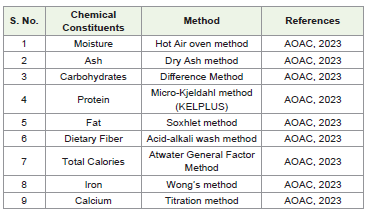

Results And Discussion
Procurement and Processing of raw material:
The online marketplace and the neighbourhood market were the
sources of the raw materials. In order to eliminate any dirt, foreign
particles, and anti-nutritional elements, all raw materials were
processed. After being cleaned and soaking in water for eight hours,
Kodo millet was shade-dried for six hours to eliminate any remaining
moisture. After the dried Kodo millet was ground into fine flour
using a mixer grinder, it was kept at room temperature in an airtight
container.Standardization and Formulation of the Product:
In order to create 100g of sample, Kodo millet flour was combined
with red gram powder, sesame seed, almond, and jaggery powder to
create a ready-to-drink energy powder. To create four distinct samples
and a control, all the ingredients were combined in varying amounts.
KMP1(control) which was 40% wheat, KMP2 which was 30% Kodo,
KMP3 which was 40% Kodo, KMP4 which was 50% Kodo, and KMP5
which was 60% Kodo.Sensory evaluation of the developed product:
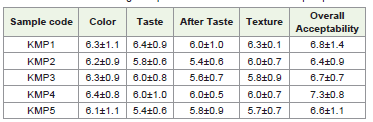
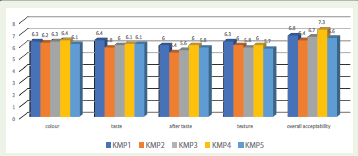
The sensory evaluation of different developed variations was
done using the 9- point hedonic rating scale which showed that the
variation no. KMP4 has the highest mean score for color (6.4±0.8) and
overall acceptability (7.3±0.8). Hence it was selected for the further
proximate analysis. The overall results of the organoleptic evaluation
of the developed product are shown in [Table 5] given below.The Mean scores and standard deviation of organoleptic
evaluation of the developed mix was found to be high in variation
(KMP4) in all the parameters i.e., color, taste, after taste, texture and
overall acceptability with a value of 6.4±0.8, 6.0±1.0, 6.0±0.5, 6.0±0.7
and 7.3±0.8 respectively. [Graph 1] depicts the mean scores of overall
acceptability of the different developed variations of the energy mix.
Proximate Analysis of the Developed mix:
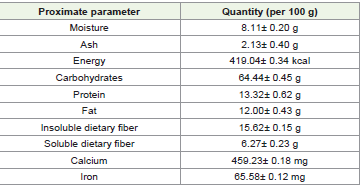
The proximate composition of the developed mix is given in
[Table 6] which consist of macro and micro nutrient composition
i.e., moisture, ash, energy, carbohydrates, protein, fat, insoluble and
soluble dietary fibers along with calcium and iron content. The total
moisture content of the developed product was found to be 8.11±
0.20 g / 100 g.The developed Kodo millet-based mix has a total ash content of 2.13± 0.40 g /100g. Patil et al., (2020) [9] conducted a study on physical, functional, nutritional, phytochemical and antioxidant properties of Kodo millet (Paspalum scrobiculatum) and found that the Kodo millet has a total ash content of 1.960 g/100g of grain.
Energy is the primary requirement to do the desired work, the developed product has energy content of 419.04± 0.34 kcal /100g. Patel et al., (2018) [10] conducted a study on variety of Kodo millet and puffed Kodo and found that some variety of Kodo millet and found that the Kodo millet had energy value of 322 kcal/100g.
The total carbohydrates content in the developed product was
found to be 64.44± 0.45 g /100g of the product. Patil et al., (2020) [9]
conducted a study on physical, functional, nutritional, phytochemical
and antioxidant properties of Kodo millet (Paspalum scrobiculatum)
and found that the Kodo millet has estimated carbohydrate content
per 100 g ranged from 71.11 to 72.24 g, with a mean of 71.800 g.
The total protein content in the developed product was 13.32±
0.62 g /100g of the product. The findings of Rajput et al. (2019)
[16] reported that the total protein content in the cultivated Kodo
millet grain was 7.85-8.85% in 100g of grain. The total fat content
in the developed product was found to be 12.00± 0.43 g /100g of the
product. Muragod et al. (2019) [11] reported that the total fat content
is 1.3g/100g in Kodo millet grain.
The developed product had a total insoluble dietary fiber content of 15.62± 0.15 g /100g of the product. Srilekha et al. (2019) [12] also reported that Kodo millet flour had 4.06 ± 0.03 % of crude fiber in 100g of flour. The total soluble dietary fiber content in the developed product was reported to be 6.27± 0.23 g /100g of the product. The total calcium content in the developed product was reported to be 459.23 ± 0.18 mg /100g of the developed product. Muragod et al. (2019) [11] reported the mineral content of Kodo millet has 32 mg of calcium per 100 g of the grain. The total iron content in the developed product was found to be 65.58± 0.12 mg /100g of the product. Patil et al., (2020) [9] in their study on Physical, functional, nutritional, phytochemical and antioxidant properties of Kodo millet found that the Kodo millet found that Kodo millet has 3.55 mg of iron per 100 g of grains.
The developed product had a total insoluble dietary fiber content of 15.62± 0.15 g /100g of the product. Srilekha et al. (2019) [12] also reported that Kodo millet flour had 4.06 ± 0.03 % of crude fiber in 100g of flour. The total soluble dietary fiber content in the developed product was reported to be 6.27± 0.23 g /100g of the product. The total calcium content in the developed product was reported to be 459.23 ± 0.18 mg /100g of the developed product. Muragod et al. (2019) [11] reported the mineral content of Kodo millet has 32 mg of calcium per 100 g of the grain. The total iron content in the developed product was found to be 65.58± 0.12 mg /100g of the product. Patil et al., (2020) [9] in their study on Physical, functional, nutritional, phytochemical and antioxidant properties of Kodo millet found that the Kodo millet found that Kodo millet has 3.55 mg of iron per 100 g of grains.
Determination of the shelf-life of the developed mix:
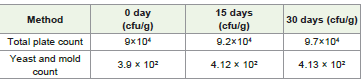
Shelf-life evaluation of the developed kodo millet-based energy
mix was carried out using standard microbiological methods,
and the results are presented in [Table 7]. Microbial quality was
assessed by determining the bacterial, fungal, and coliform counts at
different storage intervals under room temperature conditions using
the standard plate count method. The findings indicated a gradual
increase in bacterial count from the initial day to the 30th day of
storage in the developed energy mix.
According to the guidelines of the Food Safety and Standards Authority of India (FSSAI, 2020) [13], the permissible microbial limit for total plate count in food products is 10⁵ cfu/g, while the acceptable limit for yeast and mold count is 10³ cfu/g. The microbial analysis of the developed product remained within these permissible limits throughout the storage period, indicating that the product was microbiologically safe and had a shelf life of up to 30 days under room temperature conditions. Consumption of food products within the recommended microbial limits is essential to ensure food safety and maintain overall health.
According to the guidelines of the Food Safety and Standards Authority of India (FSSAI, 2020) [13], the permissible microbial limit for total plate count in food products is 10⁵ cfu/g, while the acceptable limit for yeast and mold count is 10³ cfu/g. The microbial analysis of the developed product remained within these permissible limits throughout the storage period, indicating that the product was microbiologically safe and had a shelf life of up to 30 days under room temperature conditions. Consumption of food products within the recommended microbial limits is essential to ensure food safety and maintain overall health.
Cost of the developed energy mix:
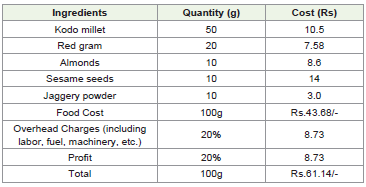
Total Cost of the mix was calculated using the latest market
price along with overhead charges at 20 per cent of expenditure
on manufacturing which includes depreciation cost on machinery,
equipment, building etc. and profit at 20 per cent was included. The
detailed cost is given below in [Table 8].Development of Food Label of the Developed mix:
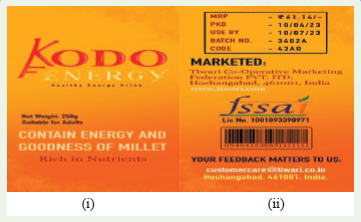
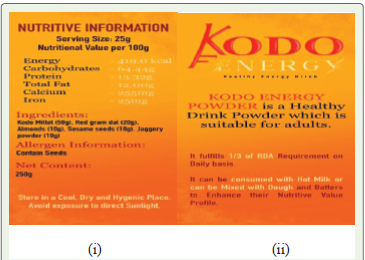
The food label was created in accordance with the most recent
Food Safety and Standards Authority of India (FSSAI) 2020 [13]
regulations for food packaging and labelling, which included the
elements listed below and the procreate application.Conclusion
The present study successfully developed and standardized
a Kodo millet-based ready-to-drink energy powder using red
gram dal, almonds, sesame seeds, and jaggery powder in suitable
proportions. Proximate analysis revealed that the developed product
was rich in energy, protein, dietary fiber, calcium, and iron, making
it nutritionally dense and beneficial for daily consumption. Shelflife
analysis further confirmed the product’s stability and safety for
storage. The food label was designed according to the latest guidelines
of the Food Safety and Standards Authority of India (FSSAI). Overall,
the developed energy powder proved to be a cost-effective, convenient,
and nutrient-rich product capable of contributing nearly one-third of
the daily nutritional requirements of an adult, particularly suitable for
individuals with busy lifestyles and irregular dietary patterns.
References
Citation
Soni D, Bose S, Mekala A, Singh S. Development and Nutritional Characterization of Nutrient-Rich Kodo Millet-Based Ready-to-Drink Energy Mix. Indian J Nutri. 2026;13(1): 344.