


Review Article
Environmental Foot Prints and Nutritional Life Cycle Assessment of Food Products: A Narrative Review
Rai R*, Ade A and Sharma S
Institute for Global Development, B-5 Greater Kailash, Enclave-II, New Delhi, India.
*Corresponding author:Raiza Rai, Institute for Global Development, B-5 Greater Kailash, Enclave-II, New Delhi, India. E-mail Id: raizaa707@gmail.com
Article Information:Submission: 09/03/2026; Accepted: 21/04/2026; Published: 24/04/2026
Copyright: © 2026 Rai R, et al. This is an open access article distributed under the Creative Commons Attribution License, which permits unrestricted use, distribution, and reproduction in any medium, provided the original work is properly cited.
Abstract
Comprehensive assessment frameworks are required to measure both environmental effect (carbon footprint, greenhouse gas (GHG) emissions) and nutritional efficacy of foods. Nutritional Life Cycle Assessment (nLCA) is an imperative tool of assessment framework. The objective of this review was the synthesis of global nLCA literature to assess the existing methodologies and standards, the various tools utilized, and the outcome measures implemented
to evaluate the environmental impact of various raw and packaged food products. We conducted a narrative review to synthesize the key findings from nLCA studies published between 2016 to 2020 using the PubMed database. The comparative reliability of nLCA was undermined by widespread methodological variations. The functional unit (FU) significantly determines ranking, which acts as a key and frequently contradictory conclusion. Reliance on FUs based
on mass sometimes renders comparisons useless by neglecting to take nutrient profiling into account. Nutritional FUs show that products such as pulses, microbial proteins, and some intensive livestock systems can offer high nutrient delivery for a lower environmental burden, while beef and dairy consistently register as environmental hotspots. The high heterogeneity resulting from co-product allocation strategies and localized production efficiency (example:
precision nutrition) was a major limitation to drawing broadly applicable findings. The nLCA community needs to get an agreement on globally standardized, nutritionally weighted FUs, prioritizing the development of public-health focused indicators such as the HENI score. Furthermore, systematic integration of social and economic factors into LCSA is required for converting complex data into holistic, region-specific actions.
Keywords:Nutritional life cycle assessment; Life cycle assessment; greenhouse gases; carbon footprint
Introduction
The environmental impact of human activities can be assessed
using a quantitative measure called Life Cycle Assessment (LCA).
The use of LCA methodology to assess the environmental impact of
agri-food products is called nutritional LCA (nLCA). Opting for the
appropriate nutritional functional unit to compare alternative food
items is critical in nLCA. Most used functional units are based on
either calories, proteins, mass of the product, or land occupied across
the supply chain or a geographical area. [1]
LCA is a system analysis and operational unit analysis that studies the environmental aspects and potential impact throughout the life cycle of a product (cradle-to-grave), which includes processes from acquiring the raw product to its production, use, and final disposal. The life cycle of a product includes the extraction of a raw material, including the energy carrier, followed by the production of an intermediate product and end-product, its use, and finally the disposal or recycling. [2]
It is critical to understand that the environment is affected by food production, processing, preservation, preparation, distribution, or disposal, in many ways, such as by the emission of greenhouse gases (GHG), use of land and water resources for the production or loss of biodiversity, etc. [3]. The level of environmental impact may vary depending upon the type of food, such as animal products may have a higher impact compared to other food types because of greater energy use and GHG emissions. It has been suggested that GHG emissions should be one of the criteria to evaluate the environmental impact of foods, but not the only criterion. Water footprints, ammonia emissions, and primary energy use are the potential impacts on the environment. [4]
LCA is a system analysis and operational unit analysis that studies the environmental aspects and potential impact throughout the life cycle of a product (cradle-to-grave), which includes processes from acquiring the raw product to its production, use, and final disposal. The life cycle of a product includes the extraction of a raw material, including the energy carrier, followed by the production of an intermediate product and end-product, its use, and finally the disposal or recycling. [2]
It is critical to understand that the environment is affected by food production, processing, preservation, preparation, distribution, or disposal, in many ways, such as by the emission of greenhouse gases (GHG), use of land and water resources for the production or loss of biodiversity, etc. [3]. The level of environmental impact may vary depending upon the type of food, such as animal products may have a higher impact compared to other food types because of greater energy use and GHG emissions. It has been suggested that GHG emissions should be one of the criteria to evaluate the environmental impact of foods, but not the only criterion. Water footprints, ammonia emissions, and primary energy use are the potential impacts on the environment. [4]
Furthermore, LCA has been complemented with costing and
social life cycle assessment to constitute what is called life cycle
sustainability assessment. It is the evaluation of performance of the
sustainability of the product with its three dimensions, including
environmental, economic, and social. The life cycle costing
includes five major types of costing, i.e., initial cost, operation cost,
maintenance cost, disposal cost, and residual cost. [5]
LCA has four steps, including the goal and scope definition, life cycle inventory, life cycle impact assessment, and interpretation. The cradle-to-grave approach involves all the stages of the life cycle approach, i.e., from extraction of the raw material to the end of life of the packaging. [6] However, little is known about the LCA of multiple food products. Also, multiple studies have used different methods and standards to perform LCA. Considering the need to review the availability of literature on LCA of different food products, the tools used to Perform them, and the key-outcome measures applied, we performed a narrative review. The objective of the review was to assess the tools used to perform LCA of different raw and packaged foods globally.
LCA has four steps, including the goal and scope definition, life cycle inventory, life cycle impact assessment, and interpretation. The cradle-to-grave approach involves all the stages of the life cycle approach, i.e., from extraction of the raw material to the end of life of the packaging. [6] However, little is known about the LCA of multiple food products. Also, multiple studies have used different methods and standards to perform LCA. Considering the need to review the availability of literature on LCA of different food products, the tools used to Perform them, and the key-outcome measures applied, we performed a narrative review. The objective of the review was to assess the tools used to perform LCA of different raw and packaged foods globally.
Materials and Methods
Screening and extraction of studies:
We used the PubMed database to find studies using the
keywords, “Life Cycle Assessment, LCA, nLCA, Nutritional Life
cycle Assessment.” The inclusion criteria were restricted to studies
published in English between 2016 and 2020 that explicitly focused on
the nutritional life cycle assessment of food products. Initial screening
was based on the relevance of titles and abstracts to the review’s
objectives, followed by a full-text evaluation of the selected articles.
Data extracted included the author and year of publication, food
items assessed, geographical context, functional unit, methodological
tools used in the study and key outcomes measured. The conceptual
grouping of the studies to synthesize the overarching themes in
nLCA methodologies was performed. Consistent with the narrative
review methodology, we did not perform a formal quality appraisal
or systematic exclusion quantification.Results and Discussion
Evidence from studies:
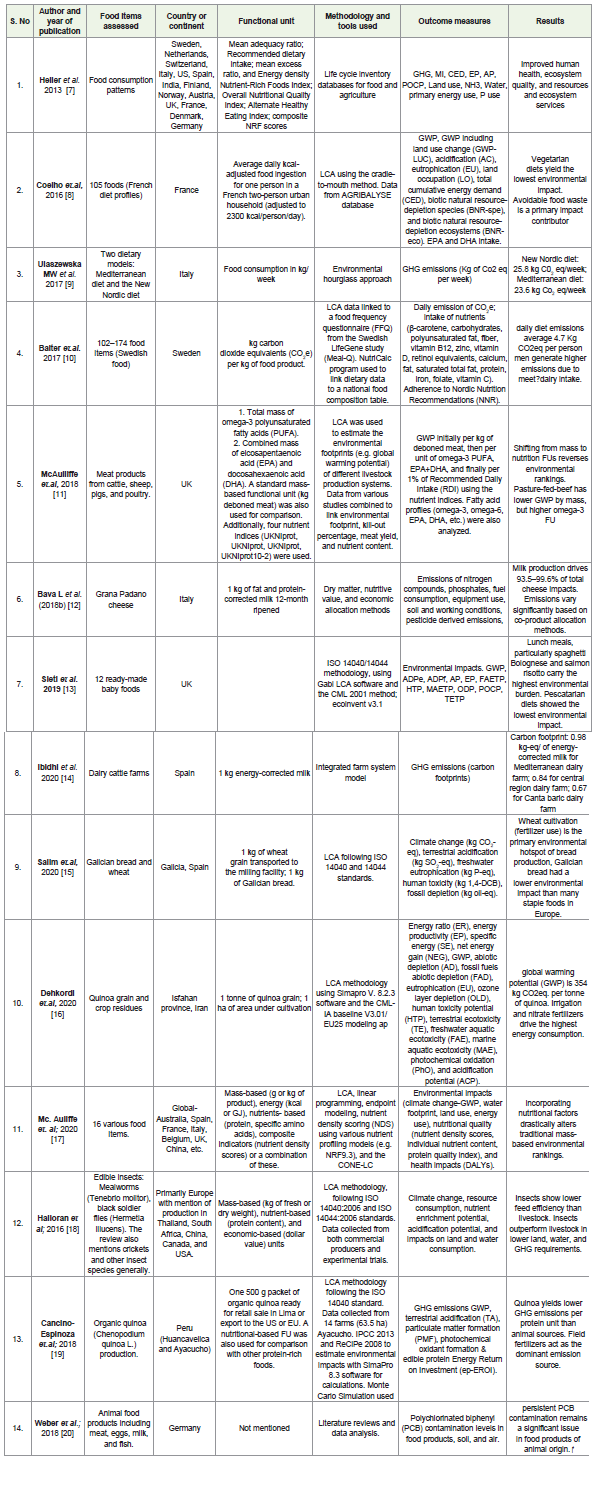
Dietary Impact Assessments: The evaluation of environmental
impacts across whole diets reveals significant variations based on
dietary composition and the chosen functional units. Heller et al.
highlighted the absence of standardized nutritional quality metrics
in LCA frameworks, noting the use of indices like the Healthy
Eating Index (HEI), Nutrient Rich Foods Index (NRF), and Overall
Nutritional Quality Index (ONQI) [7]. Building on dietary modeling,
Coelho et al. estimated that shifting from an average French diet to
a vegetarian diet significantly lowers the environmental footprint
[8]. Similarly, sustainable dietary models demonstrate comparable
efficiencies; the New Nordic Diet and the Mediterranean Diet yield
comparable weekly GHG emissions of 25.8 Kg CO2 eq and 23.6 Kg
CO2 eq, respectively [9]. Demographic factors also influence dietary
footprints, as Balter et al. observed that men in Sweden generate
higher median daily CO2 emissions (5.3 kg) than women (4.4 kg),
primarily driven by a higher intake of meat and dairy products [10].Livestock, Dairy, and Processed Food Metrics:
When evaluating specific animal products, transitioning from a
mass-based metric to a nutrient-based functional unit becomes critical
to successfully integrate meat quality and nutritional outcomes into
environmental assessments [11]. This need for precise metrics extends
to dairy products; for instance, Bava et al. evaluated Italy’s Grana
Padano cheese across multiple environmental categories, identifying
impacts including 3.26 m² of water use, a carbon footprint of 98.2
g CO2 eq, and 1.44 MJ for resource use [12]. The environmental
impact of processed products also varies widely depending on the
ingredients. Sietiti et al. showed that among children’s ready-made
foods, heavy lunch meals like spaghetti Bolognese and salmon risotto
produce the highest environmental impact, whereas dry porridge and
fruit-based desserts produce the lowest [13].Farm Management and Crop Production Interventions:
Addressing environmental burdens effectively often requires direct
agricultural interventions. Ibidhi and Calsamiglia demonstrated that
optimizing farm management to reduce milk’s footprint (0.67–0.98
Kg CO2 eq/Kg) is a more efficient mitigation strategy than changing
consumer diets [14]. Crop production faces specific pollution hotspots
despite multiple agricultural stages. For Galician wheat, the primary
pollutants are nitrogen fertilizers, field emissions, and transport fuel,
leading to European bread environmental impacts ranging from
0.5 to 6.6 kg CO2 eq/kg [15]. Similarly, evaluating resilient quinoa
production across direct and indirect inputs, Lotfalian Dekhordi
and Forootan found that producing 1 ton generates 354 kg CO2
equivalents, with phosphorus identified as the primary contributor to
toxicity impacts [16]. Shifting diets and optimizing farm production
are key to reducing environmental impacts [Figure 1].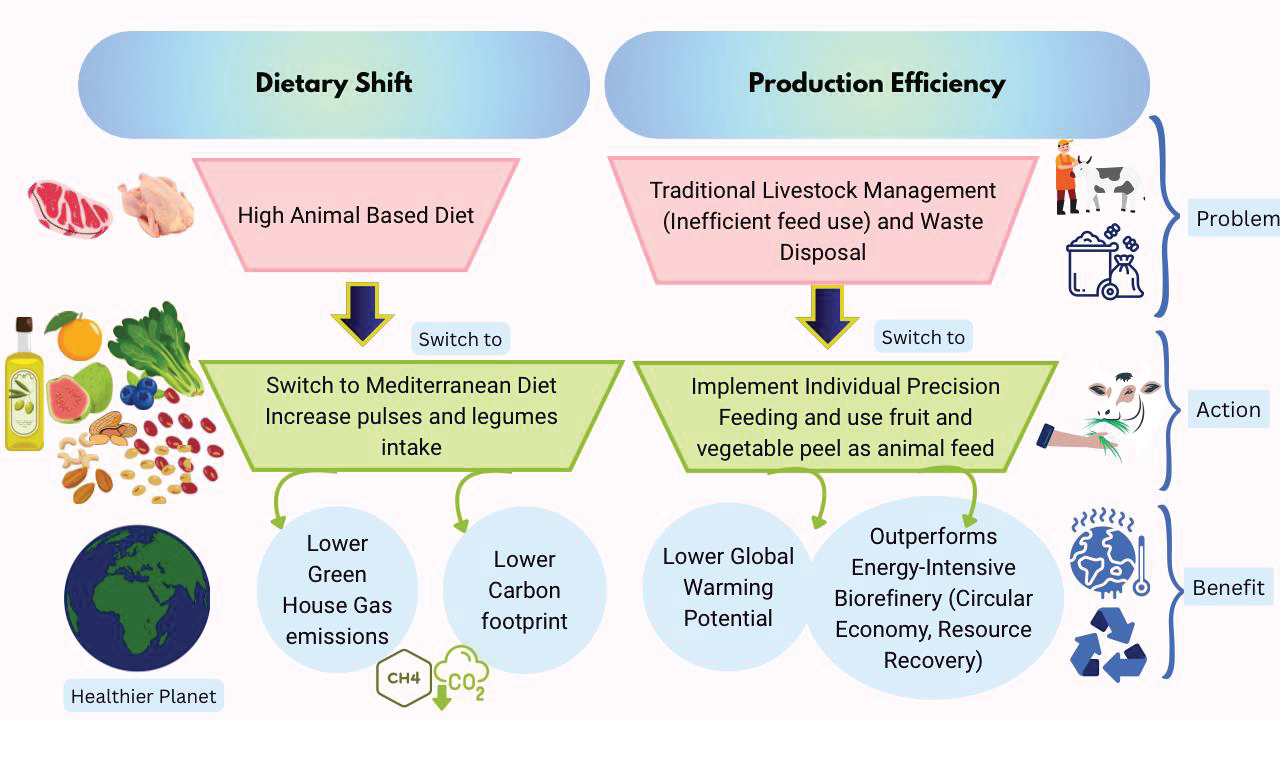
Refined Functional Units, Novel Proteins, and Contaminants:
The critical role of functional units is further emphasized by
McAuliffe et al., who highlighted that shifting from mass-based to
nutrient-based units can significantly alter environmental rankings
for foods, underscoring the need to link farm-level management
directly to a product’s nutritional quality to ensure realistic
sustainability assessments [17]. Alternative protein sources present
unique sustainability metrics in this context; Halloran et al. found
that edible insects, such as mealworms, outperform conventional
livestock by requiring less land and water and producing fewer GHG
emissions, despite possessing lower feed efficiency [18]. Nutrientdense
crops also exhibit specific emissions profiles; an LCA of a 500g
functional unit of quinoa identified nitrogen-based gases from field
operations, alongside machinery, transport, and resource use as key
emissions [19]. Finally, comprehensive impact assessments must also
consider pollutants; polychlorinated biphenyls (PCBs), measured
using toxic equivalency factors, are persistent organic pollutants
formed in combustion and noted in fish, poultry, dairy, and eggs [20].
However, the current nLCA landscape is hindered by widespread
methodological heterogeneity. Inconsistencies across databases,
software, and co-product allocation strategies severely complicate
comparative meta-analyses, and the heavy geographic skew toward
North American and European data leaves critical knowledge gaps
regarding developing economies [12,23].The Way Forward:
To ensure nLCA effectively drives global food policy, future
research must urgently prioritize: International Standardization:
Achieving global consensus on nutritionally weighted FUs, with
a priority on validating and standardizing public health-focused
indicators like the HENI score across diverse food groups. Holistic
LCSA Expansion: Systematically integrating social and economic
impact criteria into broader Life Cycle Sustainability Assessment
(LCSA) frameworks to capture the full reality of food systems. Closing
the Global Data Gap: Developing robust, localized LCA inventories
for emerging markets across Asia, Africa, and South America to
accurately reflect their distinct agricultural practices and nutritional
challenges.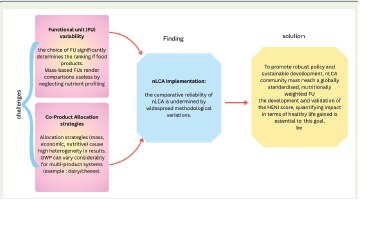
Acknowledgements
The authors wish to express their appreciation for the support by
the Institute for Global Development, New Delhi, India.
Conflict of interests:
The authors declare no competing interest.Conclusions
Transitioning to sustainable food systems is an urgent global
imperative that requires measuring both environmental damage and
nutritional efficacy. This narrative review affirms that while Life Cycle
Assessment (LCA) is a vital tool, its traditional reliance on mass- and
energy-based functional units (FUs) is fundamentally inadequate, as
these metrics fail to capture true nutritional density and bioavailability
[17]. The selection of the FU dictates a food product’s environmental
ranking; therefore, shifting toward nutritionally weighted FUs such
as DIAAS, NRF9.3, and particularly the Health Nutritional Index
(HENI) is not just a methodological upgrade, but a necessity [Figure 2] [22,1].
References
Citation
Rai R, Ade A, Sharma S. Environmental Foot Prints and Nutritional Life Cycle Assessment of Food Products: A Narrative Review. Indian J Nutri. 2026;13(1): 340.