


Research Article
Neck Circumference and Waist: Height Ratio: Potential Screening Tools for Metabolic Syndrome
Bhavisha Sancheti* and Geeta Ibrahim
Department of Foods, Nutrition and Dietetics, College of Home Science Nirmala Niketan, Mumbai, India
Corresponding author:Dr. Bhavisha Sancheti, Department of Foods, Nutrition and Dietetics, College of Home Science Nirmala Niketan, Mumbai, India. E-mail Id: bhavishaphd@gmail.com
Article Information:Submission: 20/01/2026; Accepted: 14/02/2026; Published: 17/02/2026
Copyright: © 2026 Sancheti B, et al. This is an open access article distributed under the Creative Commons Attribution License, which permits unrestricted use, distribution, and reproduction in any medium, provided the original work is properly cited.
Abstract
An increased prevalence of metabolic syndrome (MS) and limitations of current predictors emerges the need for new diagnostic tools. The current study, hence, aims at identifying neck circumference [NC] and Waist: Height ratio [WHtR] as user-friendly, economical and accurate screening tool for MS. Total 101
[51 males & 50 females] participants visiting Shilpa Medical and Research Centre, Mumbai, were screened for MS by using International Diabetes Federation [IDF-2005] criteria. They were subjected to various anthropometrical measures like Waist Circumference(WC), Body Mass Index (BMI), Neck Circumference
(NC), Waist: Hip Ratio (WHR), Waist: Height Ratio (WHtR) and access to their blood reports was gained with participants and doctor’s consent. Pearson’s Correlation-coefficient was used was used to define the correlations between test variables and reference variables. A significant [p<.001 for all] correlation of
NC was observed with all MS criteria [WC, Fasting Blood Sugar [FBS], Blood Pressure [BP], Total Triglyceride [TG] and High Density Lipoprotein [HDL] levels]. A significant correlation was found for NC followed by WC, WHtR and lastly BMI with MS markers [p=<0.001-0.5]. Present study suggests multi-dimensional use of anthropometric variables comprising NC and WHtR along with BMI and WC as an easy, economical and effective screening tool for MS. NC>38cms and >34cms for males and females respectively and universal cut-off point of >0.5 for WHtR was applicable for the given population.
Keywords:Metabolic Syndrome; Neck Circumference; Waist: Height Ratio; International Diabetes Federation Criteria 2005
Introduction
The world today is witnessing a shift from the dual burden
of under and over-nutrition to a load of triple burden which is an
additional factor of micronutrient deficiencies. The global pandemic
of obesity is on a rise with more than 1.9 billion adults overweight and
650 million obese causing around 2.8 million deaths [1]. India faces
a burden of 135 million adults being obese [1] and the prevalence rate
for central obesity varies from 16.9 - 36.3% [2]. Abdominal obesity
is one of the major risk factors for manifestation of type 2 diabetes,
cardiovascular disease, and hypertension [3], cancers, dementia,
psychosocial issues [4], hyperlipidemia, susceptibility to thrombosis,
inflammation, endothelial dysfunction [5].
A composition of these various metabolic abnormalities fabricated
the term metabolic syndrome (MS). MS refers to a clustering of
metabolic risk factors including central obesity, glucose intolerance,
hyperinsulinemia, low HDL cholesterol, high triglycerides, and
hypertension [6]. Robust evidence from various studies has shown
metabolic syndrome’s undesirable outcome/ complications of T2DM
and CVD along with other degenerative diseases rooting increased
incidence of morbidity and mortality. [7] Current diagnostic tools
like BMI, WC, and WHR present certain limitations.
BMI fails to distinguish fat mass from lean body mass and to
describe the type of obesity, does not take into account gender
variability, and cannot be used for pregnant women. BMI cannot be
used for children who today are showing high amounts of body fat %
and are the target group for preventing metabolic syndrome. Though
there are separate cut off ranges for Asians, the issue of difference of
BMI in other countries and variability of body fat % within different
countries of Asia is yet unresolved.
Waist Circumference is known to be a good predictor for
metabolic syndrome, however, has some limitations to its use. It
cannot be used on pregnant women, people with known stomacg
distention issues. It also demands skilled person to identify the correct
stage of respiration and to identify the exact location to be measured.
Hence a need for the alternative and effective diagnostic is
felt, and thus the current study aimed at identifying whether neck
circumference and waist: height ratio along with lifestyle factors can
serve as an effective diagnostic tool.
Methods and Material
• Sample size: 101 Participants
• Sampling technique: Purposive sampling was used to identify patient visiting Shilpa Medical and Research Centre, Dahisar, Mumbai, who presented with metabolic syndrome and willing to participate in the study.
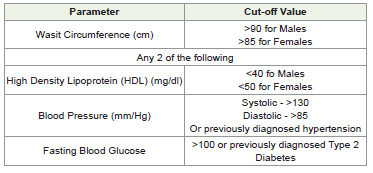
• Inclusion criteria: Participants should be classified as having metabolic syndrome according to IDF criteria [Table 1]. Participants should be between 30-60 years of age
• Exclusion criteria: Patients with hypothyroidism, stomach distension issues, pregnant women, participants not fitting in age criteria.
• The participants were subjected to anthropometrical measures and access to their blood reports were gained after obtaining written consent from them and from the endocrinologist.
• The blood reports gave data for fasting blood sugar [FBS], triglycerides [TG], High-Density Lipoprotein [HDL]. Systolic and diastolic blood pressure data were also obtained.
• Anthropometric data included height, weight, BMI, waist & neck circumference, waist: height ratio.
• Height was measured using wall mounted stadiometer with bare foot and head placed erect against wall.
• Weight and body analysis was obtained with help of Tanita body analyser UM-076 model. Participants were asked to stand bare foot on the electrodes of the analyser with no metals or heavy accessories.
• Waist Circumference was taken by using a non-stretchable measuring tape at the narrowest band of abdomen.
• Hip Circumference was taken by using a non-stretchable measuring tape at the broadest part of the hip.
• Sampling technique: Purposive sampling was used to identify patient visiting Shilpa Medical and Research Centre, Dahisar, Mumbai, who presented with metabolic syndrome and willing to participate in the study.
• Inclusion criteria: Participants should be classified as having metabolic syndrome according to IDF criteria [Table 1]. Participants should be between 30-60 years of age
• Exclusion criteria: Patients with hypothyroidism, stomach distension issues, pregnant women, participants not fitting in age criteria.
• The participants were subjected to anthropometrical measures and access to their blood reports were gained after obtaining written consent from them and from the endocrinologist.
• The blood reports gave data for fasting blood sugar [FBS], triglycerides [TG], High-Density Lipoprotein [HDL]. Systolic and diastolic blood pressure data were also obtained.
• Anthropometric data included height, weight, BMI, waist & neck circumference, waist: height ratio.
• Height was measured using wall mounted stadiometer with bare foot and head placed erect against wall.
• Weight and body analysis was obtained with help of Tanita body analyser UM-076 model. Participants were asked to stand bare foot on the electrodes of the analyser with no metals or heavy accessories.
• Waist Circumference was taken by using a non-stretchable measuring tape at the narrowest band of abdomen.
• Hip Circumference was taken by using a non-stretchable measuring tape at the broadest part of the hip.
• Neck Circumference was measured using a non-stretchable
measuring tape at the middle of the neck between the mid
cervical spine and mid anterior neck. In men with laryngeal
prominence [Adam’s apple] it was measured just below the
prominence.
• Data obtained was analysed by SPSS software. Descriptive statistical analysis was used to observe frequencies and means. To analyse the relationship between variables [various measures with MS components], Pearson’s correlation coefficient test was used.
• Data obtained was analysed by SPSS software. Descriptive statistical analysis was used to observe frequencies and means. To analyse the relationship between variables [various measures with MS components], Pearson’s correlation coefficient test was used.
Results and Discussion
Descriptive Statistics:
The mean age of males and females was 54.59 [±11.93] and
53.96 [±10.89] years respectively. The anthropometrical measures
[BMI, WC, NC, WHtR] of the participants were compared with
biochemical components of MS with an aim to differentiate their
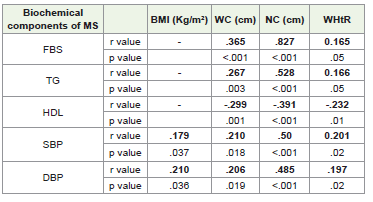
screening potential for MS identification [Table 2].Correlation of Neck Circumference with MS components
Correlation of NC with Fasting Blood Glucose:
Correlation coefficient was high between NC and FBG of the
participant (r=.827, p< 0.001) and was better as compared to WC,
similar to findings of study conducted by Zhou J et al (2013) on 4201
Chinese subjects.A high and significant correlation with FBS brings out the possibility of NC to detect insulin resistance and future risk of development of T2DM as shown by study conducted on 350 diabetic Indian subjects [8] and for development of further complications like CVD. [9]
Correlation of NC with Triglycerides and HDL:
Correlation coefficient was high between NC and TG of the
participant (r=.827, p< 0.001), similar to the findings of previous
studies [10,11].Upper body subcutaneous fat stores have shown to be associated with hypertriglyceridemia in previous researches, documented in 20th century. [12,13].
NC shows a tendency to predict dysfunctional portal fatty acid metabolism by displaying strong relationship with serum TG levels.
Another inevitable component of atherogenic dyslipidaemia is
reduced serum HDL levels along with hypertriglyceridemia.
NC had a significant negative correlation with HDL levels of the participant (r=-.391, p< 0.001) which appears to be in sharp contrast with the findings of Ben-Noun and Laur (2003) who found nonsignificant relationship of NC with HDL levels.
Upper body subcutaneous fat stores have been shown to be associated with reduced HDL levels. [14,15]. This may justify the correlation of NC with HDL levels.
NC had a significant negative correlation with HDL levels of the participant (r=-.391, p< 0.001) which appears to be in sharp contrast with the findings of Ben-Noun and Laur (2003) who found nonsignificant relationship of NC with HDL levels.
Upper body subcutaneous fat stores have been shown to be associated with reduced HDL levels. [14,15]. This may justify the correlation of NC with HDL levels.
Correlation of NC with Blood Pressure:
NC had a significant positive correlation with SBP (Systolic Blood
Pressure) levels of the participant (r=-0.5, p < .001) and with DBP
(Diastolic Blood Pressure) levels of the participant (r=-0.485, p <
.001).Similar correlations were seen in a few studies [10,16]. Increased NC has shown to increase the risk of hypertension by 3 fold. [Laakso M et al, 2002].
Overall Correlation with Metabolic Syndrome:
In the current study, neck circumference of the participant
correlated significantly with all criteria of metabolic syndrome.The finding of the current study was similar to various other studies done in past.
NC independently correlated with MS [10,11,17] uric acid, CRP [18], hyperinsulinemia [19]. Onat A et al (2009) stated that sex and age adjusted NC showed 2-3 fold increased risk for MS development. The above findings clearly suggest that NC can be used for predicting various metabolic abnormalities, beyond obesity, in different ethnic groups.
Correlation of Waist: Height Ratio with MS components
Correlation of WHtR with Fasting Blood Glucose:
WHTR depicted a poor correlation with fasting blood sugar levels
of the participant. (r= 0.165, p= 0.05). The correlation was weaker
than waist circumference alone. The findings are in contrast with
previous studies which showed WHtR to be a better predictor for
T2DM [20,21]This may indicate that the reason for impaired glucose metabolism in the population studied could be multifactorial and beyond just presence of abdominal obesity, for example stress induced hyperglycaemia and diabetes.
Correlation of WHtR with Triglycerides and HDL:
WHTR correlation with TG levels of the participant was found to
be significant but weak. (r=0.166, p= 0.05). The findings of the study
were contrasting to the previous research documented. [22,23]. The
possible cause behind the weak correlation was unknown.WHtR was correlated to the second component of atherogenic dyslipidaemia i.e. serum High Density Lipoprotein levels of the participants. WHtR had a significant negative but weak correlation with HDL levels of the participant. (r= -0.232, p= 0.01). The findings were in opposition to previous documented researches [24]
A state of hypertriglyceridemia may be manageable if an individual has high levels of anti-atherogenic factors like HDL levels. Reduced HDL level has multifactorial causes which would be beyond the capability of WHtR diagnosis.
Correlation of WHtR with Blood Pressure:
WHTR correlation with SBP was found to be significant. (r=
0.201, p= 0.02). However, the correlation was poor. A poor correlation
coefficient was observed between WHTR and DBP (r= .197, p= .02).
The possible mechanism behind the poor correlation was unknown.Overall Correlation of WHtR with Metabolic Syndrome:
WHtR showed a weak correlation with MS components as
compared to WC. The findings of the current study match the
findings of study conducted by Esmaillzadeh A et al [2006] on 5073
Tehranian women. WHtR has been seen to correlate with MS in
previous studies. [25].A meta-analysis (31 papers) consisting of >3, 00,000 adults from differing ethnic groups displayed superiority of WHtR for detecting cardio-metabolic risks for both genders as compared to BMI and WC. [22,26].
In a study by Savva SC et al [2013] WHtR exhibited more significant for detection of metabolic abnormalities especially for Asians as compared to non-Asians.
One unique advantage of using WHtR as a measure is that it facilitates an opportunity of direct comparison with different ethnic groups as it exhibits a universal cut-off point value of 0.5. Gender Specific Correlations for NC and WHtR
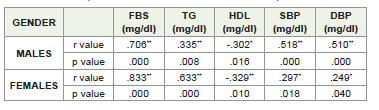
Gender Specific correlations were also observed [Table 3] . In both the sexes, significant positive correlation was found for FBS, TG, SBP, DBP and significant negative correlation with HDL levels. FBS predictability of NC was significant irrespective of the gender. Laakso M et al [2002] concluded that 5 fold increased risk of impaired FBS was observed in 541 Finnish females having increased NC. NC was seen to have stronger correlation with blood pressure for males than females. Similar findings were observed in the Framingham heart study conducted on 3307 subjects. [27,28]. However not all studies showed such gender bias for blood pressure. [29] Pries et al (2010) also pointed a strong correlation of NC with TG and FBS for females. Similar trend was observed in the current study. Overall, NC was seen to be a stronger predictor for females as
compared to men. Females have a higher tendency of producing high
levels of systemic free fatty acids concentration than males [28] which
could be a possible reason for this strong correlation.
Summary and Conclusion
The current study evaluated the predictability of different user friendly
screening tools for identifying metabolic syndrome in
adults between 30-60 years of age. A total of 101 participants having
metabolic syndrome were studied for the present study.
Neck circumference showed the highest and most significant correlation for both genders with the components of metabolic syndrome (Fasting Blood Glucose, Triglycerides, HDL cholesterol, Systolic blood pressure, and Diastolic blood pressure].
Following neck circumference, waist circumference and waist: height ratio showed better correlation with the components of metabolic syndrome. The least correlated screening tool was BMI. In conclusion, neck circumference provides a better indication of metabolic syndrome.
Neck circumference is a user-friendly, economical and effective tool for early detection of metabolic syndrome in adults of both genders.
Neck circumference showed the highest and most significant correlation for both genders with the components of metabolic syndrome (Fasting Blood Glucose, Triglycerides, HDL cholesterol, Systolic blood pressure, and Diastolic blood pressure].
Following neck circumference, waist circumference and waist: height ratio showed better correlation with the components of metabolic syndrome. The least correlated screening tool was BMI. In conclusion, neck circumference provides a better indication of metabolic syndrome.
Neck circumference is a user-friendly, economical and effective tool for early detection of metabolic syndrome in adults of both genders.
References
Citation
Sancheti B, Ibrahim G. Neck Circumference and Waist: Height Ratio: Potential Screening Tools for Metabolic Syndrome. A Study from South India. Indian J Nutri. 2026;13(1): 336.