


Research Article
Nutrition Literacy and Risk Perception of Food Additives and Processed Foods Among Students: A Cross-Sectional Study
Abraham J* and Godwin L
Department of Home Science, Morning Star College, Angamaly, Kerala, India
*Corresponding author:Jiby Abraham, Department of Home Science, Morning Star College, Angamaly, Kerala, India. E-mail Id: jibyabrahams20@gmail.com
Article Information:Submission: 27/10/2025; Accepted: 18/11/2025; Published: 20/11/2025
Copyright: © 2025 Abraham J, et al. This is an open access article distributed under the Creative Commons Attribution License, which permits unrestricted use, distribution, and reproduction in any medium, provided the original work is properly cited.
Abstract
Introduction:The concept of “nutrition literacy” can be defined as a set of personal attributes and context-related traits that facilitate adherence to a nutritious diet, prepared in accordance with appropriate nutritional rules and guidelines. It is necessary for the promotion of healthy dietary habits, and
especially important for students who are faced with new levels of independence and options. Misinformation about food additives and processed foods prevails that may result in improper eating practices, or misplaced concerns about food safety.
Aim:The present investigation examined functional, interactive and critical aspects of nutrition literacy, as well as risk perception towards food additives and processed foods among undergraduates in Kerala, India.
Methodology:Between December 2023 and February 2024, a cross-sectional survey was conducted with 452 randomly selected undergraduates from four varied colleges. A validated piolet-tested tool assessed sociodemographic, nutrition literacy and risk perceptions, with reliability indexes (Alpha- Cronbach:0.84–0.83) indicating internal consistency. Descriptive statistics was used in analysing the data in SPSS v28.
Results:While a majority of students demonstrated an understanding of basic nutrition principles, there was only a limited understanding and confidence in the application of knowledge as indicated by the relatively high proportion of neutral responses. The majority (68.3%) made use of digital sources for information; however, the critical evaluation and interpersonal discussion of nutrition was less common. The findings of the study indicate that students possessed little nutrition awareness but lacked in-depth knowledge, critical thinking and evidence-based reasoning about food additives and processed foods.
Conclusion:Results emphasise the importance of addressing more specific and targeted educational interventions that promote functional, interactive and critical nutrition literacy, given the key role they play in promoting healthier, more science-based food choices.
Aim:The present investigation examined functional, interactive and critical aspects of nutrition literacy, as well as risk perception towards food additives and processed foods among undergraduates in Kerala, India.
Methodology:Between December 2023 and February 2024, a cross-sectional survey was conducted with 452 randomly selected undergraduates from four varied colleges. A validated piolet-tested tool assessed sociodemographic, nutrition literacy and risk perceptions, with reliability indexes (Alpha- Cronbach:0.84–0.83) indicating internal consistency. Descriptive statistics was used in analysing the data in SPSS v28.
Results:While a majority of students demonstrated an understanding of basic nutrition principles, there was only a limited understanding and confidence in the application of knowledge as indicated by the relatively high proportion of neutral responses. The majority (68.3%) made use of digital sources for information; however, the critical evaluation and interpersonal discussion of nutrition was less common. The findings of the study indicate that students possessed little nutrition awareness but lacked in-depth knowledge, critical thinking and evidence-based reasoning about food additives and processed foods.
Conclusion:Results emphasise the importance of addressing more specific and targeted educational interventions that promote functional, interactive and critical nutrition literacy, given the key role they play in promoting healthier, more science-based food choices.
Keywords:Nutrition Literacy; Risk Perception; Food Additives; Processed Foods
Introduction
Nutrition literacy, the capacity to access, process, understand,
and use the nutrition information required to make appropriate
nutrition decisions, has come to be a key determinant of dietary
behavior and health status among students. This group is undergoing
distinct phases of independence and self-feeding [1-3]. Recent studies
have shown that a large percentage of students in the world have an
insufficient or marginal level of nutrition literacy, and that the level
could differ according to gender, major field of study, economic
status, and exposure to nutrition education [4-6]. For example, a high
prevalence of poor nutrition knowledge was reported among >40% of
the college students in Saudi Arabia that was significantly associated
with unhealthy eating practices including high intake of processed
food items and sugar-sweetened beverages[1]. At the same time,
increasing concerns have emerged related to the risk perceptions
of both food additives and processed foods among young adults.
Food additives, with strict regulatory treatment, are indispensable
in modern food production, but receive a lot of backlashes due
to negative media coverage, lack of acceptance from consumers,
continue incident on food safety [7-10]. Also, processed foods are
ubiquitously associated with bad health among students, reinforced
and to some extent influenced by front-of-package nutritional
warning labels and heuristic judgments on the basis of level of
processing [11-14]. Different facets of risk perception – performance
risk (risk of unmet food expectation), physical risk (potential health
hazard) and psychological risk (regret or disappointment decision
makers have from undesirable choices) affect avoidance and the
intention to health selecting options. It is important to understand
the impact of nutrition literacy on risk perception since low literacy
might lead students to overestimate the risk of food additives and
processed food with the possible consequence of unnecessary dietary
restrictions or, conversely, to underestimate real risks .By addressing
these gaps with targeted nutrition education, students can gain the
ability to critically evaluate the information they receive about food
and make informed food choices that are also good for public health
[15]. Therefore, exploring the relationship between nutrition literacy
and risk perception among students is crucial for developing effective
interventions aimed at enhancing food-related decision-making
during this formative period.
The intersection between nutrition literacy and risk perception
is thus critical in understanding how individuals interpret, evaluate,
and respond to chemical health risks in their dietary environment.
However, there remains a dearth of empirical data exploring this
relationship in low- to middle-income country contexts, where
regulatory oversight and education systems are still evolving. This
study aims to assess the levels of nutrition literacy and risk perception
regarding food additives and processed foods among undergraduates.
By identifying knowledge gaps and misperceptions, the findings
may inform public health strategies, curriculum development, and
regulatory frameworks aimed at minimizing chemical health risks
through improved food-related decision-making.
Methodology
Study Design and Setting:
This study employed a cross-sectional survey to assess the level
of nutrition literacy and the perception of chemical risks associated
with food additives and processed foods among undergraduates
students. The data was collected by survey method between oct 2023
to January 2024 from four colleges located in Alappuzha District,
Kerala, India. These institutions represent different academic
disciplines, like science, arts and commerce, thereby variability in
student background.Study Population and Sampling:
The target population consisted of undergraduate students aged 19
to 23 years, enrolled across various disciplines. A multi-stage stratified
random sampling approach was employed: The undergraduates were
divided into strata of science, arts and commerce streams. Within each
stratum, simple random sampling was used to select undergraduates.
A total of 452 with 50% male and 50% female students were selected
in the study with inclusion and exclusion criteria.Inclusion criteria were: currently enrolled undergraduate student,
aged 19-23 years, provided informed consent and able to understand
a self-administered English questionnaire.
Exclusion criteria included: Postgraduate students, those with diagnosed cognitive or psychiatric conditions affecting comprehension
Using Cochran’s formula for cross-sectional studies and assuming a 50% prevalence (to maximize sample size), a 95% confidence interval, and 5% margin of error, the minimum sample size was estimated at 384. To account for non-response or incomplete submissions, the final target was 500 undergraduates, with 452 complete responses retained for analysis.
Exclusion criteria included: Postgraduate students, those with diagnosed cognitive or psychiatric conditions affecting comprehension
Using Cochran’s formula for cross-sectional studies and assuming a 50% prevalence (to maximize sample size), a 95% confidence interval, and 5% margin of error, the minimum sample size was estimated at 384. To account for non-response or incomplete submissions, the final target was 500 undergraduates, with 452 complete responses retained for analysis.
Instrumentation:
A well-structured questionnaire was developed in English,
which was validated through expert review and pilot tested on
100 undergraduates. The instrument consisted of two sections:
Sociodemographic profile of the undergraduates which consisted of
age, gender, year of study, area of residence, monthly income. The
second section was Nutrition literacy assessment developed by Gibbs
et al. (2018) and modified for cultural relevance. Domains included
Functional, Interactive, Critical nutrition literacy. Items used a
5-point Likert scale (1 = Strongly Disagree to 5 = Strongly Agree).Validity and Reliability:
The face validity and content validity was assessed by a panel of
experts in nutrition, public health and toxicology. A pilot study was
conducted to examine the clarity, reliability and completion time. The
data of the pilot study were not included in the final data analysis.
Cronbach’s alpha was calculated for nutrition literacy scale, risk
perception scale and overall internal consistency, Cronbach’s alpha
was 0.84,0.78,0.83 respectively for all the scale.Data Collection Procedure:
Data was collected between December 2023 to February 2024.
The personal interview was conducted by the research scholar to
collect data. Participation was voluntary, anonymous, and guided by
an informed consent process.Ethical Considerations:
Written or digital informed consent was obtained from all
participants prior to data collection. No personal identifiers were
collected.Data Management and Statistical Analysis:
Data were coded and entered into IBM SPSS version 28.0 for
analysis. The following steps were undertakenResults:
The assessment of the functional nutrition literacy of
undergraduate students indicates that, in spite of moderate familiarity
with basic principles of nutrition, their literacy is superficial and
sporadic. While most undergraduate students asserted awareness of
basic principles such as a balanced diet (56.6%) and food preservation
methods (51.1%). Many undergraduate students presented confusion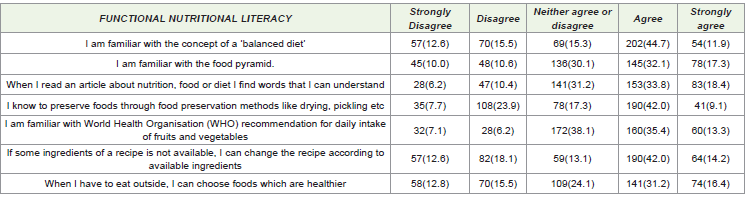

in the response of more technical points of nutrition. For instance,
30.1% of the undergraduate students were neutral when they were
asked about the food pyramid, whereas 38.1% of them were uncertain
regarding recommendations of the World Health Organization
regarding consumption of fruits and vegetables. Furthermore, almost
a third of the students presented difficulty in the understanding of
nutrition-specified vocabulary or in the making of healthier decisions
when they dined out. As illustrated in a litany of research studies, the
awareness of the undergraduate regarding nutrition is sporadic and
superficial, despite moderate familiarity with basic principles [16].
The high rate of indifferent response could also reflect passive
exposure to messages, rather than active processing or understanding.
With so much processing and ultra-processing of the modern food
scene, such concerns are heightened in particular. Navigating modern
food systems and fostering long-term health demands functional
nutrition literacy, or the ability for people to understand sophisticated
diet facts. The study proves the significance of integrating practical
nutrition education into undergraduate studies. Upgrading the skills
of reading food labels, identifying chemical additives, and being
informed in making the right choices of food in terms of content
will significantly influence the food decisions and minimize the
health risk of chemicals. These findings suggest that while basic
awareness exists, it is inconsistently applied, reflecting a surface-level
understanding of nutrition. The high percentage of neutral responses
may point to limited confidence or passive engagement with food related
information. These patterns are concerning in light of growing
dietary exposure to processed foods and synthetic additives, where
functional literacy serves as a key determinant of informed decision making.
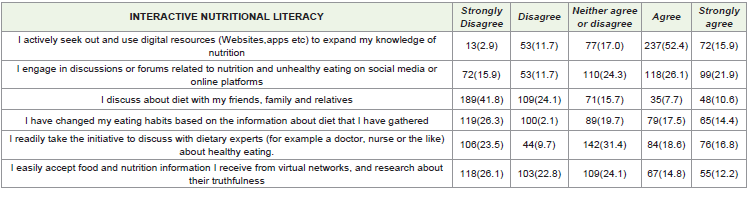
Based to the interactive nutritional literacy (INL) study, the
majority of students (68.3%) actively look for nutrition-related
information via websites and applications. However, 65.9% of
students rarely talk about diet with friends or family, compared to
just 18.3% who do so often. Both willingness to consult health experts
(35.4% agreed/strongly agreed) and participation in online forums
and discussions were modest (48% agreed/strongly agreed). Based on
the information obtained, around one-third (31.9%) had altered their
eating habits. Nearly half (48.9%) demonstrated little initiative in
critically assessing online nutrition material, while having high levels
of digital literacy.
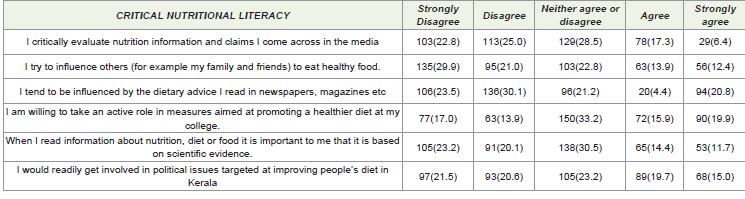
The findings suggest overall low to moderate critical nutritional literacy of respondents. More than three-quarters of respondents (77.4%) disagreed or strongly disagreed with the statement that they critically appraise nutrition information from media, and fewer than a quarter (23.7%) endorsed the statement. Correspondingly, only 26.3% tried to influence their peers’ healthy eating behaviour and more than half (50.9%) did not. More than half (53.6%) the students disregarded newspapers and magazine advice, although 20.8% found it influential. The inclination to participate in political issues targeted at improving people’s diet was moderate (35.8%), however one third of students answered neutrally. Only 26.1% reported that they believe in scientific evidence in nutrition information and 43.3% deny it. Political participation in relation to dietary factors within Kerala was also low, with 34.7% of participants who would be willing to be part of this and 42.1% who would not.
The findings suggest overall low to moderate critical nutritional literacy of respondents. More than three-quarters of respondents (77.4%) disagreed or strongly disagreed with the statement that they critically appraise nutrition information from media, and fewer than a quarter (23.7%) endorsed the statement. Correspondingly, only 26.3% tried to influence their peers’ healthy eating behaviour and more than half (50.9%) did not. More than half (53.6%) the students disregarded newspapers and magazine advice, although 20.8% found it influential. The inclination to participate in political issues targeted at improving people’s diet was moderate (35.8%), however one third of students answered neutrally. Only 26.1% reported that they believe in scientific evidence in nutrition information and 43.3% deny it. Political participation in relation to dietary factors within Kerala was also low, with 34.7% of participants who would be willing to be part of this and 42.1% who would not.
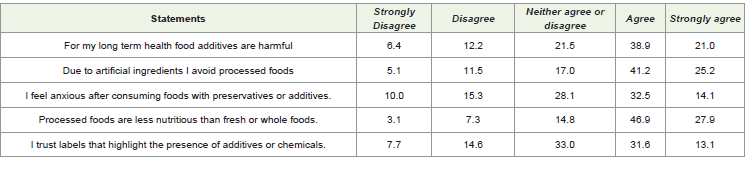
The results indicate that students generally perceive food additives
and processed foods as health risks. A majority (59.9%) agreed or
strongly agreed that food additives could harm long-term health, and
66.4% reported actively avoiding processed foods due to concerns
over artificial ingredients. Emotional responses were evident, with
46.6% expressing anxiety after consuming preservative-containing
products. Nutritional skepticism was high: 74.8% believed processed
foods are less nutritious than fresh options. However, trust in food
labels was mixed—only 44.7% trusted labelling related to additives.
Additionally, 63.2% reported avoiding foods with long ingredient
lists, reflecting a reliance on visual cues and heuristic judgments when
assessing food safety.
The correlation between gender and risk perception (ρ = +0.09, p = 0.182) was weak and statistically non-significant. This suggests that male and female students exhibit comparable levels of perceived risk regarding food additives and processed foods. Although females recorded slightly higher mean perception scores (3.57) compared to male (3.49), the difference was not strong enough to indicate a gender-based variation in overall awareness or concern.
The correlation between gender and risk perception (ρ = +0.09, p = 0.182) was weak and statistically non-significant. This suggests that male and female students exhibit comparable levels of perceived risk regarding food additives and processed foods. Although females recorded slightly higher mean perception scores (3.57) compared to male (3.49), the difference was not strong enough to indicate a gender-based variation in overall awareness or concern.
Discussion
The study underscores the need for integrated nutrition
education within higher education to strengthen foundational
knowledge. Improving students’ ability to interpret labels, recognize
chemical additives, and make informed dietary choices is critical to
reducing chemical health risks. Institutions should consider tailored
interventions—such as digital tools, label-reading workshops,
and culinary skill-building—to enhance food agency and literacy.
Functional nutrition literacy not only influences personal health
behaviors but also underpins broader public health goals by
empowering individuals to navigate increasingly complex and
chemically-laden food environments. Critical nutritional literacy
was generally low. Most students did not critically assess mediabased
nutrition claims or value scientific evidence when interpreting
dietary information. There was also limited initiative in promoting
healthy eating within peer groups or engaging in policy-level actions.
Overall, while digital access to nutrition information is high, the study
highlights significant gaps in critical thinking, informed decision making,
and practical application.
Conclusion
These findings underscore the urgent need for integrated,
evidence-based nutrition education in college settings—programs
that not only convey information but also develop students’ analytical
skills, self-efficacy, and ability to engage with both personal and
societal dietary issues.
Acknowledgement
We would like to express our gratitude to all the participants and
stakeholders
References
Citation
Abraham J, Godwin L. Nutrition Literacy and Risk Perception of Food Additives and Processed Foods Among Students: A Cross-Sectional Study. Indian J Nutri. 2025;12(2): 331.