


Research Article
Nutritional Awareness and Dietary Practices among Adults Aged 40 and Above: A Cross- Sectional Analysis of Knowledge, Behaviour and Barriers
Smati Sambyal*, Kumar S, Shukla E, Raj M, Kirandeep and Goyal T
University College of Physiotherapy, Baba Farid University of Health Sciences, Faridkot , Punjab, India
*Corresponding author: Dr. Smati Sambyal, University College of Physiotherapy, Baba Farid University of Health Sciences, Faridkot, Punjab, India. E-mail Id: drsambyal@ggsmch.org
Article Information:Submission: 22/08/2025; Accepted: 16/09/2025; Published: 19/09/2025
Copyright: © 2025 Sambyal S, et al. This is an open access article distributed under the Creative Commons Attribution License, which permits unrestricted use, distribution, and reproduction in any medium, provided the original work is properly cited.
Abstract
Background: With aging, changing dietary needs and poor nutrition increase the risk of lifestyle diseases. Awareness alone is insufficient, as barriers like lifestyle, affordability and misinformation hinder healthy eating.
Aim: The aim of this study was to assess the level of dietary awareness and nutrition related behaviour among adults focusing on knowledge of macronutrient recommendations, healthy dietary practices and barriers to adopting a nutritious diet.
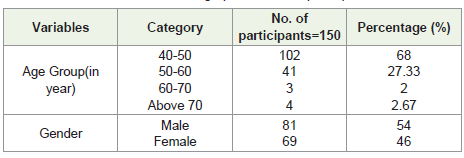
Methods: A descriptive cross-sectional study was conducted using a self-structured questionnaire administered both in-person and via google form for wider reach. A total of 150 male and female participants, willing and able to read and write, aged 40 years and above, meeting the selection criteria, were recruited from the general population via convenient sampling. The questionnaire aimed to examine participants demographic profile, knowledge of macronutrient requirements, awareness of recommended sugar intake, dietary behaviour and barriers such as affordability and time constraints for cooking.
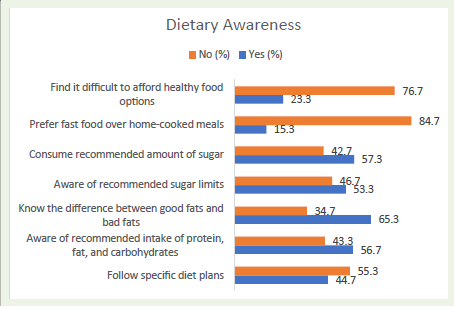
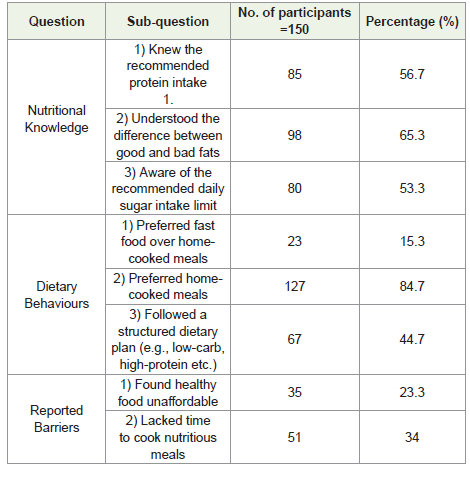
Results: In terms of nutritional knowledge, 56.7% (n = 85) of the participants knew the recommended protein intake, while 65.3% (n = 98) understood the difference between good and bad fats. Additionally, 53.3% (n = 80) were aware of the recommended daily sugar intake limit. Regarding dietary behaviours, a significant majority of participants (84.7%, n = 127) preferred home-cooked meals, whereas only 15.3% (n = 23) reported a preference for fast food. Furthermore, 44.7% (n = 67) of participants followed a structured dietary plan such as low-carb or high-protein diets. As for the barriers to healthy eating, 23.3% (n = 35) of the participants found healthy food unaffordable and 34.0% (n = 51) reported lacking the time to cook nutritious meals.
Conclusion: The study found gaps in dietary knowledge and behavior among adults over 40, highlighting the urgent need for nutrition education in public health programs and affordable access to healthy foods.
Aim: The aim of this study was to assess the level of dietary awareness and nutrition related behaviour among adults focusing on knowledge of macronutrient recommendations, healthy dietary practices and barriers to adopting a nutritious diet.
Methods: A descriptive cross-sectional study was conducted using a self-structured questionnaire administered both in-person and via google form for wider reach. A total of 150 male and female participants, willing and able to read and write, aged 40 years and above, meeting the selection criteria, were recruited from the general population via convenient sampling. The questionnaire aimed to examine participants demographic profile, knowledge of macronutrient requirements, awareness of recommended sugar intake, dietary behaviour and barriers such as affordability and time constraints for cooking.
Results: In terms of nutritional knowledge, 56.7% (n = 85) of the participants knew the recommended protein intake, while 65.3% (n = 98) understood the difference between good and bad fats. Additionally, 53.3% (n = 80) were aware of the recommended daily sugar intake limit. Regarding dietary behaviours, a significant majority of participants (84.7%, n = 127) preferred home-cooked meals, whereas only 15.3% (n = 23) reported a preference for fast food. Furthermore, 44.7% (n = 67) of participants followed a structured dietary plan such as low-carb or high-protein diets. As for the barriers to healthy eating, 23.3% (n = 35) of the participants found healthy food unaffordable and 34.0% (n = 51) reported lacking the time to cook nutritious meals.
Conclusion: The study found gaps in dietary knowledge and behavior among adults over 40, highlighting the urgent need for nutrition education in public health programs and affordable access to healthy foods.
Keywords:Dietary behaviour; Healthy diet; Macronutrients; Nutritional awareness
Introduction
Optimal growth and development of the entire body system is
heavily reliant on adequate nutrition. Diets are primarily composed
of macronutrients such as proteins, fats and carbohydrates and
micronutrients such as calcium, phosphorus and vitamin D. [1]
Nutritional intake is also critically associated with the onset, progression and management of cardiovascular diseases. A balanced and nutrient-rich diet is widely recognized as a fundamental preventive measure against cardiovascular conditions.[2]
Nutritional intake is also critically associated with the onset, progression and management of cardiovascular diseases. A balanced and nutrient-rich diet is widely recognized as a fundamental preventive measure against cardiovascular conditions.[2]
Establishing and maintaining a healthy lifestyle during the
transition from middle age to older adulthood significantly enhances
longevity, improves health outcomes and fosters the potential for
healthy ageing.[3]
In this context, older adults are particularly advised to consume
a balanced, nutrient-dense diet, as nutritional deficiencies have been
strongly correlated with increased morbidity and mortality. Normal
ageing is accompanied by physiological changes that affect dietary
requirements and body composition, including increased adiposity,
decreased muscle mass and reduced total body water all of which
lower caloric needs.[4]
In response to the rising prevalence of diet-related illnesses
worldwide, numerous public health initiatives have been launched
to promote nutritional literacy and encourage healthier dietary
behaviours.[5]
However, previous studies have revealed a notable disparity
between perceived and actual dietary intake. This discrepancy implies
that a large number of people overestimate how nutritious their
eating patterns are, which lowers their drive to adopt healthier eating
practices. These false beliefs may have a significant impact on health
outcomes.[6]
Healthcare systems face challenges from population aging and
rising life expectancy, with middle-aged and older adults playing a
crucial role in community well-being. Westernized eating habits
and limited nutritional awareness hinder healthy aging and increase
chronic disease risk. Since behaviour change is complex, knowledge
alone is insufficient; interventions must consider personal, social,
gender and age-related factors. Promoting a shift toward plant based
diets requires tailored strategies rather than a one-size-fitsall
approach. [7,8,9,10]
A thorough understanding of the reasons why people participate in unhealthy behaviours or refrain from adopting healthy ones is necessary to engage people in midlife health promotion activities and guide the development of successful interventions that take into account their unique circumstances.[11]
Accordingly, the purpose of this study was to assess the level of nutritional awareness, dietary behaviours and barriers to adopting a healthy diet among adults aged 40 years and above, with particular emphasis on knowledge of macronutrient recommendations, adoption of healthy eating practices and identification of challenges such as affordability and time constraints that hinder the implementation of a nutritious diet.
A thorough understanding of the reasons why people participate in unhealthy behaviours or refrain from adopting healthy ones is necessary to engage people in midlife health promotion activities and guide the development of successful interventions that take into account their unique circumstances.[11]
Accordingly, the purpose of this study was to assess the level of nutritional awareness, dietary behaviours and barriers to adopting a healthy diet among adults aged 40 years and above, with particular emphasis on knowledge of macronutrient recommendations, adoption of healthy eating practices and identification of challenges such as affordability and time constraints that hinder the implementation of a nutritious diet.
Material and Methods
A descriptive cross-sectional study was conducted from May 2025
to June 2025, involving a total of 150 male and female participants,
willing and able to read and write, aged 40 years and above, meeting
the inclusion and exclusion criteria were recruited from the general
population through convenient sampling. The study was conducted
both in-person at Outdoor Patient Department (OPD), University
College of Physiotherapy, Faridkot and through online google forms
for wider reach. Participants were excluded if they were experiencing
an acute illness at the time of the study, had any diagnosed cognitive
impairment or were unwilling to participate. All selected participants
were informed about the nature and purpose of the study and
informed consent was obtained prior to their participation. The
participants in this study were not from a nutritional background.
They were recruited from the general population, aged 40 years and
above and represented lay individuals without formal training in
nutrition or dietetics. This approach was adopted to assess the general
awareness, dietary behaviours and barriers related to nutrition
among community dwelling adults rather than professionals with
specialized knowledge.
Data was collected using a self-structured questionnaire which
aimed to examine the participants demographic information (age
and gender), nutritional knowledge (awareness of macronutrient
requirements, understanding of good and bad fats, recommended
sugar intake levels), dietary behaviour (frequency of fast food
consumption, preference for home-cooked meals and use of
structured dietary plan i.e. intermittent fasting or low-carb/highprotein
rich diet) and barriers to healthy eating such as affordability
of healthy food and time constraints for cooking. The google form
was disseminated over a period of 3 weeks through email and social
media platforms allowing them to voluntarily participate and submit
their responses. Only one response per participant was allowed.
After gathering the responses, data was exported to Microsoft Excel
and analysed through statistical software and descriptive statistics
(frequency, percentages) were calculated.
Results
The data of 150 participants was analysed in the current study
that examined the level of dietary awareness and nutrition-related
behaviour among adults focusing on knowledge of macronutrient
recommendations, healthy dietary practices and barriers to adopting
a nutritious diet.
Discussion
The current study aims to assess the level of dietary awareness and
nutrition related behaviour among adults aged 40 years and above
focusing on nutritional knowledge and awareness of macronutrient
recommendations, dietary practices and perceived barriers to
adopting a nutritious diet. The results reflect a high concern regarding
affordability and lack of time to prepare nutritious meals. In support
of the current study, Sallis et al. (2012) examined how personal and
environmental limitations, such as a lack of cooking time, financial
difficulties and convenience can significantly impede the adoption
of healthy behaviours. For dietary awareness to become impactful, it
must be coupled with motivation, practical guidance and supportive
environments that encourage healthier food choices. Another study
conducted by Bauer Jet al. (2013) highlighted the significance of
consuming enough protein to avoid sarcopenia, a disorder that is
becoming more common as people age. This is consistent with the
participant’s understanding of the function of protein in maintaining
muscle mass. But awareness does not always result in action. The
existence of people who are knowledgeable about healthy eating
but do not regularly follow it indicates a gap that may not be filled
by educational tactics alone. This demonstrates how difficult it is to
turn awareness into action. These findings resonate with our data,
reinforcing the need to address not just what people know, but also
what prevents them from applying that knowledge in daily life.
The results also point to the need for more targeted nutrition
literacy initiatives, especially ones that clarify common dietary
misconceptions, emphasize reading food labels and promote balanced
meal planning. As individuals age, their nutritional needs become
more specific, yet many remain unaware of how to tailor their diet
to address age related changes such as slower metabolism, reduced
muscle mass or increased cardiovascular risk.
In essence, while dietary awareness among middle-aged and
older adults shows encouraging trends, there remains substantial
room for growth. Enhancing this awareness through community
outreach, culturally sensitive education and practical interventions
while simultaneously addressing structural barriers can lead to more
sustained and meaningful improvements in health outcomes.
Limitations:
Present study has several limitations that should be
acknowledged. Firstly, the use of self-reported data on dietary
behaviour may be subject to recall bias and social desirability bias,
potentially compromising the accuracy of the information provided
by participants. Secondly, the study was limited to literate individuals
with access to the internet, which may exclude a significant portion
of the population, particularly those from rural or underserved areas,
thereby affecting the generalizability of the findings. Lastly, important
factors like education, chronic illness, income and access to resources
were not fully examined, which could have influenced the results.Conclusion
The study revealed gaps in dietary knowledge and behaviour
among adults over 40 years. It is crucial to encourage affordable access
to nutritious food options and incorporate nutrition education into
public health initiatives. Affordability of nutrient-dense foods, the
simplification of dietary standards for ease of comprehension, and
the encouragement of community-based meal planning programs are
aspects that must be addressed in order to effectively support healthier
eating habits among this population. Together these tactics have the
potential to enable people to make knowledgeable food decisions and
promote sustained advancements in public health.
Recommendations:
Raising awareness about healthy eating practices can be greatly
aided by setting up free nutrition counselling camps for individuals
aged 40 years and above. Adopting balanced diets can be made
easier and more convenient for people by promoting nutritious meal
packages and recipes online. Working together with dietitians to hold
workshops locally will offer helpful, neighbourhood based advice
catered to individual dietary requirements. Furthermore, lowering
financial barriers and increasing the accessibility of nutritious foods
for vulnerable populations can be achieved by providing government
subsidies for healthy food options in lower income communities.References
Citation
Sambyal S, Kumar S, Shukla E, Raj M, Kirandeep, et al. Nutritional Awareness and Dietary Practices among Adults Aged 40 and Above: A Cross-Sectional Analysis of Knowledge, Behaviour and Barriers. Indian J Nutri. 2025;12(2): 326.