


Review Article
Ragi (Eleusine coracana): A Review of Its Nutritional Composition and Health Benefits
Alisha Shirole, Mansi Andhare and Sayali Gambhir*
Department of Nutrition and Dietetics, Indian Institute of Cosmetology and Nutrition, Pune, Maharashtra, India
*Corresponding author:Sayali Gambhir, Department of Nutrition and Dietetics, Indian Institute of Cosmetology and Nutrition, Pune, Maharashtra, India. E-mail Id: iicannutritionhod02@gmail.com
Article Information:Submission: 11/06/2025; Accepted: 03/07/2025; Published: 05/07/2025
Copyright: ©2025 Andhare M, et al. This is an open access article distributed under the Creative Commons Attribution License, which permits unrestricted use, distribution, and reproduction in any medium, provided the original work is properly cited.
Abstract
Ragi (Eleusine coracana), also known as finger millet, is a staple cereal crop widely cultivated in parts of South India, recognized for its exceptional nutritional value and health-promoting properties. Unlike refined cereals, ragi is a rich source of dietary fiber, calcium, iron, essential amino acids, polyphenols,
and antioxidants. This review explores the existing literature on the nutritional composition and therapeutic potential of ragi in relation to modern health concerns, including anemia, diabetes, bone health, and nutritional support during pregnancy and lactation. The high dietary fiber and low glycemic index of ragi contribute to improved glucose metabolism, making it particularly beneficial for individuals with type 2 diabetes. Its polyphenolic content has been shown to exhibit antioxidant and anti-inflammatory effects, while its superior calcium and iron concentrations support bone health and help combat iron-deficiency anemia. Additionally, the rich micronutrient profile of ragi makes it an ideal dietary inclusion for pregnant and lactating women, aiding in maternal and fetal nutritional needs. The traditional use of ragi in regional cuisines, combined with modern scientific validation of its health benefits, positions it as a functional food with the potential to contribute to nutritional security and disease prevention. This review highlights the importance of reintroducing ragi into modern diets and emphasizes the need for further clinical studies to substantiate its therapeutic efficacy.
Keywords:Ragi (Eleusine coracana); Finger millet; Nutritional benefits; Anemia; Diabetes; Bone health; Pregnancy; Lactation; Functional foods
Introduction
In today’s world, most people depend on cereals as their primary
source of food.Among these, wheat, rice, and corn are the most widely
consumed staples globally.In the post-Green Revolution era, millets
have experienced a significant decline in prominence compared
to major cereal crops.Millets are small-grained cereal crops, grown
mainly for food and animal feed, and are often grouped together due
to their similar agricultural characteristics.These crops grow well in
hot and dry environments and require minimal water, which makes
them highly suitable for farming in arid and semi-arid areas. Millets
come in various forms, each with its own distinct texture, traits,
and nutritional value.Some common varieties include finger millet,
pearl millet, foxtail millet, proso millet, sorghum, kodo millet, and
In today’s world, most people depend on cereals as their primary
source of food.Among these, wheat, rice, and corn are the most widely
consumed staples globally.In the post-Green Revolution era, millets
have experienced a significant decline in prominence compared
to major cereal crops.Millets are small-grained cereal crops, grown
mainly for food and animal feed, and are often grouped together due
to their similar agricultural characteristics.These crops grow well in
hot and dry environments and require minimal water, which makes
them highly suitable for farming in arid and semi-arid areas. Millets
come in various forms, each with its own distinct texture, traits,
and nutritional value.Some common varieties include finger millet,
pearl millet, foxtail millet, proso millet, sorghum, kodo millet, and
browntop millet, all of which are known for their health-promoting
properties. [1] Asian countries rank as the third-largest contributors
to global millet production, with India accounting for approximately
80% of the region’s cultivation.Within India, states such as Rajasthan,
Karnataka, Maharashtra, Uttar Pradesh, and Haryana are the leading
producers, contributing significantly to the national millet yield. [2]
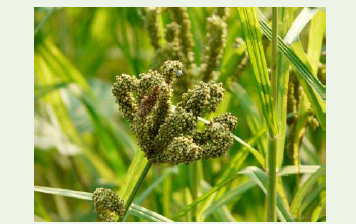
Finger millet (Eleusine coracana), commonly known as ragi,
has been utilized for centuries, particularly in traditional diets of
rural communities where various indigenous preparations are
still prevalent.It is a rich source of essential amino acids such as
isoleucine, leucine, methionine, and phenylalanine—nutrients often
lacking in other carbohydrate-rich foods.In terms of macronutrient
content, ragi is comparable to rice, providing approximately 6–8%
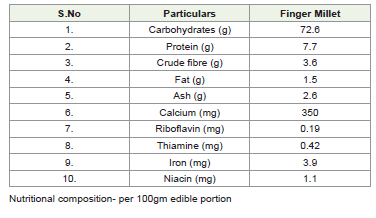
protein and 1–2% fat.However, it surpasses both rice and wheat in its
mineral and micronutrient composition.Ragi has attracted growing
attention for its health benefits, particularly due to its high content of
slowly digestible and resistant starch, contributing to a low glycemic
index. This property makes it especially suitable for individuals
with diabetes. Moreover, ragi possesses significant antioxidant and
antimicrobial properties, which contribute to its overall nutritional
and medicinal significance. [3]
Finger millet is a small-seeded cereal, measuring approximately
1.2–1.8 mm in diameter, with a seed coat that ranges from light
brown to brick red in color. This outer layer is particularly rich in
phytochemicals, including dietary fiber and polyphenols, and contains
higher concentrations of these compounds compared to commonly
consumed cereals such as barley, rice, maize, and wheat. As a native
minor millet, finger millet is widely used in the preparation of healthoriented
foods, including those intended for infants, the elderly, and
individuals with specific dietary needs.It is processed into flour for
the production of various food items such as porridge, puddings,
pancakes, biscuits, flatbreads (roti), bread, and assorted snacks. When
malted, finger millet serves as a highly nutritious food for infants and
is considered a suitable dietary option for individuals with diabetes
due to its beneficial nutritional properties. [4]
The kernel of finger millet is composed of three primary
structural layers: the outer seed coat (testa), the central endosperm,
and the innermost embryo.Finger millet differs from other varieties
like pearl millet, foxtail millet, proso millet, and kodo millet due to its
distinctive five-layered seed coat (testa). This structural characteristic
is believed to contribute to its relatively high dietary fiber content
Health Benefits
Anemia:
Finger millet is very good source of iron and that’s a beneficial for
who are having low haemoglobin levels and who doesn’t have enough
red blood cells(anaemic patients). After sprouting there is increase
inVitamin C and results in easy uptake of iron(Fe) into bloodstream.
[6]Diabetes:
Finger millet has been shown to play a beneficial role in the
regulation of blood glucose levels and the enhancement of antioxidant
defense mechanisms. Its inclusion in the diet contributes to improved
glycemic control and has demonstrated the ability to accelerate the
wound healing process, particularly in diabetic conditions.The
hypoglycemic effect of finger millet is primarily attributed to its
low glycemic response, which results from the presence of natural
antinutritional factors. These compounds decrease starch digestibility
and slow the rate of glucose absorption in the gastrointestinal tract,
thereby minimizing rapid spikes in blood glucose levels.Moreover,
the phenolic compounds concentrated in the seed coat of finger millet
exert inhibitory effects on key carbohydrate-hydrolyzing enzymes,
such as amylase and α-glucosidase. By limiting the enzymatic
breakdown of complex carbohydrates, these bioactive constituents
help reduce postprandial hyperglycemia. In addition to their glycemic
benefits, these phenolics also contribute to the grain’s antioxidant
properties, further enhancing its therapeutic potential in managing
oxidative stress-related complications commonly associated with
diabetes. [7]Ragi in Celiac Disease Management:
Celiac disease is an immune-mediated enteropathy triggered by
the ingestion of gluten in genetically predisposed individuals. Gluten,
a protein found in wheat, barley, and rye, provokes an autoimmune
response that damages the small intestinal mucosa, leading to
malabsorption and various clinical symptoms.Due to their naturally
gluten-free nature, millets—particularly finger millet—serve as an
excellent dietary option for individuals with celiac disease. Among
gluten-free grains, finger millet is especially notable for its rich
nutritional composition, including high levels of calcium, dietary
fiber, and polyphenols. Compared to traditional gluten-containing
cereals such as wheat, finger millet not only offers a safe alternative but
also provides additional health benefits that support gastrointestinal
function and overall nutritional well-being. [8]Ragi in bone health:
Calcium plays a critical role in maintaining optimal bone health
and structural integrity of the skeletal system. Finger millet (ragi)
is recognized as an excellent dietary source of calcium, offering
significantly higher levels of this essential mineral compared to most
other cereals. Regular dietary intake of finger millet has the potential
to enhance bone mineral density and support the prevention of
calcium-deficiency-related disorders, thereby contributing to overall
skeletal health.[9]Ragi during pregnancy:
Pregnancy is a physiological state characterized by increased
nutritional requirements to support the growth and development of
the fetus, as well as the health of the mother. This period is associated
with significant physiological adaptations, including increased
maternal body weight, expanded plasma and blood volume, and
substantial hormonal fluctuations. One of the most prevalent
nutritional concerns during pregnancy is iron-deficiency anemia,
which may arise due to inadequate dietary intake, reduced absorption,
limited iron stores, or concurrent infections.Millet-based food products such as mixed millet malt, ragibased
biscuits, ragi cutlets, and energy bars formulated with finger
millet (ragi), sorghum (jowar), and pearl millet (bajra) have shown
beneficial effects on improving maternal nutritional status, including
positive impacts on weight gain and body mass index (BMI) during
pregnancy. [10]
Conclusion
Ragi (Eleusine coracana) demonstrates significant potential
as a functional food due to its comprehensive nutritional profile
and associated health benefits. Its high calcium and iron content
contributes to improved bone mineral density and the prevention of
iron-deficiency anemia, particularly in nutritionally vulnerable groups
such as pregnant and lactating women. The presence of complex
carbohydrates, dietary fiber, and polyphenolic compounds enables
finger millet to exert a low glycemic response, supporting glycemic
control in individuals with diabetes. Moreover, as a naturally glutenfree
cereal, finger millet serves as an appropriate dietary alternative for
individuals with celiac disease and other forms of gluten intolerance.
The integration of finger millet into daily diets through various
food formulations not only enhances nutritional adequacy but also
contributes to the dietary management of chronic metabolic and
micronutrient-deficiency-related conditions. Continued research is
necessary to further elucidate the bioactive mechanisms and longterm
health impacts of finger millet consumption, thereby supporting
its wider application in public health nutrition and therapeutic
dietary planning.
Acknowledgements
The author would like to express sincere gratitude to all those
who have contributed to the successful completion of this research
paper. First and foremost, we extend our heartfelt appreciation to
the Head of the dept. Dr Mansi Andhare and Faculty Sayali Gambhir
for their guidance and support, and valuable insights throughout the
entire research process.
References
Citation
Andhare M, Shirole A, Gambhir S. Ragi (Eleusine coracana): A Review of Its Nutritional Composition and Health Benefits. Indian J Nutri. 03 2025;12(2): 318.