


Research Article
Exposure, Resources, and Place: Associations of Perceived Weather-Related Challenges, Financial Hardship, and Residential Context with Environmental Worry in the United States
McNeill C1, Ponce-Garcia E2, Garrison MEB3*, Yadav SK4, Bushra N5 and Rohli RV6
1College of Nursing and Health Professions, University of Southern Mississippi, Hattiesburg, MS, USA
2College of Medicine, University of Oklahoma, Oklahoma City, OK USA
3School of Human Environmental Sciences, University of Arkansas, Fayetteville, AR USA
4Department of Geography, Texas A&M University, TX, USA
5Department of Oceanography and Coastal Sciences, Coastal Studies Institute, Louisiana Office of State Climatology, Louisiana State University, Baton Rouge, LA, USA
6Department of Oceanography and Coastal Sciences, College of the Coast & Environment, Louisiana State University, Baton Rouge, LA, USA.
*Corresponding author:Garrison MEB, 210 HOEC Bldg, University of Arkansas, Fayetteville, AR 72701 USA. E-mail Id: megarris@uark.edu
Article Information:Submission: 01/09/2026; Accepted: 26/10/2026; Published: 29/10/2026
Copyright: © 2026 McNeill, C. et al. This is an open access article distributed under the Creative Commons Attribution License, which permits unrestricted use, distribution, and reproduction in any medium, provided the original work is properly cited.
Abstract
Environmental worry is an important affective dimension of environmental risk perception, yet relatively little research has examined its simultaneous associations with perceived environmental conditions, financial hardship, and residential context. Guided by environmental psychology, social vulnerability theory, and place scholarship, we examine environmental worry using three conceptual domains: Exposure (Perceived Weather-Related Challenges), Resources (financial hardship), and Place (residential context). Using the 2024 4R-Stat Baseline Survey (N = 13,240) data, we examined differences in environmental worry across residential settings and U.S. regions and assessed the independent associations of demographic characteristics, financial hardship, and Perceived Weather-Related Challenges with environmental worry. Broad geographic region was not significantly associated with environmental
worry, whereas residential setting showed a clear gradient, with urban residents reporting higher environmental worry than suburban and rural residents. Perceived Weather-Related Challenges showed the largest standardized association with environmental worry, while financial hardship and residential setting were also associated with environmental worry. Younger respondents, women, and respondents from racial and ethnic minority groups reported higher environmental worry. Education was not significantly associated with environmental worry. The final model explained 8.1% of the variance; exploratory interaction terms jointly added only 0.4 percentage points. Because financial hardship is not equivalent to economic worry, these cross-sectional findings do not constitute a direct test of the finite-pool-of-worry hypothesis. The findings describe social and residential differences in environmental worry and identify questions for future research on Perceived Weather-Related Challenges, economic circumstances, and residential context.
Keywords:Environmental Worry; Financial Hardship; Perceived Weather-Related Challenges; Residential Context; Environmental Risk Perception
Introduction
Weather- and climate-related hazards increasingly affect
communities by disrupting infrastructure, livelihoods, health, and
everyday life, although the magnitude and nature of these impacts vary
across hazards and locations [1]. Beyond their physical consequences,
these changes also influence how people perceive environmental risks
and respond emotionally to them [2,3]. Environmental worry refers
to affective response to perceived environmental threats, reflecting the
degree to which individuals worry about environmental conditions
affecting the places where they live [4]. Understanding environmental
worry is therefore important not only for environmental psychology
but also for environmental sociology, geography, public health, and
environmental policy because emotional responses influence risk
perception, preparedness, mitigation behaviors, adaptation, and
public support for environmental action.
Unlike eco-anxiety, which may involve functional impairment or
clinically significant distress, environmental worry is generally regarded
as a normal emotional response, rather than a psychopathology, that
may motivate adaptive engagement with environmental issues [2,5-8]. Research in environmental psychology further demonstrates
that affective responses often influence environmental judgments
independently of factual knowledge or cognitive assessments of
risk [9-11]. Consequently, understanding who experiences greater
environmental worry, and under what circumstances, has become
increasingly important for both environmental research and public
policy.
Although environmental worry is typically measured at the
individual level, considerably less attention has been devoted to
understanding how broader social and environmental contexts
shape these emotional responses [5,8]. Existing studies have
linked environmental worry to climate emotions, demographic
characteristics, environmental experiences, and environmental
risk perception, but these correlates have generally been examined
independently rather than within a unified framework [2,3,12-16]. As
a result, relatively little is known about the extent to which perceived
environmental conditions, household resources, and residential
context are jointly associated with environmental worry.
Three complementary perspectives guide this study. Environmental psychology emphasizes affective and experiential influences on environmental judgments. Social vulnerability scholarship highlights the role of economic resources and inequality in shaping environmental risks, and place scholarship emphasizes how environmental change is interpreted within residential and community contexts [10,11,17-22]. In the present study, environmental change refers broadly to perceived weather- and climate-related conditions that respondents identify as affecting the places where they live.
Three complementary perspectives guide this study. Environmental psychology emphasizes affective and experiential influences on environmental judgments. Social vulnerability scholarship highlights the role of economic resources and inequality in shaping environmental risks, and place scholarship emphasizes how environmental change is interpreted within residential and community contexts [10,11,17-22]. In the present study, environmental change refers broadly to perceived weather- and climate-related conditions that respondents identify as affecting the places where they live.
Taken together, these perspectives suggest that environmental
worry is likely associated with three broad conceptual domains, each
aligned to a perspective. Although environmental worry may reflect
concerns about environmental issues operating at multiple spatial
scales, ranging from local environmental conditions to broader
climate change, the present study focuses on conditions respondents
perceive as affecting the places where they live. The first, Exposure,
is operationalized as respondents’ perceptions of weather-related
challenges affecting where they live, reflecting perceived local
environmental conditions rather than objectively verified physical
exposure to hazards. The second is Resources, operationalized
through financial hardship. The third is Place, operationalized
through residential setting; broader geographic region is included as
a statistical control.
Previous research provides support for each of these domains individually. Studies of environmental risk perception have consistently found that perceived environmental experiences are associated with stronger emotional responses to environmental hazards, although the strength of these relationships varies according to the type of environmental event and the outcomes examined [15,16,23]. Similarly, research grounded in social vulnerability and environmental justice has shown that environmental burdens are disproportionately experienced by populations facing economic disadvantage and structural inequities, suggesting that financial hardship may intensify emotional responses to environmental disruption[24-26]. Place-based research likewise demonstrates that residential environments influence both objective environmental conditions and the social interpretation of environmental change, making residential context an important but often underexamined dimension of environmental worry [22,27,28].
Despite these advances, relatively few studies have simultaneously examined Perceived Weather-Related Challenges, financial hardship, and residential context within a large sample of adults from across the United States. Integrating these domains offers a broader understanding of how environmental worry is socially and spatially patterned while connecting environmental psychology, environmental sociology, hazards geography, and public health within a single analytical framework.
Accordingly, this study examines environmental worry using data from the 2024 4R-Stat Baseline Survey. Guided by an integrated conceptual framework, we examine whether environmental worry differs across U.S. regions and residential settings, whether financial hardship and Perceived Weather-Related Challenges are associated with environmental worry after accounting for demographic characteristics, and which focal domain indicator demonstrates the strongest standardized association with environmental worry.
Background and Literature Review:
Weather-related disruption can affect communities through
physical damage, health, household finances, and psychological
wellbeing [29-31]. These impacts are not distributed evenly but
vary according to environmental conditions, available resources,
and characteristics of the places where people live [17,18].
Understanding emotional responses to these conditions is therefore
an interdisciplinary problem spanning environmental psychology,
environmental sociology, hazards geography, and public health. The
following sections review the literature on Environmental Worry,
Exposure, Resources, and Place, and integrate these perspectives into
the conceptual framework guiding the present study.Environmental Worry as an Affective Response to Environmental Change:
Environmental worry is an affective dimension of environmental
concern [4]. Whereas environmental concern encompasses beliefs
and evaluations about environmental threats, environmental worry
reflects emotionally charged apprehension about environmental
conditions and uncertain futures [2,8,32]. Although seriousness,
concern, and worry are sometimes used interchangeably, they are
conceptually distinct, just as eco-anxiety is distinct, and individuals
may express concern without experiencing persistent worry [3] or
anxiety. Verplanken and Roy found that habitual ecological worry
was not associated with psychopathological worry and was instead
linked to constructive environmental tendencies, while Ojala et
al. concluded that climate-related worry can represent a normal
and potentially adaptive response to environmental threats [2,33].
Together, these findings support distinguishing environmental worry
from psychopathology.Environmental worry is important because affect influences judgment and behavior. The risk-as-feelings framework proposes that emotional reactions to risk can diverge from cognitive evaluations and influence decision making, while the effect heuristic suggests that affective responses shape subsequent assessments of risks and benefits [10,11]. Consistent with these perspectives, van der Linden found that experiential and affective factors were important predictors of climate-change risk perception alongside sociocultural values and norms [3]. Because lay judgments are influenced by perceived rather than objective hazards, environmental worry cannot be inferred directly from objective environmental exposure [34]. Climate-related worry has also emerged as a population mental-health concern, particularly among younger people, and may co-occur with economic and housing insecurity [12,31,35]. Consequently, understanding how Exposure, Resources, and Place are associated with environmental worry has important implications for environmental policy and public health.
Exposure: Perceived Weather-Related Challenges and Environmental Worry:
The Exposure domain is operationalized as perceived weatherrelated
challenges affecting respondents’ local environments. The
domain captures respondents’ reports of weather-related conditions
where they live, not verified physical exposure to hazards. Prior
research suggests that direct experience with environmental hazards is
frequently, though not uniformly, associated with environmental risk
perception. Respondents reporting personal experience with flooding
expressed greater concern about climate change, perceived it as less
uncertain, and reported greater confidence in their ability to mitigate
its effects [15]. However, these relationships vary across hazards.
Whitmarsh found that flood victims did not consistently attribute
their experiences to climate change, whereas air-pollution victims
expressed stronger pro-environmental values than non-victims,
suggesting that associations between environmental experience and
environmental responses depend on hazard type, attribution, and the
outcome assessed [16,23].Recent research indicates that weather-related disruption often coincides with financial strain and psychological distress [30,31,36]. Together, these findings suggest that Perceived Weather-Related Challenges and economic circumstances may be jointly associated with environmental worry, although causal direction remains unresolved.
The relationship between environmental experience and environmental worry is not uniform, however. Although experiential factors consistently contribute to climate-risk perception, their effects vary depending on the outcome being examined [3]. Duan and Bombara, for example, found that personal experience with wildfires was associated with climate-change engagement only indirectly, through increased negative emotions and reduced psychological distance, with these pathways differing by political orientation and subjective knowledge [37]. Together, these findings suggest that associations between weather-related experiences and environmental worry depend on how exposure is measured and which response dimension is assessed [23].
Resources: Financial Hardship and Social Vulnerability:
Social vulnerability scholarship holds that susceptibility to
environmental harm is shaped by social and economic inequality
rather than by physical hazards alone [17,18]. Tierney similarly
argued that disasters reflect broader social and institutional processes,
including economic inequality and inadequate risk regulation [19].
Material pathways linking financial hardship with weather-related
strain are well documented. Temperature extremes disproportionately
increase household energy burdens among low-income households
and residents of energy-inefficient housing, while housing constraints
and limited access to assistance can increase vulnerability to urban
heat [26,27,38]. Economic and housing insecurity have also been
associated with climate-related psychological distress [31]. Together,
these findings provide a basis for expecting financial hardship to be
positively associated with environmental worry, although the present
study does not examine the underlying mechanisms.Whether financial hardship reduces or amplifies environmental
worry remains an open empirical question. Weber’s finite-pool-ofworry
hypothesis proposes that limited attentional and emotional
capacity may cause concern in one domain to displace concern
in another [39]. Evidence from European regions suggests that
environmental and economic concerns may sometimes compete,
particularly during concurrent environmental and economic
shocks [40]. However, the present study does not directly test this
hypothesis because difficulty paying bills measures material hardship
rather than economic worry, and the cross-sectional design cannot
evaluate changes in competing concerns over time. Instead, the
finite-pool hypothesis serves as an interpretive contrast to the social
vulnerability perspective, which suggests that financial hardship and
environmental worry may coexist.
Demographic disparities are also relevant to environmental worry. Environmental justice scholarship demonstrates that environmental burdens are unevenly distributed across socially disadvantaged and racial and ethnic minority communities [24,25,41]. Together, these perspectives suggest that environmental worry may also vary across socially disadvantaged groups, although this expectation represents an inference tested in the present study rather than a direct conclusion of prior research.
National survey research indicates that racial and ethnic minority groups and lower-income Americans often express environmental concern equal to or greater than that of White and higher-income Americans, despite widespread public underestimation of these concerns [14]. Women likewise report somewhat greater climate change knowledge and concern than men [13]. Demographic findings are nonetheless mixed. van der Linden reported weak or inconsistent associations between income, age, education, and climate-risk perception, while Hornsey et al. found that political orientation, values, and worldviews were stronger predictors than sociodemographic characteristics [3,42]. Because beliefs, risk perceptions, concern, and affective responses represent distinct constructs, whether these demographic patterns extend to environmental worry remains an empirical question. Financial hardship may also operate differently from income as a measure of current material circumstances rather than socioeconomic position.
Place: Residential Context and Environmental Worry:
Place scholarship suggests that perceptions of environmental
threats are shaped by where people live [20-22]. In the present study,
Place is operationalized using self-reported urban, suburban, or rural
residence.Urban environments present distinctive hazards, including urban heat islands and impervious-surface flooding, and residents recognize and express concern about these conditions [27,38]. Communitybased studies further suggest that climate concerns correspond with neighborhood environmental exposures and social vulnerability and that climate exposure, social vulnerability, and mental-health distress may become increasingly concentrated over time [28,43]. Together, these findings suggest that urban residential contexts may shape environmental worry through both environmental conditions and social context.
Rural and remote communities face a different pattern of environmental vulnerability, characterized by greater dependence on climate-sensitive livelihoods, more limited infrastructure, and reduced adaptive capacity [44,45]. Reviews of the literature indicate that climate change can undermine material security, social cohesion, cultural identity, and mental health in these communities [44,46]. Housing quality and tenure further influence vulnerability by affecting thermal protection, energy efficiency, and displacement risk [26,47].
Place can be represented through multiple geographic dimensions. Broad geographic region reflects large-scale climatic and cultural variation, whereas self-reported urban, suburban, or rural residence captures settlement context, including differences in environmental conditions, infrastructure, and social interpretation [21]. Social vulnerability likewise varies across both geographic regions and settlement contexts [18]. Examining both residential setting and geographic region therefore provides a limited test of the spatial patterning of environmental worry, while recognizing that these measures do not capture neighborhood-level environmental conditions or objective environmental exposure.
Toward an Integrated Framework:
Across these literatures, Exposure (Perceived Weather-Related
Challenges), Resources (financial hardship), and Place (residential
context) each have plausible associations with environmental
worry. However, few studies have examined these three conceptual
domains simultaneously within a large sample of adults across the
United States. Ojala et al. likewise emphasized the importance of
understanding climate emotions within their social and place-based
contexts [2]. The present study addresses this gap while recognizing
that its cross-sectional, self-reported measures cannot establish causal
mechanisms or objective environmental exposure.Taken together, prior findings are mixed. Associations between environmental experiences and environmental responses vary across studies, and demographic correlates are often modest relative to values, ideology, and affect. Some inconsistency likely reflects differences in the outcomes examined, including beliefs, risk perceptions, concern, worry, anxiety, and behavioral engagement. The remaining empirical question is whether the conceptual domains of Exposure, Resources, and Place retain independent associations with environmental worry after adjusting demographic characteristics and geographic region.
Accordingly, this study addresses three research questions:
RQ1. Does environmental worry differ across residential settings
and broad U.S. geographic regions?RQ2. After adjusting for demographic characteristics and geographic region, are Perceived Weather-Related Challenges, financial hardship, and residential context independently associated with environmental worry?
RQ3. Which focal predictor representing the Exposure, Resources, and Place domains shows the strongest standardized association with environmental worry?
[Figure 1] illustrates the conceptual framework guiding the study.
[Figure 1]. Conceptual framework of environmental worry as a socially and spatially situated response. The conceptual domains of Exposure (Perceived Weather-Related Challenges), Resources (financial hardship), and Place (residential context) are examined as correlates of environmental worry. Demographic characteristics and geographic region are included as statistical control variables. The dotted link between Financial Hardship and Residential Context depicts the Resources × Place interaction represented by the Financial Hardship × Residential Context terms tested in Model 3; additional exploratory interaction terms are described in Methods.
Methods
Data Source and Sample:
The 4R-Stat Baseline 2024 Survey was a collaborative effort
between the U.S. Regional Rural Development Centers and Auburn
University [48]. Conducted during 2024 and 2025, the survey assessed
household, business, and community well-being. Quota sampling
was nested within states, with targets for rural–urban residence,
household type, gender, age, and race/ethnicity informed by U.S.
Census data and adjusted for regional characteristics and recruitment
feasibility. The project’s technical documentation specifies an overall
target of 18,288 respondents; the released dataset contained 18,596
respondents, although attainment of individual demographic quotas
was not reported. Most data were collected through Qualtrics’ online
panels, with participants recruited through sources including website
intercepts, member referrals, targeted email lists, and social media.Panel providers generally offer participation incentives, such as cash,
reward points, or other benefits, but the project team confirmed
that study-specific incentive amounts and a survey response rate
are unavailable. Data-quality procedures included three attention check
questions and required-response fields; incorrect attention check
responses did not automatically result in exclusion. The
dataset was de-identified before public release to protect participant
confidentiality.
The original dataset included 18,596 respondents from all 50 U.S.
states. Perceived Weather-Related Challenges were a key variable in
the present study, and the analyses focused on respondents reporting
at least one challenge. Respondents who reported no challenges (n
= 5,081) or refused to answer the item (n = 275) were excluded,
yielding an analytic sample of 13,240 respondents, a reduction of
5,356 (28.8%). Reporting no challenges was a substantive response
rather than missing data; its exclusion reflects the analytic scope
of the study. Although the survey sought broad demographic and
geographic participation, the resulting analytic sample is national in
scope but is not treated as nationally representative of U.S. adults.
Respondents ranged in age from 18 to 99 years (M = 48.94, SD = 16.71). Race/ethnicity was represented by three dummy variables identifying Black, Hispanic, and other racial/ethnic minority respondents, with White respondents serving as the reference category. Smaller racial/ethnic groups were combined into an “Other race/ethnicity” category because of limited subgroup sample sizes. The sample was 55% women, 70% identified as White, 15% as Black/ African American, 8% as Hispanic/Latino, and 5% as other. Thirtyfour percent reported a high school diploma/equivalent or lower, 52% were married or coupled, and 47% reported annual household incomes below $50,000.
Region was categorized according to the U.S.D.A. Regional Rural Development Centers (Northeast, North Central, South, and West). For regression analyses, the West region served as the reference category. About 30% of the respondents were from the Southern region, about 22% each were from the North Central and Northeastern regions, and 27% were from the Western region. With respect to residential location, 38% were living in an urban area, 39% in a suburban area, and the remaining 23% in a rural area.
Measures:
Environmental worry was measured using nine items assessing
concerns about air pollution; pollution of rivers, lakes, and
reservoirs; drinking water pollution; soil quality; litter and waste
dumping; extreme high temperatures; extreme low temperatures;
drought; and flooding. The items represent a broad range of local
environmental concerns rather than severe hazards alone; litter and
waste dumping were retained as concerns about local environmental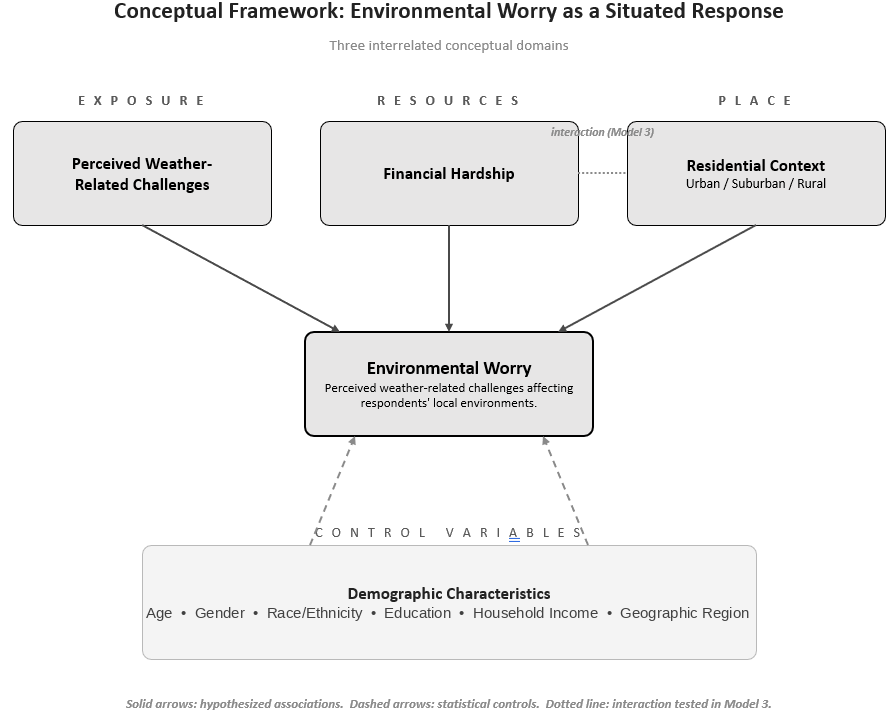
quality. Responses ranged from 1 (“not at all”) to 5 (“a great deal”).
The Kaiser–Meyer–Olkin measure of sampling adequacy (.93) and
Bartlett’s test of sphericity (χ² = 57,642, df = 36, p < .001) supported the
suitability of the data for factor analysis. Exploratory factor analysis
using maximum likelihood extraction yielded a single factor with an
eigenvalue of 4.57, accounting for 50.8% of the total variance; thus,
rotation was not performed. All nine items loaded strongly on the
factor, with loadings ranging from .607 to .791. Internal consistency
was high (Cronbach’s α = .90). These findings provide preliminary
support for a common dimension and the internal consistency of
the composite, but do not independently establish its construct or
discriminant validity. Accordingly, the items were summed to create
a single composite environmental worry score (range = 9–45, M =
23.55, SD = 7.12), with higher scores indicating greater environmental
worry.
Perceived weather-related challenges were measured by asking
respondents to select all weather-related challenges affecting
where they lived from a list of seven events and another category:
increased rainfall, sea-level rise, prolonged drought, wildfires,
flooding, hurricanes, and temperature changes. The dataset recorded
selection of “other” but contained no accompanying text specifying
the challenge. Responses, including selections of “other,” were
summed to create a count of reported challenges ranging from 1 to
8. Forty-three percent of respondents reported one challenge, 28%
reported two, 18% reported three, and 11% reported four or more.
The composite was treated as a count of the distinct weather-related
challenges respondents perceived as affecting where they lived, that is,
the breadth of perceived local weather stress, rather than as a measure
of exposure to, or the severity of, any single hazard. A count was
used because several of the listed events commonly occur together or
share meteorological drivers (for example, hurricanes, flooding, and
increased rainfall), and because the item asked about perceived local
conditions rather than specific events. Because the seven events differ
in physical character, spatial extent, and relevance to coastal versus
inland locations, the composite cannot identify which hazards are
most closely associated with environmental worry.
Financial hardship was measured using a single item assessing how often respondents had trouble keeping up with household bills during the previous 12 months, with responses on a 5-point scale ranging from “never” to “every month.” Higher scores indicated greater financial hardship.
The control variables were measured using standard survey questions. Educational attainment and annual household income were recorded in ordered, interval groupings, a common approach in survey research.
Data Analysis:
Following descriptive analyses, two one-way analyses of variance
(ANOVAs) with Scheffé post hoc tests were conducted to examine
differences in environmental worry across geographic regions and
residential settings (N = 13,240). Scheffé’s test was chosen because it is
a conservative method for controlling Type I error when conducting
multiple group comparisons [49].
Hierarchical multiple regression was used to examine the
independent associations of demographic characteristics, financial
hardship, residential context, and Perceived Weather-Related
Challenges with environmental worry. This approach allows
predictors to be entered in theoretically informed blocks, enabling
the assessment of the incremental contribution of weather-related
challenges after accounting for demographic, economic, and
residential factors [49]. Financial hardship was included as the
primary indicator of economic strain because subjective assessments
capture aspects of “individuals’ lived economic circumstances”
and well-being that household income alone may not reflect [50].
Household income, however, was also included to account for
economic resources distinct from perceived hardship. The correlation
between household income and financial hardship was statistically
significant but modest (r = −.245), supporting their inclusion as
related but distinct indicators of economic circumstances. Model 1
included demographic characteristics, household income, financial
hardship, residential context, and geographic region. Model 2 added
Perceived Weather-Related Challenges. Model 3 added interaction
terms between financial hardship and residential context, Perceived
Weather-Related Challenges and residential context, and financialhardship and Perceived Weather-Related Challenges to examine
whether these associations varied across residential contexts or
levels of financial hardship. Geographic region was retained as a
control variable because the literature provided little theoretical basis
for expecting these associations to differ across broad U.S. regions.
Continuous predictors (financial hardship and perceived weatherrelated
challenges) were mean-centered before creating interaction
terms to facilitate interpretation and reduce multicollinearity.
Results
The preliminary ANOVA examining regional differences in
environmental worry was not statistically significant, F(3, 13236) = .52,
p = .67, η² < .001. In contrast, the ANOVA examining differences by
residential location was statistically significant, F(2, 13237) = 81.69, p <
.001, η² = .012, indicating that environmental worry followed a clear
gradient across residential contexts. Respondents living in urban
areas reported the highest levels of environmental worry, followed by
suburban residents, while rural residents reported the lowest levels.
Post hoc comparisons indicated that all pairwise differences between
rural, suburban, and urban groups were statistically significant.
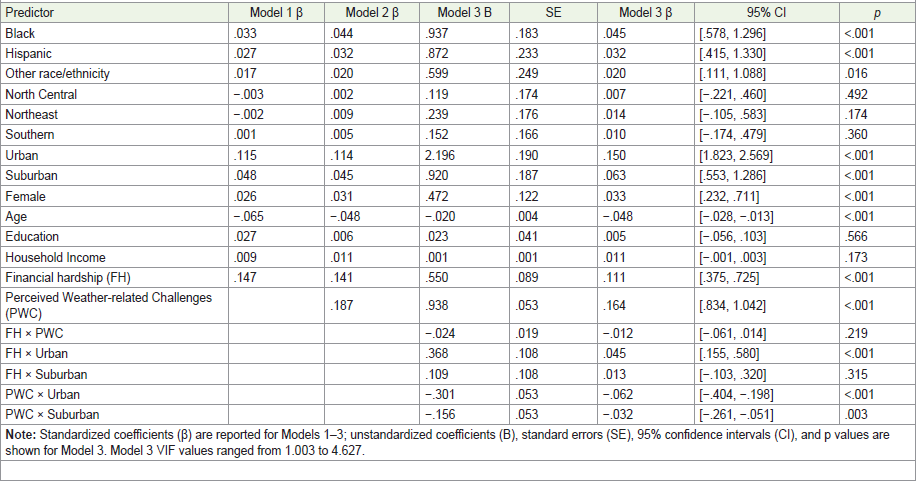
Hierarchical regression results are presented in Tables 1 and 2. Model 1 was statistically significant,F(13, 13226)= 45.77, p < .001, explaining 4.3% of the variance in environmental worry. Adding Perceived Weather-Related Challenges in Model 2 improved model fit, ΔR² = .034, ΔF(1, 13225) = 485.48, p < .001, increasing the explained variance to 7.7%.
In Model 2, Perceived Weather-Related Challenges showed the largest standardized association with environmental worry (β = .187, p < .001). Financial hardship remained a significant positive predictor (β = .141, p < .001), indicating that respondents experiencing greater economic strain reported higher levels of environmental worry. Younger respondents reported significantly greater environmental worry than older respondents (β = −.048, p < .001), and women reported higher levels than men (β = .031, p < .001). Relative to White respondents, Black (β = .044, p < .001), Hispanic (β = .032, p < .001), and respondents in the oher race/ethnicity category (β = .020, p = .019) reported significantly greater environmental worry. Urban (β = .114) and suburban (β = .045) residents also reported significantly greater environmental worry than rural residents (both p < .001). Household income, geographic region, and education were not

significantly associated with environmental worry.
Model 3 added the interaction terms and produced a small increase in explained variance, ΔR² = .004, ΔF(5, 13220) = 10.66, p < .001, increasing the total explained variance to 8.1%. Three interaction terms were statistically significant. The interaction between financial hardship and urban residence was positive (B = .368, β = .045, p < .001), indicating that the association between financial hardship and environmental worry was stronger among urban residents than among rural residents. The interactions between perceived weatherrelated challenges and urban residence (B = −.301, β = −.062, p < .001) and suburban residence (B = −.156, β = −.032, p = .003) were negative, indicating that the association between perceived weatherrelated challenges and environmental worry was weaker among urban and suburban residents than among rural residents. Neither the interaction between financial hardship and suburban residence (p = .315) nor the interaction between financial hardship and Perceived Weather-Related Challenges (p = .219) was statistically significant.
Multicollinearity diagnostics for the final model indicated tolerance values ranging from .216 to .997 and variance inflation factor (VIF) values ranging from 1.003 to 4.627, suggesting no severe multicollinearity among the predictors. The highest VIF was observed for financial hardship, which was included both as a main effect and in interaction terms in the final model; this overlap can increase standard errors and reduce the precision of coefficient estimates but does not, by itself, indicate biased estimates.
Overall, Perceived Weather-Related Challenges had the largest standardized coefficient in Model 2; this is a descriptive comparison, and differences between coefficients were not formally tested. Financial hardship and residential context were also associated with environmental worry. The final model explained 8.1% of the variance, leaving approximately 91.9% unexplained, indicating modest explanatory power despite statistical significance in this large sample. Although three interaction terms were statistically significant, all five interaction terms jointly added only 0.4 percentage points of explained variance. This increment cannot be attributed to any individual interaction, and the moderation findings should be considered exploratory.
Discussion
This study examined environmental worry using an integrated
conceptual framework encompassing three complementary domains:
Exposure, Resources, and Place, operationalized through Perceived
Weather-Related Challenges, financial hardship, and residential
context, respectively. Using a large sample of adults from across the
U.S., the study evaluated the independent associations of these focal
indicators with environmental worry while adjusting for demographic
characteristics and geographic region. Four principal findings
emerged. First, Perceived Weather-Related Challenges demonstrated
the largest standardized association with environmental worry.
Second, financial hardship remained independently associated with
greater environmental worry after accounting for perceived weather-
related challenges and other covariates. Third, residential setting, but
not broad U.S. geographic region, was associated with environmental
worry, with urban residents reporting greater worry than suburban
and rural residents. Finally, three exploratory interactions suggested
variation in associations across residential contexts, but the five
interaction terms jointly added only 0.4 percentage points of
explained variance.
Collectively, these findings support conceptualizing
environmental worry as a socially and spatially situated response
rather than solely an individual psychological characteristic. Although
environmental worry is experienced at the individual level, the results
suggest that it is associated with perceptions of local environmental
conditions, material resources, and residential context. This integrated
framework extends approaches that focus primarily on demographic
characteristics or climate-related emotions by emphasizing the
independent associations of Exposure, Resources, and Place. The
observed demographic patterns, with greater environmental worry
among younger respondents, women, and racial and ethnic minority
respondents, are likewise consistent with prior evidence on the social
patterning of environmental concern [13,14,35].
Exposure: Perceived Weather-Related Challenges and Environmental Worry:
The Exposure domain, operationalized as perceived weather related
challenges, demonstrated the largest standardized association
with environmental worry. Respondents reporting a greater number
of Perceived Weather-Related Challenges also reported higher
environmental worry after adjusting for demographic characteristics,
financial hardship, residential context, and geographic region. This
finding is consistent with previous research demonstrating that
perceived environmental conditions are associated with emotional
responses to environmental risks [15,23,37].These findings should not be interpreted as evidence that objective environmental exposure directly increases environmental worry. Rather, the present study assessed respondents’ perceptions of weather-related challenges, which may reflect direct experience, observations within their communities, media exposure, or broader awareness of local environmental conditions. Because the source of these perceptions cannot be identified, the Exposure association is best read as an association between two appraisals, perceived local weather-related challenges and environmental worry, rather than as evidence about environmental conditions themselves. This reading is consistent with previous work suggesting that affective responses to environmental risks are shaped by perceived rather than objective environmental conditions [3,10,11], but it also means that part of the association may reflect a shared tendency to notice and worry about environmental problems (see Limitations).
Although Perceived Weather-Related Challenges demonstrated
the largest standardized association, the overall variance explained
remained modest, suggesting that environmental worry is influenced
by additional factors such as values, ideology, media exposure, and
prior experiences [3,42]. The modest explanatory power of the model
is therefore consistent with the multifactorial nature of environmental
worry and underscores the importance of examining additional
psychological, social, political, and contextual determinants in future
research.
Resources: Financial Hardship and Environmental Worry:
The Resources domain, operationalized as financial hardship,
remained independently associated with environmental worry
after accounting for Perceived Weather-Related Challenges and
other covariates. This finding is consistent with social vulnerability
scholarship, which emphasizes that environmental risks are
experienced across social and economic contexts [17-19]. Individuals
experiencing financial hardship often have fewer resources with which
to prepare for, respond to, or recover from environmental disruptions,
making environmental threats potentially more consequential.
The independent association between financial hardship and
environmental worry likewise aligns with environmental justice
perspectives emphasizing that environmental risks and vulnerabilities
are embedded within broader systems of social inequalities [24,25,41].These findings should not, however, be interpreted as a direct test of the finite-pool-of-worry hypothesis [39,40]. Financial hardship is not equivalent to economic worry, and the cross-sectional design cannot determine whether financial and environmental concerns compete with or reinforce one another. Instead, the findings are more consistent with the proposition that material vulnerability and environmental worry may coexist. Longitudinal studies that directly access multiple domains of worry are needed to distinguish between these competing theoretical perspectives.
Place: Residential Context May Matter More Than Broad Region:
For the Place domain, residential context was independently
associated with environmental worry, whereas broad U.S. geographic
region, included as a statistical control, was not. Respondents living in
urban areas reported greater environmental worry than those living in
suburban and rural settings. This pattern is consistent with previous
research suggesting that environmental perceptions are more closely
related to local environmental conditions than to broad geographic
classifications [28,36]. These findings suggest that residential context
may be more closely associated with environmental worry than broad
regional classifications, which may obscure meaningful variation in
local environmental conditions and lived experiences.These findings are consistent with place scholarship emphasizing that environmental perceptions develop within everyday social and environmental contexts [20-22]. Although residential setting is not a direct measure of place attachment or place identity, it appears to serve as a useful contextual indicator of how environmental conditions are experienced. Future research incorporating neighborhood-level environmental characteristics, objective environmental indicators, and direct measures of place attachment would help clarify these relationships.
Exploratory Interactions by Residential Context:
The interaction analyses suggested that the association between
financial hardship and environmental worry was stronger among
urban than rural respondents, whereas the association between
Perceived Weather-Related Challenges and environmental worry was
weaker among urban and suburban than rural respondents. Although
three interaction terms were statistically significant, the five-term
interaction block added only 0.4 percentage points of explained
variance (ΔR² = .004). This small increment applies to the block as a
whole, not to the financial hardship × urban interaction alone. These
findings provide limited incremental explanatory value and should be
interpreted as exploratory and in need of replication.One possible explanation for the financial hardship × urban interaction is that urban environments present greater concentrations of environmental hazards, infrastructure vulnerabilities, housing constraints, or energy-related costs that increase the salience of environmental conditions among financially constrained households [26,27,38,46]. Differences in environmental communication, neighborhood conditions, or access to adaptive resources may also contribute. Because these mechanisms were not measured directly, they remain speculative. Replication using nationally representative samples and studies incorporating objective measures of environmental exposure and neighborhood characteristics will be important before drawing broader conclusions.
Environmental Worry as an Adaptive Response:
An important implication of these findings is that greater
environmental worry should not automatically be interpreted as a
negative psychological outcome. Previous research distinguishes
environmental worry from clinically significant anxiety, suggesting
that moderate environmental worry may motivate information
seeking, preparedness, and engagement with environmental issues
[2,33]. However, the present study did not assess adaptive behaviors
or psychological functioning and therefore cannot determine whether
higher environmental worry reflects constructive engagement
or emotional distress. Rather, the findings are compatible with
conceptualizing environmental worry as a normal affective response,
while prior research suggests that such worry may under some
circumstances motivate adaptive engagement.Limitations:
Several limitations should be considered when interpreting these
findings. First, the cross-sectional design precludes conclusions
regarding temporal ordering or causality. Although Perceived
Weather-Related Challenges, financial hardship, and residential
context were associated with environmental worry, the analyses
cannot determine the direction of these relationships. Longitudinal
research is needed to examine how environmental worry changes
over time and in response to evolving environmental conditions.Second, the study relied on self-reported measures. The Exposure indicator captured respondents’ perceptions of local weather-related challenges rather than objectively verified environmental exposures. These perceptions may reflect personal experience, media coverage, community discussions, or broader environmental awareness. Reliance on self-report also raises the possibility of shared method variance: respondents with a greater general tendency to worry may report both higher environmental worry and more weather-related challenges, potentially inflating the observed associations. The contribution of shared method variance was not quantified and cannot be ruled out. In addition, three challenges, drought, flooding, and temperature changes, have corresponding items in the environmental worry scale. This overlap in content may have strengthened the association between the measures and warrants consideration when interpreting the relative strength of the Exposure indicator. Although the worry items showed high internal consistency, this does not independently establish content or discriminant validity; the composite should be interpreted as a broad measure of worry about local environmental conditions rather than a validated measure specific to severe hazards or climate anxiety.
The challenge count captured the breadth of reported challenges rather than their severity, frequency, or duration and combined events differing in physical characteristics, spatial extent, and geographic relevance. Associations with environmental worry may therefore vary across challenge types. Responses in the “other” category were retained, but accompanying descriptions were unavailable, preventing assessment of whether they fit existing categories or represented distinct challenges. Furthermore, because respondents reporting no challenges were excluded, the findings describe associations among those reporting at least one challenge. No imputation or sensitivity analysis was conducted to assess the effect of the exclusions. This restriction may have influenced the estimated associations and limits their applicability to respondents reporting none; selection bias cannot be ruled out.
Future research should include the full range of responses, assess challenge severity and frequency, and examine individual challenges or groupings with similar physical characteristics. Integrating subjective perceptions with objective environmental indicators, including linking respondents to hazard or disaster data when geographic information more precise than state of residence is available, would help distinguish perceived challenges from documented exposures. Where feasible and consistent with participant confidentiality, making descriptions of “other” responses available in public datasets would support interpretation, appropriate recoding, and identification of additional challenge types. Regression diagnostics do not resolve these measurement and sample-selection concerns. Future studies should assess the robustness of the findings using alternative measures and analytic approaches, complemented by more detailed exposure data and samples that include respondents reporting no weather-related challenges.
Third, environmental worry is likely influenced by factors
not available in the present dataset, including political ideology,
environmental values, trust in scientific institutions, prior disaster
experience, media exposure, social networks, place attachment, and
individual psychological characteristics. General worry, negative
affectivity, and anxiety were not controlled, and these and other
omitted factors may account for part of the observed associations. The
modest variance explained by the regression models is consistent with
the multifactorial nature of environmental worry and highlights the
importance of examining additional psychological, social, political,
and contextual determinants in future research.
Fourth, several racial and ethnic groups with small sample sizes were combined into an Other race/ethnicity category to improve statistical stability. This approach may obscure potentially important differences in environmental and weather-related experiences among groups, including American Indian/Alaska Native, Native Hawaiian, and Pacific Islander populations. Findings should therefore be interpreted with caution. Future research should examine these groups separately when possible and may benefit from qualitative approaches that provide a deeper understanding of their experiences.
Finally, residential context served as a broad indicator of Place rather than a direct measure of neighborhood characteristics or place attachment, and the four geographic regions could not capture local environmental variation. Similarly, the interaction terms jointly explained little additional variance and should be considered exploratory until replicated using nationally representative samples and more detailed measures of environmental conditions and community characteristics.
Implications:
The findings identify several questions for future research
on environmental communication, adaptation planning, and
community resilience. Because the study examined cross-sectional
associations rather than interventions or behavioral outcomes, it
cannot establish the effectiveness of particular communication or
preparedness strategies.
First, the association between Perceived Weather-Related
Challenges and environmental worry provides a basis for testing
whether communication focused on locally recognizable conditions
differs from broader messaging in its relevance, comprehension, or
influence on preparedness.
Second, the association between financial hardship and
environmental worry suggests examining whether economic
circumstances shape how households receive and act on
environmental information, including whether material support
affects their ability to undertake preparedness activities.
Third, differences across residential settings warrant research on
whether communication needs and responses vary among urban,
suburban, and rural populations.
Finally, although prior research suggests that environmental
worry can accompany constructive engagement, the present study did
not assess preparedness, adaptive behavior, or community resilience.
Longitudinal and intervention studies are needed to determine when
worry is associated with constructive action or distress and whether
communication or support strategies influence these outcomes.Conclusion
Environmental worry is often conceptualized as an individual
emotional response to environmental change, yet the present findings
suggest that it is also associated with broader environmental, social,
and spatial contexts. Using an integrated framework, this study found
that Perceived Weather-Related Challenges, financial hardship,
and residential context were each independently associated with
environmental worry, with Perceived Weather-Related Challenges
showing the strongest standardized association. Residential
setting, but not broad geographic region, was also associated
with environmental worry. Together, these findings suggest that
environmental worry may be understood in part as a socially and
spatially situated response to perceived environmental conditions.
By integrating perspectives from environmental psychology, social vulnerability theory, and place scholarship, this study highlights the value of examining Exposure, Resources, and Place simultaneously rather than in isolation. Future research should incorporate objective environmental indicators, neighborhood-level characteristics, and longitudinal designs to better understand how environmental worry develops and influences adaptation, resilience, and public engagement. Understanding environmental worry within its broader social and environmental context may help inform more effective environmental communication, adaptation planning, and resilience-building efforts.
By integrating perspectives from environmental psychology, social vulnerability theory, and place scholarship, this study highlights the value of examining Exposure, Resources, and Place simultaneously rather than in isolation. Future research should incorporate objective environmental indicators, neighborhood-level characteristics, and longitudinal designs to better understand how environmental worry develops and influences adaptation, resilience, and public engagement. Understanding environmental worry within its broader social and environmental context may help inform more effective environmental communication, adaptation planning, and resilience-building efforts.
Statements and Declarations
Competing Interests. The authors have no relevant financial or non-financial interests to disclose.
Funding. The authors did not receive support from any organization for the submitted work.
Ethics Approval. This study analyzed de-identified data from the 2024 4R-Stat Baseline Survey, a publicly available dataset. The current analysis was determined to be exempt from institutional review board oversight by Purdue University #2023-1420.
Consent to Participate. Informed consent for the original data collection was through an electronic consent process in which participants indicated their agreement to continue before proceeding with the online survey.
Consent to Publish. Not applicable. The manuscript does not contain individually identifiable data or images. Data Availability. The 4R-Stat Baseline Survey 2024 public-use dataset is available through the U.S. Regional Rural Development Centers and Auburn University. Analytic code used in the current analyses is available from the corresponding author upon reasonable request.
Use of AI-assisted tools. The authors used AI-assisted tools to support citation verification, reference formatting, and language editing of the author-drafted manuscript. All conceptual work, data analysis, interpretation, and final content decisions were made by the human authors, who take full responsibility for the accuracy and integrity of the manuscript.
Author Contributions. All authors contributed to the study conception and design. C. McNeill and M. E. B. Garrison led the conceptualization. M. E. B. Garrison conducted the statistical analysis and drafted the Methods, Data Analysis, and Results sections; C. McNeill drafted the remaining sections of the initial manuscript and revised M. E. B. Garrison’s initial draft. E. Ponce-Garcia, S. K. Yadav, N. Bushra, and R. V. Rohli contributed to writing, editing, and critical review. All authors commented on and revised subsequent versions of the manuscript and read and approved the final version.
References
Citation
McNeill C, Ponce-Garcia E,Garrison MEB, Yadav SK, Bushra N, et al. Exposure, Resources, and Place: Associations of Perceived Weather-Related Challenges, Financial Hardship, and Residential Context with Environmental Worry in the United States. J Environ Soc Sci. 2026;11(1): 150.