


Review Article
Balancing on the Edge: The Resilient Lives of Kashmiri Fisherwomen
Mushtaq ST*, Shah TH, Mushtaq SA, Hafiz Z and Jan A
Department of Fisheries Resource Management Faculty of Fisheries, SKUAST-K, Rangil, Ganderbal, India
*Corresponding author: Syed Talia Mushtaq, Department of Fisheries Resource Management Faculty of Fisheries, SKUAST-K, Rangil, Ganderbal, India. E-mail Id: syedtalia2020@gmail.com
Article Information: Submission: 12/12/2025; Accepted: 07/05/2026; Published: 09/05/2026
Copyright: © 2026 Mushtaq ST, et al. This is an open access article distributed under the Creative Commons Attribution
License, which permits unrestricted use, distribution, and reproduction in any medium, provided the original work is
properly cited.
Abstract
Women in Kashmir’s inland fisheries and lake-based economies play indispensable yet largely overlooked roles in sustaining livelihoods, aquatic ecosystems, and community resilience. Despite their central contributions, fisherwomen remain marginalized in both research and policy discourse, even as climate change, armed conflict, and socioeconomic transitions intensify pressures on freshwater resources. This review examines the ecological, cultural, and economic dimensions of Kashmiri fisher women’s resilience, spanning daily survival strategies, adaptive practices, and intergenerational knowledge systems. Drawing on a systematic review of 82 studies published between 1970 and 2025, the paper situates women’s experiences within broader frameworks of gendered resource governance, sustainability, and empowerment. By illuminating how women’s work, knowledge, and agency underpin the resilience of freshwater-dependent communities, this study underscores the need to recognize Kashmiri fisherwomen as central actors in equitable fisheries management and climate-adaptive policy making.
Keywords:Fisherwomen; Feminist Political Ecology; Inland Fisheries; Kashmir; Resilience; Gendered Labor; Sustainability
Introduction
Globally, fisheries and aquaculture sustain the livelihoods of
more than 59 million people, forming a cornerstone of food security,
employment, and cultural identity across aquatic landscapes (FAO,
2022). Small-scale fisheries (SSF), in particular, are crucial to the
nutritional and economic resilience of coastal and inland communities,
especially in the Global South (Béné, 2016). Increasingly, these
systems are being recognized not only as economic enterprises but
also as complex socio-ecological systems where local knowledge,
social networks, and gender relations mediate sustainability outcomes
(Allison, 2001; Smith & Basurto, 2019). In India, the inland fisheries
sector employs over 28 million people and contributes significantly
to rural livelihoods, with an annual growth rate of 7.3% (FAO, 2022).
Within this national context, the freshwater fisheries of Kashmir hold
particular ecological and cultural importance. Supported by a rich
network of lakes and rivers such as Dal, Wular, and Manasbal, these
ecosystems sustain diverse fish species and thousands of households
whose livelihoods depend on fishing and aquatic resource use.
Yet, beneath this productivity lies a profound gendered asymmetry.
Kashmiri fisherwomen, primarily from the Hanji (Haenz) community,
play indispensable roles in harvesting, processing, and marketing fish,
as well as maintaining household food security and intergenerational
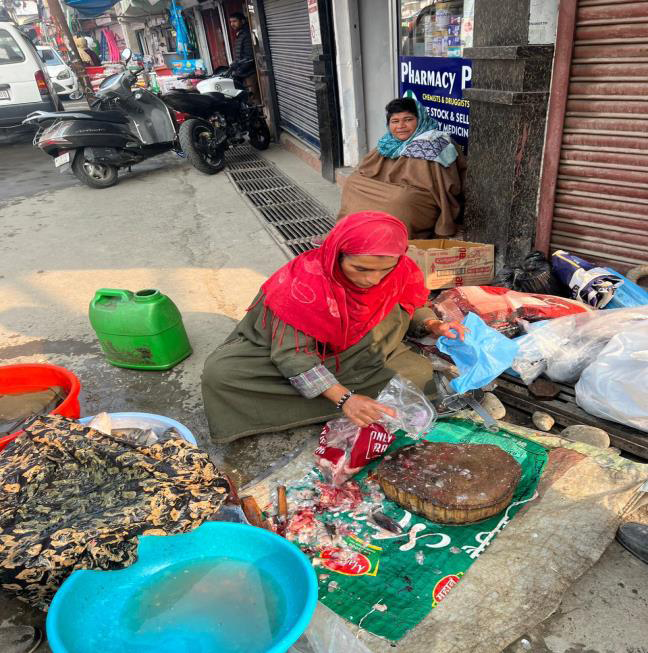
knowledge systems as shown in (Figure 1). Despite this, their labour
remains largely invisible in policy discourse, statistical records,
and fisheries management frameworks. This invisibility not only
marginalizes women socially but also weakens adaptive capacity in
the face of ecological stress.
Like small-scale fisherwomen globally, Kashmiri fisherwomen navigate multiple intersecting vulnerabilities, including environmental degradation, political instability, poverty, and exclusion from decision-making (Göncüoğlu & Ünal, 2011; Uduji & Okolo-Obasi, 2020). These intersecting pressures have only intensified under the combined impacts of climate variability, wetland deterioration, and
Like small-scale fisherwomen globally, Kashmiri fisherwomen navigate multiple intersecting vulnerabilities, including environmental degradation, political instability, poverty, and exclusion from decision-making (Göncüoğlu & Ünal, 2011; Uduji & Okolo-Obasi, 2020). These intersecting pressures have only intensified under the combined impacts of climate variability, wetland deterioration, and
the protracted armed conflict that continues to shape daily life in
Kashmir. Although several studies document discrete aspects of
fisherwomen’s lives in Kashmir such as occupational health risks
Sengupta & Krajewska-Kułak, 2014 or post-harvest labour, the
existing literature remains fragmented. Few attempts have been
made to integrate historical, cultural, socioeconomic, and ecological
dimensions into a coherent understanding of women’s lived realities
and adaptive strategies. Moreover, the gendered implications of
governance, environmental change, and market restructuring in
Kashmir’s inland fisheries remain underexplored. Addressing this
gap is essential for developing inclusive and climate-adaptive fisheries
management that recognizes women as key actors in sustainability
transitions.
To fill this gap, the present review offers a comprehensive synthesis
of interdisciplinary scholarship on Kashmiri fisherwomen, examining
their historical evolution, cultural significance, and socioeconomic
challenges within the broader context of ecological and political
change. Guided by a feminist political ecology framework, this study
explores how gendered relations of power shape women’s access to
resources, environmental knowledge, and resilience in freshwaterdependent
communities. Specifically, it seeks to answer four questions:
(1) How have the roles and social positioning of Kashmiri
fisherwomen evolved historically within the Hanji community?
(2) What are the primary socio-economic and politicalecological
constraints on fisherwomen’s livelihoods and agency?
(3) How do fisherwomen’s traditional ecological knowledge and informal
governance roles contribute to household and community resilience? and
(4) What are the critical gaps in policy and research, and what
pathways can advance equitable and sustainable fisheries governance
in Kashmir?
Methodology
This systematic review synthesized peer-reviewed and grey
literature on the historical, cultural, and socio-economic dimensions
of fisherwomen’s livelihoods in Kashmir. The review followed
established guidelines for environmental evidence synthesis
(Collaboration for Environmental Evidence 2018) ensuring
transparency, reproducibility, and minimization of selection bias. The
overall objective was to integrate dispersed evidence into a coherent
understanding of gendered roles, knowledge systems, and resilience
among Kashmiri fisherwomen.
A structured literature search was carried out between January
and August 2025 across five major databases: Scopus, Web of
Science, Google Scholar, JSTOR, and PubMed, to capture a
broad interdisciplinary scope spanning environmental science,
anthropology, gender studies, and South Asian development.
The search combined Boolean operators and key terms reflecting
population, context, and gender dimensions. The search included
combinations such as: (“fisherwomen” OR “women in fisheries”)
AND (“Kashmir” OR “Jammu and Kashmir”);(“Hanji” OR “Haenz”)
AND (“gender roles” OR “livelihoods”);(“small-scale fisheries” OR
“inland fisheries”) AND (“Kashmir”) AND (“gender”);(“traditional
ecological knowledge” OR “TEK”) AND (“fisheries” OR “wetlands”)
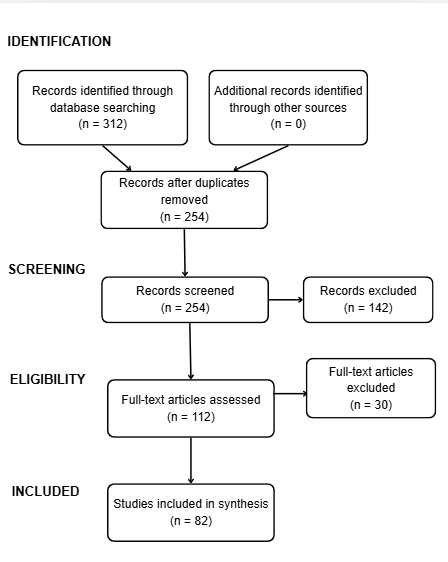
AND “Kashmir”. The initial search yielded 312 records, of which 254
unique studies remained after duplicate removal. Titles and abstracts
were screened according to predefined inclusion and exclusion
criteria. Inclusion criteria comprised studies that (1) focused
explicitly on fisherwomen, the Hanji community, or gendered labor
within Kashmir’s inland fisheries; (2) addressed ecological or socioeconomic
contexts of Kashmir’s lakes and wetlands; and (3) were
published in English between 1970 and 2025. Foundational historical
texts (e.g., Lawrence 1992; Sanyal 1979) were selectively included for
contextual depth. Exclusion criteria removed publications lacking
a gender focus, studies outside Kashmir, and non-credible grey
literature unless they provided unique community insights. After fulltext
review of 112 articles, 82 studies met the criteria for inclusion
in the synthesis. The selection process was done following PRISMA
guidelines. The study selection process is summarized in the PRISMA
flow diagram [Figure 2].
Each included study was entered into a standardized extraction
sheet capturing bibliographic information, objectives, findings,
geographic scope, and methodological approach. A mixed inductive–
deductive coding framework guided thematic analysis, identifying
recurring patterns aligned with the study’s research questions. Six
overarching analytical themes were derived:
• Historical evolution and gendered division of labour • Cultural identity and transmission of traditional ecological knowledge (TEK)
• Socio-economic vulnerabilities and access to resources
• Impacts of political and ecological instability
• Roles in the fisheries value chain and informal governance
• Policy and governance gaps
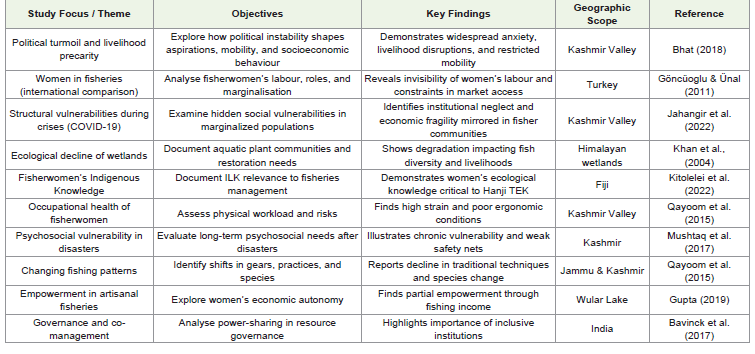
A representative subset of the reviewed studies is shown in (Table 1) illustrating thematic and geographic diversity.
The synthesis is limited by the scarcity of gender-disaggregated fisheries data and the qualitative nature of most evidence, which precluded quantitative meta-analysis. Rapidly changing political and ecological conditions in Kashmir may also alter contextual relevance over time. Additionally, restricting the search to English-language sources may have excluded relevant regional literature.
• Historical evolution and gendered division of labour • Cultural identity and transmission of traditional ecological knowledge (TEK)
• Socio-economic vulnerabilities and access to resources
• Impacts of political and ecological instability
• Roles in the fisheries value chain and informal governance
• Policy and governance gaps
A representative subset of the reviewed studies is shown in (Table 1) illustrating thematic and geographic diversity.
The synthesis is limited by the scarcity of gender-disaggregated fisheries data and the qualitative nature of most evidence, which precluded quantitative meta-analysis. Rapidly changing political and ecological conditions in Kashmir may also alter contextual relevance over time. Additionally, restricting the search to English-language sources may have excluded relevant regional literature.
Thematic Analysis:
Historical Evolution and Gendered Division of LabourThe historical trajectory of Kashmiri fisherwomen is deeply intertwined with the evolution of the Hanji (Haenz) community - a water-dwelling group whose livelihoods centered around fishing, ferrying, water-nut collection, and lake-based commerce for centuries. Early references to these fishing communities appear in ancient Kashmiri literature, including Kalhana’s Rajatarangini, which mentions “Nishads,” a class of boatmen and fishermen associated with the region’s waterways (Stein, 1900; Lawrence, 1992).
By the 19th and early 20th centuries, ethnographic accounts
portray the Hanji as a marginalized yet indispensable group, providing
fish, transportation, and ecological services while occupying the
lowest rungs of the social hierarchy (Lawrence, 1992; Sanyal, 1979).
Their settlements, clusters of houseboats, wooden huts, and floating
gardens around lake margins, reinforced a distinct identity rooted in
water-based livelihoods (Dar, 2014).
Historical accounts consistently highlight a clear gendered division
of labor within Kashmiri fishing households. Men traditionally
engaged in night-time fishing using gillnets and cast nets on lakes and
rivers, while women shouldered extensive daytime responsibilities:
fish sorting, cleaning, marketing, household provisioning, childcare,
fuel gathering, and water-nut collection (Sanyal, 1979; Dar, 2014).
Women’s dominance in fish vending represents a particularly
significant feature of the Hanji economy, making them the primary
link between lake ecosystems and urban consumers through door-todoor
sales and roadside vending (Dar, 2014).
Socially, fisherwomen occupied a marginalized yet vital space. Their economic contributions were essential, but decision-making power remained limited (Uduji & Okolo-Obasi, 2020). They were systematically excluded from fishing associations and cooperatives, restricting access to formal recognition and policy benefits (Göncüoğlu & Ünal, 2011). This marginalization was reinforced through symbolic practices, including naming conventions where women received diminutive names from spiritual preceptors, reflecting their subordinate status within Kashmiri society (Khan, 2007).
Over recent decades, these traditional roles have evolved under multiple pressures. Regional disparities in fish production growth - 7.9% in Jammu province compared to 4.2% in Kashmir province, indicate shifting resource dynamics and economic opportunities (Qayoom et al., 2015). Environmental degradation, particularly the decline of ecologically important species like Nelumbo nucifera,
Socially, fisherwomen occupied a marginalized yet vital space. Their economic contributions were essential, but decision-making power remained limited (Uduji & Okolo-Obasi, 2020). They were systematically excluded from fishing associations and cooperatives, restricting access to formal recognition and policy benefits (Göncüoğlu & Ünal, 2011). This marginalization was reinforced through symbolic practices, including naming conventions where women received diminutive names from spiritual preceptors, reflecting their subordinate status within Kashmiri society (Khan, 2007).
Over recent decades, these traditional roles have evolved under multiple pressures. Regional disparities in fish production growth - 7.9% in Jammu province compared to 4.2% in Kashmir province, indicate shifting resource dynamics and economic opportunities (Qayoom et al., 2015). Environmental degradation, particularly the decline of ecologically important species like Nelumbo nucifera,
has threatened traditional livelihoods (Khan et al., 2004). The
COVID-19 pandemic further exposed structural vulnerabilities,
disproportionately affecting households dependent on women’s dayto-
day vending activities (Jahangir et al., 2022). Overall, the historical
analysis reveals a persistent pattern where Kashmiri fisherwomen’s
economic centrality has coexisted with social and institutional
marginalization. While their specific tasks have evolved, their position
as indispensable yet undervalued actors within the fisheries economy
has remained remarkably consistent, establishing a critical foundation
for understanding contemporary challenges and resilience strategies.
Cultural Identity and Transmission of Traditional Ecological Knowledge:
The cultural identity of Kashmiri fisherwomen represents
a complex interplay of spiritual practices, social norms, and
intergenerational knowledge systems deeply embedded in freshwater
ecosystems. For the Hanji community, fishing constitutes not merely
an occupation but a cultural and ancestral legacy, with fish holding
symbolic value associated with fertility, prosperity, and spiritual
meaning (Allan, 2005).Cultural and religious values profoundly shape fisherwomen’s roles and identities. In Kashmir’s predominantly Muslim fishing communities, patriarchal interpretations of religious norms have historically structured gender roles, emphasizing women’s responsibilities in domestic labor, childcare, and limited mobility (Sanyal, 1979; Dar, 2014). These expectations influenced the types of fisheries-related work women could undertake, permitting vending and processing but often restricting participation in night fishing, gear ownership, or village councils. Spiritual life reinforces social cohesion, with regular visits to shrines (dargahs) and communal rituals strengthening shared identity among fisher families (Dar, 2014). Like many artisanal fishing communities globally, cultural practices surrounding fish, water, and livelihoods intertwine with spiritual beliefs, seasonal cycles, and communal rituals (Allan, 2005; Seixas et al., 2018). Traditional Ecological Knowledge (TEK) forms the cornerstone of this cultural heritage, with fisherwomen serving as primary custodians of lacustrine knowledge systems. Their gender-specific TEK encompasses intimate understanding of fish behavior, seasonal hydrological patterns, aquatic vegetation dynamics (including species like Nelumbo nucifera), water quality indicators, and market preferences (Kitolelei et al., 2022; Khan et al., 2004). While men accumulate TEK through night fishing and gear handling, women develop expertise in sorting, processing, and market dynamics, forms of knowledge critically underrepresented in formal research (Gupta, 2019).
This knowledge is transmitted intergenerationally through practical demonstration during daily activities, creating a repository of ecological understanding that contributes to sustainable fisheries management (Seixas et al., 2018). Recent research shows that when women participate in community-based monitoring, ecological data becomes more robust and management outcomes improve. Material culture further reflects cultural identity, with ornamentation historically limited to simple coral bead necklaces and glass bangles, indicating both aesthetic preferences and economic constraints (Khan, 2007). Despite social marginalization, fisherwomen maintain strong community ties through storytelling, folk songs, shared meals, and communal work, reinforcing a sense of belonging and cultural continuity (Lawrence, 1992).
Synthesis: The cultural dimensions reveal fisherwomen as crucial repositories of ecological knowledge and cultural heritage. Their TEK represents not merely a historical artifact but a living, adaptive resource that offers valuable insights for contemporary conservation challenges. Recognizing and validating this knowledge is essential for developing culturally grounded and ecologically sustainable fisheries management approaches in Kashmir.
Socio-economic Vulnerabilities and Access to Resources:
The socio-economic position of Kashmiri fisherwomen is
characterized by intersecting vulnerabilities that span demographic,
educational, economic, and institutional dimensions.Demographically, fisherwomen predominantly belong to the Hanji community, with household structures typically large and multigenerational, where women contribute substantially to family subsistence despite limited formal recognition (Dar, 2014). Marriage patterns often involve early union, which combined with cultural restrictions reduces opportunities for formal education and limits occupational mobility (Sanyal, 1979; Khan, 2007).
Literacy levels remain persistently low, shaped by intergenerational beliefs that women’s education offers little economic return (Sanyal, 1979; Khan, 2007). This educational barrier restricts women’s ability to access formal employment, engage in fisheries governance, or navigate bureaucratic processes required to obtain licenses or government benefits, mirroring global trends where limited education in smallscale fisheries correlates with reduced economic agency (Uduji & Okolo-Obasi, 2020; FAO, 2014). Economically, fisherwomen’s contributions are indispensable yet systematically undervalued and precarious. They dominate postharvest activities including sorting, cleaning, drying, and transporting fish, and serve as the primary market interface through door-to-door vending and informal sales (Dar, 2014). Their economic role extends to water-nut (Trapa spp.) harvesting, providing crucial supplementary income during seasonal catch declines (Dar, 2014). These laborintensive activities, conducted under harsh conditions, contribute to poor occupational health outcomes including musculoskeletal strain and chronic fatigue, highlighting physical strain (Figure 3) (Sengupta & Krajewska-Kułak, 2014).
Persistent gender disparities in resource access exacerbate economic vulnerabilities. Ownership of productive assets like boats, nets, and gear overwhelmingly rests with men, restricting women’s autonomy in production decisions. Most government subsidies, training programs, and credit schemes target registered fishermen, systematically excluding women who rarely hold licenses or cooperative memberships (Göncüoğlu & Ünal, 2011). This pattern is documented across Asia and Africa, where women struggle to enter formal fisheries co-operatives or benefit from capacity-building initiatives (Uduji et al., 2020).
Market-related constraints further undermine economic security.
The absence of designated fish markets forces fisherwomen to sell in
informal spaces lacking sanitation, shelter, and municipal protection
(Dar, 2014). Inadequate transport infrastructure and mobility
restrictions limit market access, reducing bargaining power and
forcing acceptance of lower prices, a global pattern where women
in small-scale fisheries face similar spatial and economic constraints
(FAO, 2014; Bavinck et al., 2017).
The COVID-19 pandemic dramatically exposed these structural vulnerabilities, as movement restrictions and market closures severely disrupted livelihoods, exacerbating financial insecurities (Jahangir et al., 2022) . For communities already experiencing political instability and environmental degradation, such shocks compound longstanding hardships (Bhat, 2018; Mushtaq et al., 2017).
The socio-economic analysis reveals a paradox where fisherwomen’s economic centrality coexists with systemic marginalization. Their labor forms the backbone of the fisheries economy, yet intersecting barriers in education, resource ownership, financial access, and market infrastructure perpetuate cycles of vulnerability. This underscores the need for targeted interventions that address both economic inclusion and social empowerment.
The COVID-19 pandemic dramatically exposed these structural vulnerabilities, as movement restrictions and market closures severely disrupted livelihoods, exacerbating financial insecurities (Jahangir et al., 2022) . For communities already experiencing political instability and environmental degradation, such shocks compound longstanding hardships (Bhat, 2018; Mushtaq et al., 2017).
The socio-economic analysis reveals a paradox where fisherwomen’s economic centrality coexists with systemic marginalization. Their labor forms the backbone of the fisheries economy, yet intersecting barriers in education, resource ownership, financial access, and market infrastructure perpetuate cycles of vulnerability. This underscores the need for targeted interventions that address both economic inclusion and social empowerment.
Navigating Political Conflict and Environmental Change:
Kashmiri fisherwomen operate within a complex landscape of
compounded stressors, where political instability and environmental
degradation intersect to create unique challenges that test their
resilience and adaptive capacities.Political and Conflict-Related Constraints:
The protracted political instability in Kashmir has profoundly
shaped fisherwomen’s daily lives and livelihood security. Frequent
security restrictions, curfews, checkpoints, and communication
shutdowns disrupt routine activities and compromise income
reliability (Mushtaq et al., 2017). For fisherwomen who rely on
mobility across neighborhoods for door-to-door fish vending, any
movement restriction directly translates into lost earnings and spoilage
of perishable goods (Dar, 2014). Market fragmentation intensifies
during periods of unrest, with road closures and transportation delays
reducing access to urban centers. The absence of cold storage facilities
compounds these losses, creating cascading economic impacts (Nabi
et al., 2016).
The psychological toll of prolonged conflict adds an invisible but
substantial burden to fisherwomen’s daily labor. Stress, uncertainty,
and fear for family safety reflect patterns noted in conflict-affected
fishing communities globally, where women already burdened with
household responsibilities experience compounded vulnerability due
to political disruptions (Béné, 2016).Environmental Pressures and Climate Impacts:
Environmental degradation poses equally severe threats to
fisherwomen’s livelihoods. Dal and Wular Lakes, once rich in fish
diversity and productivity, have suffered extensive eutrophication,
encroachment, siltation, and invasive species proliferation (Khan
et al., 2004). Declining fish stocks directly decrease the volume and
consistency of catches that women depend on for post-harvest work
and market vending.
Climate-related changes exacerbate these trends, with altered
rainfall patterns, shortened winters, and increased frequency of
extreme weather events disrupting traditional fishing cycles (Qayoom
et al., 2015). The reduced availability of economically significant
species like Schizothorax particularly affects women, as lower fish
availability means reduced daily earnings and diminished capacity
to buffer environmental shocks, echoing patterns observed in small scale
fisheries across the Himalayas and Southeast Asia (FAO, 2014;
Smith & Basurto, 2019).Habitat degradation also impacts water-nut (Trapa spp.) harvesting, another critical livelihood activity for fisherwomen. Increased pollution and wetland shrinkage reduce Trapa productivity, creating seasonal instability and labor intensification as women must cover larger areas for collection (Dar, 2014).
Intersecting Vulnerabilities and Adaptive Responses:
These political and environmental pressures intersect with preexisting
gender-specific constraints. Restrictions on mobility, shaped
by conservative interpretations of safety and propriety, limit women’s
access to distant markets or alternative employment during crises (Dar,
2014). Occupational health challenges compound these barriers, with
long hours of physical labor in challenging conditions resulting in
chronic health issues that often go untreated due to limited healthcare
access (Sengupta & Krajewska-Kułak, 2014).Despite these compounded challenges, fisherwomen demonstrate remarkable adaptive capacity. Many employ sophisticated coping strategies, including livelihood diversification, strengthening of informal credit networks, and reliance on intergenerational ecological knowledge to navigate changing environments (Gupta, 2019). Their participation in community-based conservation initiatives such as lake stewardship and seasonal monitoring demonstrates their potential as key actors in developing context-appropriate adaptation strategies.
Synthesis: The intersection of political conflict and environmental
change creates a uniquely challenging operating environment for
Kashmiri fisherwomen, where external shocks amplify pre-existing
vulnerabilities. However, their demonstrated resilience and adaptive
strategies highlight the importance of recognizing fisherwomen not as
passive victims but as active agents whose knowledge and experience
are essential for developing effective, context-sensitive approaches
to crisis management and environmental stewardship in conflict affected
regions.
Roles in Fisheries Value Chain and Informal Governance:
Kashmiri fisherwomen constitute the operational backbone of the
small-scale fisheries economy, performing a comprehensive spectrum
of tasks that span the entire value chain. Their contributions,
though often invisible in formal policy and academic discourse,
encompass pre-harvest, harvest-adjacent, post-harvest, marketing,
and knowledge-transmission domains, mirroring global patterns
where women provide nearly half of all fisheries labor yet remain
systematically under-recognized (FAO, 2014).Pre-Harvest and Harvest-Adjacent Roles:
While cultural norms largely exclude women from capture
fishing, they exert substantial influence in preparatory and supportive
stages. Fisherwomen frequently assist in cleaning nets, preparing
bait, repairing baskets, and coordinating household schedules to
align fishing activities with domestic responsibilities, a pattern of
“supportive labor” documented across South Asian small-scale
fisheries (Göncüoğlu & Ünal, 2011; Bavinck et al., 2017). Their role
extends to financial stewardship, as women often manage household
capital needed to maintain fishing equipment, negotiating loans and
purchasing inputs to stabilize operations amid erratic fish availability
and political disruptions.Even without direct participation in capture fishing, women maintain an active lake presence through Trapa (water-nut) collection and seasonal harvesting of aquatic plants like nadru (lotus stems). These activities provide crucial supplementary income during fish catch declines, serving as vital buffer mechanisms against environmental and political shocks (Dar, 2014). This harvest-adjacent work is particularly significant for widowed, elderly, or single women who depend on small-scale lake-based livelihoods.
Post-Harvest Processing: The Central Domain:
Post-harvest work represents the domain where fisherwomen
exercise their most concentrated influence. Their responsibilities
include fish cleaning, sorting by size and species, gutting, washing,
and preparing products for sale. Some women engage in valueaddition
through marinating, curing, or pre-chopping fish for timeconstrained
urban consumers. These tasks require sophisticated
knowledge of species handling and quality assessment, yet they
remain largely unpaid within household settings and undervalued in
economic assessments.Global studies affirm that women’s post-harvest labor serves as a primary stabilizer of small-scale fisheries, ensuring food quality, safety, and efficient distribution (FAO, 2014). However, this essential work exposes women to significant occupational risks, including cold-water exposure, repetitive-strain injuries, and ergonomic stress from prolonged periods in physically demanding positions (Sengupta & Krajewska-Kułak, 2014).
Marketing and Trade: Economic Interface:
For most fisherwomen, selling fish constitutes the core source
of cash income and represents their most visible economic role.
Women dominate the marketing stage, particularly through doorto-
door vending, a traditional distribution model in Srinagar that
ensures rapid product movement in a context lacking cold storage
infrastructure (Dar, 2014). This system relies on personalized
customer relationships, flexible pricing strategies, and culturally
embedded trust networks, with women’s negotiation skills directly
determining daily household income.
Despite spatial limitations imposed by gender norms and
safety concerns, which restrict vending to familiar neighborhoods,
fisherwomen have developed highly effective localized trade networks.
Earnings from vending provide substantial household bargaining
power, enabling women to purchase food, support children’s
education, and manage emergencies. However, these economic
gains occur within challenging conditions, including harassment,
municipal evictions, lack of shelter, and competition from male
vendors—challenges echoed in informal small-scale fisheries markets
worldwide (Bavinck et al., 2017).Knowledge Systems and Informal Governance:
Fisherwomen play an indispensable role in preserving and
transmitting Traditional Ecological Knowledge (TEK), a cumulative
body of understanding about fish behavior, lake ecology, seasonal
timing, and product quality refined through generations of daily
practice. Elder women, in particular, teach younger generations
about sustainable harvesting practices for Trapa and aquatic plants,
cultural norms associated with lake stewardship, food preservation
methods, and market dynamics (Sanyal, 1979; Lawrence, 1992; Smith
& Basurto, 2019).Although formal fisheries governance structures rarely include women, they participate extensively in informal decision-making spaces like family councils, community meetings, and neighborhood networks, where daily operational choices are negotiated. Women influence decisions about selling timing and pricing, fishing locations (through indirect negotiation with male relatives), household budget management, and conflict resolution during political disruptions. Globally, these informal governance roles in small-scale fisheries contribute significantly to community resilience and social cohesion, even when institutions fail to formally recognize them (Bavinck et al., 2017).
Synthesis:
The comprehensive analysis of fisherwomen’s roles across the
fisheries value chain reveals a fundamental disconnect between their
operational centrality and institutional recognition. While their
labor, knowledge, and informal governance sustain both household
economies and ecological practices, their systematic exclusion from
formal decision-making structures perpetuates a cycle where policies
affecting their lives and livelihoods are developed without their input.This paradox highlights the urgent need for governance models that
bridge the gap between women’s de facto expertise and their de jure
representation in fisheries management.
Discussion
This systematic review, guided by a feminist political ecology
framework, demonstrates that Kashmiri fisherwomen operate at the
intersection of ecological knowledge, gendered labor, and political
marginalization. Far from passive actors, they actively sustain both
household economies and freshwater ecosystems, despite structural
exclusion from formal governance.
The Paradox of Centrality and Marginalization:
A key finding is the persistent paradox wherein fisherwomen’s
economic and ecological centrality coexists with institutional
invisibility. Women dominate post-harvest processing, marketing, and
knowledge transmission, yet remain excluded from decision-making
structures (Dar, 2014). This reflects broader patterns in small-scale
fisheries globally, where women’s contributions remain undervalued
despite their critical roles (Göncüoğlu & Ünal, 2011; Uduji & Okolo-
Obasi, 2020). In Kashmir, this marginalization is further shaped by
the Hanji community’s historical social positioning, reinforcing
layered inequalities.Gendered Knowledge and Ecological Stewardship:
Fisherwomen’s Traditional Ecological Knowledge (TEK) emerges
as a crucial yet under-recognized resource for sustainable fisheries
management. Their insights into fish quality, seasonal variation,
aquatic vegetation, and market dynamics complement maledominated
capture knowledge systems. Integrating this gendered
knowledge into management frameworks is not only an issue of
equity but also essential for ecological sustainability, particularly
under increasing climate stress (Khan et al., 2004; Smith & Basurto,
2019).Resilience under Compound Vulnerabilities:
Kashmiri fisherwomen operate within overlapping stressors
such as political conflict, environmental degradation, and economic
precarity. Despite these constraints, they demonstrate adaptive
strategies such as livelihood diversification, informal credit networks,
and flexible market practices (Gupta, 2019). While this resilience
highlights agency, it should not obscure systemic inequities. Overreliance
on individual coping mechanisms risks reinforcing long-term
vulnerability.Governance Gaps and Policy Implications:
The absence of fisherwomen from formal governance structures
represents both a social inequity and a management limitation.
Policies that exclude women overlook critical knowledge and
reduce effectiveness. The COVID-19 pandemic further exposed
these vulnerabilities, underscoring the need for inclusive and crisisresponsive
governance systems (Jahangir et al., 2022).Comparative Insights and Gendered Safety:
Kashmiri fisherwomen share similarities with women in small scale
fisheries globally, particularly in relation to informal labor,
restricted mobility, and limited institutional recognition. However,
the intersection of conflict, ecological change, and cultural norms
creates a distinct context requiring locally grounded solutions.
Additionally, safety concerns including harassment in markets and
insecure vending spaces remain underreported but significantly affect
women’s economic agency and mobility.Overall, the findings emphasize that meaningful fisheries governance in Kashmir must move beyond gender-neutral approaches and actively integrate fisherwomen’s roles, knowledge, and lived realities into policy and practice.
Policy and Management Implications:
Based on our systematic review, we propose eight evidence-based
policy directions that address the intersecting challenges faced by
Kashmiri fisherwomen while leveraging their demonstrated resilience
and ecological knowledge.In the Kashmir context, targeted interventions could include the formal recognition of Dal and Wular lake fisherwomen as registered stakeholders in lake management authorities, provision of designated vending zones in Srinagar fishing markets such as Hazratbal and Lal Chowk, and integration of fisherwomen into wetland restoration programs led by government agencies. Additionally, region-specific mobility passes during security restrictions and inclusion in tourismlinked value chains (e.g., eco-cultural lake tourism) could significantly enhance livelihood resilience.
Institutional Recognition and Governance Inclusion:
Formally recognize fisherwomen’s contributions across the
value chain by ensuring their representation in lake-management
committees, vendor associations, and community-based
organizations. Evidence from comparable contexts demonstrates that
women’s formal participation improves sustainability outcomes and
enhances policy compliance (Göncüoğlu & Ünal, 2011; Bavinck et al.,
2017).Gender-Responsive Market Infrastructure:
Establish dedicated, hygienic fish markets with designated
women’s vending spaces, cold storage facilities, and basic amenities.
Such infrastructure would reduce harassment, prevent evictions, and
minimize post-harvest losses critical for women who rely on daily
sales for household sustenance (Dar, 2014).Mobility and Safety Measures:
Implement gender-sensitive mobility solutions, including
subsidized transport passes, women-only transit routes during early
morning hours, and safe vending zones. In conflict-affected contexts,
consider GPS-assisted boat mobility permissions during curfews to
maintain essential livelihood activities (Mushtaq et al., 2017).Financial Inclusion Mechanisms:
Develop women-focused financial products including nocollateral
micro-credit schemes, simplified banking procedures, and
financial literacy programs. Gender-responsive credit access has
proven effective in reducing dependence on exploitative lenders and
enhancing economic resilience in comparable small-scale fisheries
(FAO, 2014).Social Protection and Occupational Health:
Implement comprehensive social protection measures including
universal health insurance, subsidized protective gear (waterproof
clothing, gloves), dedicated health camps for musculoskeletal
disorders, and childcare support at markets. These measures address
the documented occupational health risks faced by women in smallscale
fisheries value chains (Sengupta & Krajewska-Kułak, 2014).Climate-Resilient Fisheries Management:
Integrate wetland restoration, pollution control, and invasive
species management with gender-responsive approaches. Specifically,
involve fisherwomen in ecological monitoring teams to leverage their
traditional ecological knowledge of seasonal changes and habitat
conditions (Khan et al., 2004).Education and Leadership Development:
Support adult literacy programs, vocational training in value addition
techniques, digital literacy for market access, and leadership
courses aimed at increasing participation in fisheries governance.
Education remains a critical pathway for enhancing women’s market
competitiveness and political agency (Khan, 2007).Alignment with Global Standards:
Formally align Kashmir’s fisheries policies with the FAO Small-
Scale Fisheries Guidelines, emphasizing human rights, gender equity,
social protection, and participatory governance. This alignment
would facilitate gender-sensitive data collection, explicit recognition
of women’s economic rights, and protection from market harassment
and eviction.Future Research Directions:
Our systematic review identifies eight critical research priorities
that would significantly advance understanding of Kashmiri
fisherwomen’s lives and livelihoods:Gender-Disaggregated Data Systems:
Priority should be given to systematic enumeration of women’s
contributions across the value chain, including gender-specific
income, labor, and mobility data. Time-use surveys documenting
double workloads and longitudinal market participation data are
urgently needed to make fisherwomen visible in governance (FAO,
2014).Contemporary Ethnographic Studies:
Detailed ethnographic research is needed to examine everyday
labor practices, evolving cultural norms, spiritual dimensions of
women’s roles, household power dynamics, and transformations in
traditional ecological knowledge transmission.Gendered Climate Vulnerability:
Research should investigate gender-differentiated climate
impacts, including how water quality decline and invasive species
affect women’s foraging and vending practices, and document
women’s adaptive strategies during environmental and political crises.Market Dynamics and Economic Pathways:
Studies should analyze gendered constraints in marketing and
pricing, post-harvest losses, potential for value-addition enterprises,
digital transformations in market access, and effects of market
formalization on women’s agency.Governance in Conflict Contexts:
Research should explore how conflict dynamics shape women’s
participation in governance, barriers to cooperative membership, and
models for gender-inclusive co-management in politically volatile
regions.Comparative and Cross-Cultural Analysis:
Situating Kashmir within global context through comparisons
with small-scale fisheries women in Southeast Asia, East Africa,
and the Middle East would reveal transferable lessons and unique
contextual factors.Intergenerational Change:
Critical research is needed on youth transitions, including future
traditional knowledge transmission, shifting attitudes toward fishing
livelihoods, and gender role renegotiation as educational access
expands.Psychosocial Well-being:
Virtually unexplored is the psychological dimension - stress,
anxiety, emotional labor, mental health impacts of conflict and
precarity, and community resilience mechanisms, essential for
designing holistic social protection programs.Acknowledgements
The authors gratefully acknowledge the scholars, practitioners,
and community members whose work and lived experiences informed
this review. We also thank colleagues who provided valuable feedback
during the development of this manuscript. No specific funding was
received for this study.
Competing Interests:
The authors declare that they have no financial or non-financial
interests that could be perceived as directly or indirectly influencing
the work reported in this manuscript.Conclusion
This systematic review demonstrates that Kashmiri fisherwomen
occupy a complex position at the intersection of gender, ecology,
livelihood, and political uncertainty. While their labor, knowledge,
and informal governance sustain both household economies and
freshwater ecosystems, their contributions remain structurally
undervalued within policy, scholarship, and public perception.
The evidence reveals a persistent paradox: fisherwomen’s economic and ecological centrality coexists with their social and institutional marginalization. Despite operating in a context of compounded vulnerabilities—where political conflict, environmental degradation, economic precarity, and patriarchal norms intersect—these women demonstrate remarkable resilience through sophisticated adaptive strategies, including livelihood diversification, informal networks, and knowledge-based navigation of change. Our findings suggest that recognizing fisherwomen’s voices, valuing their labor, and supporting them is not merely an equity issue but an ecological and economic imperative. The integration of their traditional ecological knowledge into management frameworks, coupled with their formal inclusion in governance structures, represents a critical pathway toward both social justice and environmental sustainability in Kashmir’s inland fisheries. By highlighting gendered dimensions of resilience in a conflictaffected freshwater system, this review contributes to broader understandings of social-ecological adaptation under climate stress and reframes Kashmiri fisherwomen not as passive victims of structural inequities but as knowledge-holders, ecological stewards, and central actors whose experiences offer powerful insights into the intertwined futures of gender, ecology, and livelihood in smallscale fisheries worldwide. Without gender-inclusive reforms, fisheries governance in Kashmir risks reinforcing existing inequalities while undermining long-term ecological sustainability.
The evidence reveals a persistent paradox: fisherwomen’s economic and ecological centrality coexists with their social and institutional marginalization. Despite operating in a context of compounded vulnerabilities—where political conflict, environmental degradation, economic precarity, and patriarchal norms intersect—these women demonstrate remarkable resilience through sophisticated adaptive strategies, including livelihood diversification, informal networks, and knowledge-based navigation of change. Our findings suggest that recognizing fisherwomen’s voices, valuing their labor, and supporting them is not merely an equity issue but an ecological and economic imperative. The integration of their traditional ecological knowledge into management frameworks, coupled with their formal inclusion in governance structures, represents a critical pathway toward both social justice and environmental sustainability in Kashmir’s inland fisheries. By highlighting gendered dimensions of resilience in a conflictaffected freshwater system, this review contributes to broader understandings of social-ecological adaptation under climate stress and reframes Kashmiri fisherwomen not as passive victims of structural inequities but as knowledge-holders, ecological stewards, and central actors whose experiences offer powerful insights into the intertwined futures of gender, ecology, and livelihood in smallscale fisheries worldwide. Without gender-inclusive reforms, fisheries governance in Kashmir risks reinforcing existing inequalities while undermining long-term ecological sustainability.
Ethics approval:
The research involved voluntary social-science interviews and
did not require formal institutional ethics approval. All participants
provided informed verbal consent prior to participation.References
Citation
Mushtaq ST, Shah TH, Mushtaq SA, Hafiz Z, Jan A. Balancing on the Edge: The Resilient Lives of Kashmiri Fisherwomen. J Environ Soc Sci. 2026;11(1): 136.