


Research Article
An Imperative Study of Ecotourism with Respect to Environmental Consciousness and Their Impact in Shekhawati Region of Rajasthan
Dular AK* and Khan N
Department of Environmental science, MGS University, Bikaner, Rajasthan, India
*Corresponding author:Anil Kumar Dular, Department of Environmental Science, MGS University, Bikaner, Rajasthan, India. E-mail Id: dular_ak@rediffmail.com
Article Information:Submission: 09/12/2025; Accepted: 07/01/2026; Published: 10/01/2026
Copyright: © 2026 Dular AK, et al. This is an open access article distributed under the Creative Commons Attribution License, which permits unrestricted use, distribution, and reproduction in any medium, provided the original work is properly cited.
Abstract
Ecotourism may appeal to ecologically and socially conscious individuals. Generally, it focuses on volunteering, personal growth and environmental responsibility. Ecotourism typically involves travel to destinations where flora, fauna, and cultural heritage are the primary attractions. One of the goals of ecotourism is to offer tourists insight into the impact of human beings on the environment, and to foster a greater appreciation of our natural habitats. Therefore, in addition to evaluating environmental and cultural factors, an integral part of ecotourism is the promotion of recycling, energy efficiency, water conservation, and creation of economic opportunities for local communities.
Introduction
Ecotourism (also known as ecological tourism) is responsible
travel to fragile, pristine, and usually protected areas that strives to
be low impact and (often) small scale [4]. It purports to educate the
traveller; provide funds for ecological conservation; directly benefit
the economic development and political empowerment of local
communities; and foster respect for different cultures and for human
rights. Ecotourism is held as important by those who participate in it
so that future generations may experience aspects of the environment
relatively untouched by human intervention. Ecotourism is a form
of tourism that involves traveling to tranquil and unpolluted natural
areas [6] According to the definition and principles of ecotourism
established by The International Ecotourism Society (TIES) in 1990,
ecotourism is “Responsible travel to natural areas that conserves the
environment and improves the well-being of local people.[7]
About Study Area
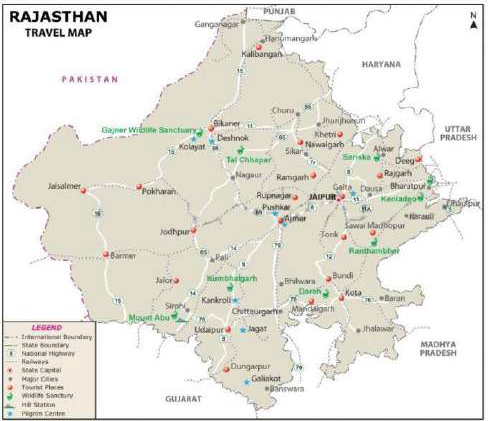
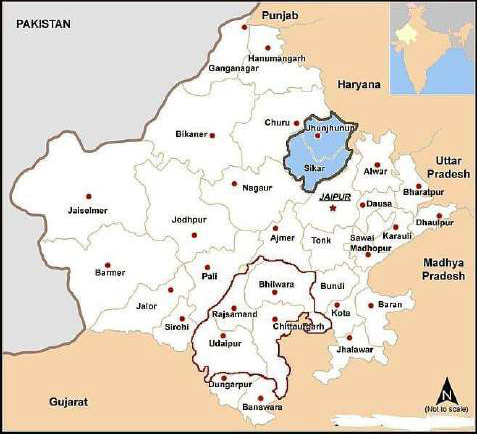
Shekhawati region of Rajasthan consists of the areas falling under
Sikar, Jhunjhunu and some parts of Churu, Nagaur and Jaipur. There
are thousands of Villages & Towns which falls under this region.
Shekhawati is famous for its rich heritage and beautiful architectures
full of fresco paintings, hence also known as open air art gallery. In
terms of geography, Shekhawati is an arid desert zone in Northeastern
Rajasthan [6]. It falls under the Sikar, Jhunjhunu regions, and parts of
Churu, Nagaur, and Jaipur. It is a hotspot for those who want to take
a peek into India‘s rich cultural heritage and its art—the gorgeous
architecture of Shekhawati is adorned with beautiful fresco paintings,
giving it the name the open-air art gallery. The architectural structures
you will get to see include Havelis(mansions), Bawadi (step wells),
Dharamshalas (charitable inns), Chhatris (cenotaph), and Forts,
built by the Shekhawat Rajput rulers and Marwari community.
The Shekhawati region in Rajasthan is known for its sculptures,
handicrafts, and most importantly, its fresco paintings on the walls
of Havelis and historical buildings. It has the largest concentration
of wall painted mansions, forts, cenotaphs, and mansions in the
country and the most extensive collection of murals in the world [8].
Some of the most important sites to visit are Nawalgarh, Mandawa,
Jhunjhunu, Churu, Dundlod, Mukundgarh, Alsisar, and Tal Chhapar
Sanctuary. The fresco paintings were made by artists who were called
chiteras, who belonged to the kumhars(potters) caste. They were
bright and colorful depictions of Shekhawati culture made using only
natural colors.
The present inventory of mammals and birds will help in
monitoring the population in future.[2] Shekhawati region is not so
rich in carnivores and large mammals ‘diversity as compared to other
districts of the Thar desert. Major reason for the poor diversity of
these animals is high human population, fast destruction of natural
habitats, industrialization, illegal mining, irrigation, shrinking forest
covers and poaching. Only protected area of the region, Tal Chhapar
Blackbuck sanctuary, is a small fenced area of about 7.19sq km. In
addition to Blackbucks, some snakes, lizards, harriers and some
other predator avian species are found in the sanctuary. Important
mammals found in the region are Desert fox, Blackbuck, Blue bull,
Desert cat, Mongoose, Hedgehog, Musk shrew, Desert gerbil, Indian
gerbil and eight chiropteran species. Cobra, Saw-scaled viper and
Krait are poisonous snakes of the area. No significant work on
vertebrate diversity of Shekhawati region has been carried out, except
the systematic of small mammalian [10].
As in floral composition the region lies in semiarid zone with low
floral diversity due to scantly and irregular rainfall. Wind velocity
in the region is quite high during the summer and sand storms are
common feature of the area. Sand dunes are dominant in the entire
region especially in northwestern part [1]. Though a large percentage
of the total area is desert and even though there is little forest cover,
Rajasthan has a rich and varied flora and fauna. The natural vegetation
is classed as Northern Desert Thorn Forest (Champion 1936). These
occur in small clumps scattered in a more or less open forms. Density
and size of patches increase from west to east following the increase
in rainfall. The Northwestern thorn scrub forests lie in a band around
the Thar Desert, between the desert and the Aravallis. The Aravalli
and the south-eastern region are home to the dry deciduous forests,
with tropical dry broadleaf forests that include teak, Acacia, and
other trees [3] Uncontrolled mining in mountain range of Aravalli
and other small hiclocks in Jhunjhunu and Sikar districts are also
affecting the floral and faunal diversity. Changing floral composition
will definitely affect the faunal composition of the region [5].
Methodology
The inventory of the present discourses was based on secondary
data collected from different previous research, questionnaires made
during the visit at various destination pertaining to ecotourism, help
has been taken from the officials of tourism department of govt of
Rajasthan, government policies, reports, case studies and various
reports generated by NGOs as a supplemented studies for the
proliferation as ecotourism concept. The researcher also used the
information and facts already available as base in order to analyze,
explore and evaluate the problem at hand critically to figure out
conclusion.
The study was based mainly upon the primary data and to find out the tourist potential of the area secondary data also used.
Primary data:It was collected from the local people and from the official of the various departments.
Secondary data:To find out the potential for tourism in that area secondary source such as Brochures, Publicity materials of the tourism dept. were used. The information was collected with the help of interview through questionnaires. Identification of flora in study is based on the use of herbarium of the parental varsity. To obtain the answer to question that how we can involve community in that area interviews of the above respondents were taken. To find out the potential for tourism in that area, interviews of local people were taken. The question in this part was open ended, with respondents encouraged to identify as many opportunities and impediments as possible. The questions in the questionnaire were focused to find out the problems in the conservation and ecotourism. This part deals with the analysis & interpretation of the data collected with the help of questionnaire related to professionals. Local people and tourists at Jhunjhunu district, specifically. There are about 10 questionnaires out of which 7 are filled by professionals (service man, government organization tourism department etc. of the region and remaining 3 filled by people of the local area community who are not engaged in any professional field at present (retired persons, self-employed, traditional peoples and so on).
The study was based mainly upon the primary data and to find out the tourist potential of the area secondary data also used.
Primary data:It was collected from the local people and from the official of the various departments.
Secondary data:To find out the potential for tourism in that area secondary source such as Brochures, Publicity materials of the tourism dept. were used. The information was collected with the help of interview through questionnaires. Identification of flora in study is based on the use of herbarium of the parental varsity. To obtain the answer to question that how we can involve community in that area interviews of the above respondents were taken. To find out the potential for tourism in that area, interviews of local people were taken. The question in this part was open ended, with respondents encouraged to identify as many opportunities and impediments as possible. The questions in the questionnaire were focused to find out the problems in the conservation and ecotourism. This part deals with the analysis & interpretation of the data collected with the help of questionnaire related to professionals. Local people and tourists at Jhunjhunu district, specifically. There are about 10 questionnaires out of which 7 are filled by professionals (service man, government organization tourism department etc. of the region and remaining 3 filled by people of the local area community who are not engaged in any professional field at present (retired persons, self-employed, traditional peoples and so on).
Results and Discussion
Graphical representation and interpretation of statistical
data received from the respondents as per various
parameters
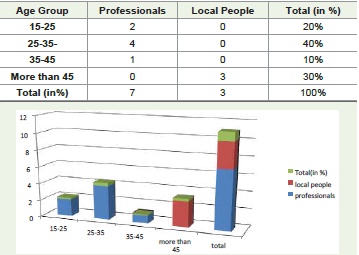
1. AGE GROUP (PARAMETER):
InterpretationThrough the data collected it has been found that most of the people are young ones in the case of professionals out of 70%, 20% lie in the age group of 15-25, 40% of professional’s lie in the age group of 25-35 and 10% lie in the age group of 35-45 while in the case of local respondents, all of the 30% lie in the age group of more than 45 years.
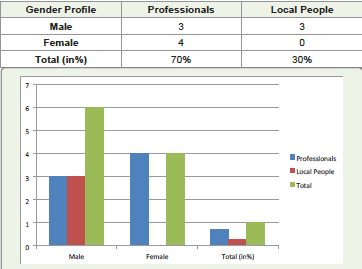
2. GENDER PROFILE (PARAMETER):
InterpretationThrough the data collected it has been found that in the case of professionals there are 30% male
& 40% are female. Similarly in the case of local people there are 30% respondents of male Gender only. Therefore, it’s clear from the above data that ratio of male Gender is e more in terms of respondents as compared to female respondents.
3. EDUCATIONAL QUALIFICATION (PARAMETER):
Interpretation
For analyzing educational status of respondents, we sought as
Graduate, Post graduate & others like illiterate, matric, etc. Now in
the case of professionals as per the name (category) all were post
graduate (70%) whereas in the case of local people, 10% are graduate
while remaining 20% are from others.4.. OCCUPATION (PARAMETER):
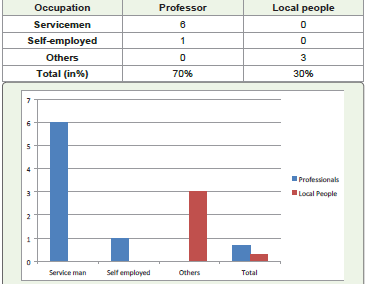
InterpretationPortion regarding occupation of the respondents were based on occupation as service man, self-employed and others like unemployed, student, retired etc. In the case of professionals all 60% where service man expects of 10% are self-employed, whereas among local people all 30% are of others.
5. Do you know about Ecotourism? (Parameter):
Interpretation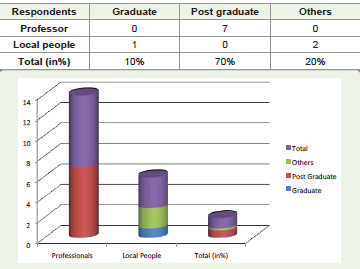
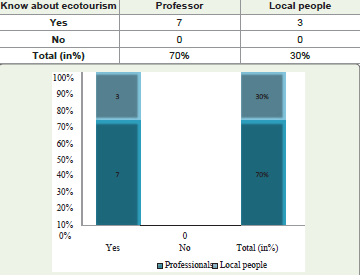
Through the data collected, I found in the case of ‘ to know about
the ecotourism ‘ all 70% from professionals as well as from local
(30%) were aware about this topic.
6.. Do you welcome tourists with open hands? (Parameter:
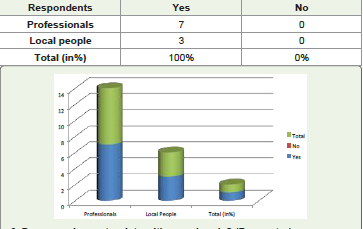
InterpretationThrough the date collected, we concluded that all the 70% of professionals agree to the statement that they welcome tourists with open hands similarly all the 30% of the local people agree with the same.
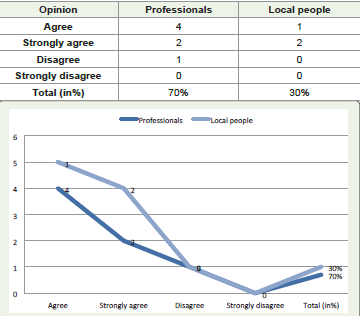
7. Does Ecotourism create employment for people? (Parameter):
InterpretationThrough the data collected, In the case of professionals, it is clear that 20% are agree while 50% are strongly agree with the statement
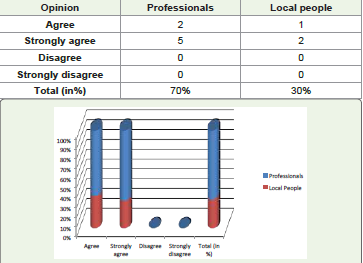
that ‘ ecotourism creates employment for people ‘ and among local
people 10% are agree while 20% are strongly agree with this statement.
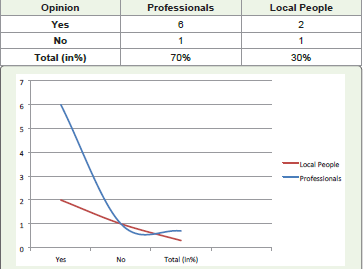
8. Do you think Government is looking forward to improve the ecological condition in shekhawati region? (Parameter):
InterpretationThrough the collected data, I found in the case of professionals that 60% are satisfied with that, government have improved ecological condition in Jhunjhunu district while 10% are not satisfied, and in the case of local people 20% are satisfied & remaining 10% are not satisfied.
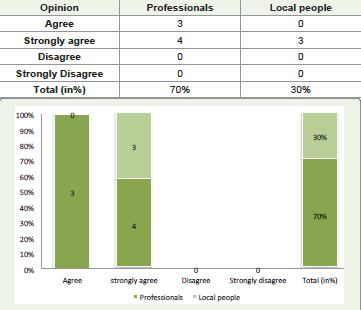
9. Do you also contribute in improving the ecological condition? (Parameter):
InterpretationThrough the data collected, I found in the case of professionals 30% are agree that they’re contributing for the improvement of ecological condition &40% are strongly agree while among local people all 30% are strongly agree with that statement. Hence, no one found to be disagreed with the statement among all the respondents.
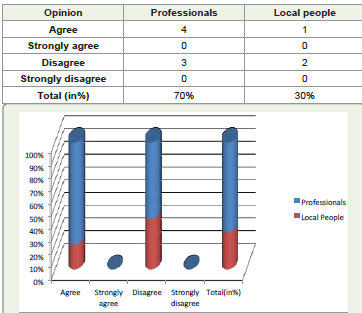
10. Do you agree that the funds raised by government are fully spent for the development of ecotourism? (Parameter):
InterpretationThrough the data collected in the case of professionals 40% are agree with that, the funds raised by govt. are fully spent, 30% are disagree with that, while among local people it’s 10% those are agreed and 20% are disagree with the statement.
11. Is shekhawati a good destination for the purpose of ecotourism? (Parmeter):
InterpretationThrough the data collected it’s clear that 10% agree & 60% are strongly agree among professionals while among locals 10% are
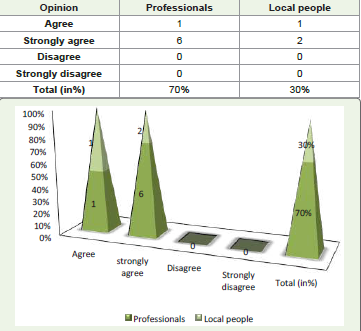
agree & 20% are strongly agree with the statement agree and 20% are
disagree with the statement.
12. Are rules and regulations must for the improvement of ecological condition in shekhawati region? (Parameter):
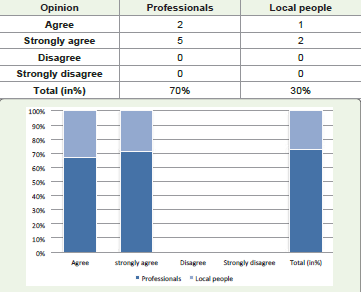
InterpretationThrough the data collected it’s clear that 20% of professional agree with that, rules and regulations are must for the improvement of ecological conditions, 50 % are strongly agree with this, whereas 10% of local people are agree with this & 20% strongly agree with this statement.
13. Do you agree that shekhawati region offers a lot in terms of natural beauty? (Parameter):
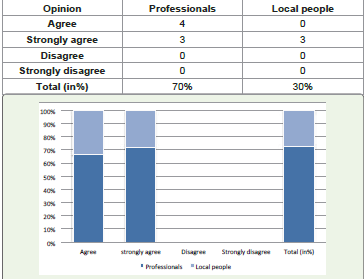
InterpretationGraphical analysis show that in case of professionals 40% are agree that, shekhawati region offers a lot in terms of natural beauty and 30% are strongly with the statement whereas among local people, all 30 are strongly agree with the statement. Interpretation
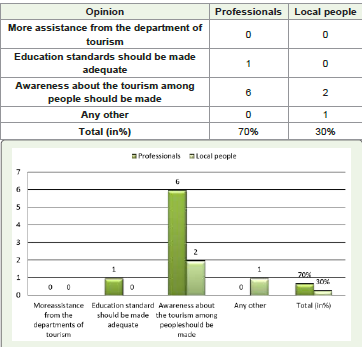
Through the data collected it has been found that 60% of professionals are in the favor of opinion that awareness about the tourism among people should be made. whereas 10% of professionals thinks that education standards should be adequate, while on the other side, 20% of local people opinion ‘s about awareness for tourism among people should be made.
14. Do you agree that the environment of shekhawati region is clean? (Parmeter):
InterpretationThrough the data collected it’s clear that I’m the case of professionals 40% are agree, 20% are strongly agree with this statement, while 10% are disagree. On the other hand, in the case of local people 10% are agree & 20% are strongly agreed that the environment of shekhawati region is clean.
15. Do you agree that the environment of shekhawati region is clean? (Parmeter):
InterpretationThrough the data collected it’s clear that I’m the case of professionals 40% are agree, 20% are strongly agree with this statement, while 10% are disagree. On the other hand, in the case of local people 10% are agree & 20% are strongly agreed that the environment of shekhawati region is clean.
Discussion
As per the responses recorded and analysis through questionaaires
key findings are notified that temples and monuments at Shekhawati
area have great architectural and historical value It was observed
that the temples and monuments at Shekhawati area have great
architectural and historical value. Majority of the respondents are also
agreeing with the same. There are number of magnificent temples in
Shekhawati which are best known for their intricate architecture and
speak about Indian heritage. The fresco paintings were made by artists
who were called chiteras, who belonged to the kumhars(potters)
caste. They were bright and colorful depictions of Shekhawati culture
made using only natural colors.The study revealed that majority of
the respondents agrees that rural tourism has increased the prestige
of the village which showcases that rural tourism has proved to be
beneficial for the village About three-fourth of the respondents are
satisfied with the opportunities that the village locales get in the form
of host families and they agree to the host family in the rural areas
as an interesting concept.Most of the respondents agree or strongly
agree that the development of social amenities and infrastructure has
increased due to tourism, whereas few of the respondents strongly
disagree or disagree for the same and for some of the respondents it did
not make any difference.It was observed that most of the respondents
agreed that education and health services have improved in the area
whereas only few people disagree with the same. It shows people have
realised the importance of health and education in their life and are
giving much importance to it. Present study portrays that majority
of the respondents feel that tourism in Shekhawati helps keep local
culture alive and maintain cultural identity. There were hardly 4-5
% respondents who disagreed with the statement. Tourism plays a
pivotal role in enhancing local and national identity [9]. It is because of
tourism that a particular area becomes a known destination. Tourism
has created employment opportunities for the people in Shekhawati.
Most of the people agreed with this. Although there were very few
people who was not in favour that tourism has created employment
for the people.
Conclusion
It needs to invite and give wide opportunity of participation
of the private sector in the tourism industry, and especially for
infrastructure development, human resources development and
quality service for sustainable eco-tourism development in the state.
It needs to develop good coordination networks among the other
ministries/ departments such as ministry of civil aviation, ministry
of home affairs, ministry of forest &environment, ministry of railway
and transport, ministry of communication, etc. who are also involved
in the tourism industry for sustainable ecotourism development in
the state.
References
Citation
Dular AK, Khan N. An Imperative Study of Ecotourism with Respect to Environmental Consciousness and Their Impact in Shekhawati Region of Rajasthan. J Environ Soc Sci. 2026;11(1): 134.